
Lake Toba Recedes, Mass Fish Die-Offs Litter the Waters
Lake Toba Recedes, Mass Fish Die-Offs Litter the Waters
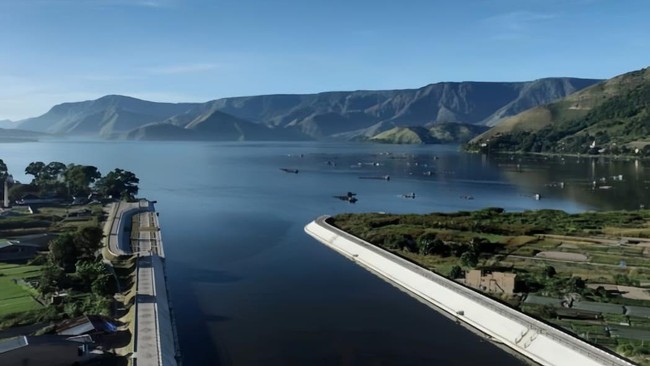
Jakarta, CNBC Indonesia - The Bogor Agricultural Institute (IPB) has found a decline in the water level in the Lake Toba area. The phenomenon is attributed to a sustained dry season and could threaten various activities including the aquaculture sector.
Satellite altimetry data recorded the water surface in the area continuing to fall to around 1.6 metres from June 2025 to March 2026. It could fall further to 2 metres if the drought persists.
This disaster could be more severe because BMKG issued predictions of a possible El Niño and a positive Indian Ocean Dipole (IOD) phase concurrently in 2026.
‘This combination could trigger an extended dry season in Indonesia, including the Lake Toba region, which would accelerate the depletion of the lake’s water volume and could cause mass fish kills in KJA (Floating Net Cages),’ said IPB Satellite Remote Sensing Expert Jonson Lumban Gaol in a statement on IPB’s official website.
The decline in the lake’s water surface is normally linked to incidents of mass fish kills in KJA. One example is thousands of tonnes of fish died when the water surface had receded to two metres deep in 2016.
In the years 2018, 2020, and 2023, similar events occurred when the water level was relatively low, albeit on a smaller scale.
However, he explained that the direct cause of fish deaths is not the drop in water level per se but the triggering factors, such as the mixing of water masses during extreme weather and strong winds.
Strong winds will churn sediment and organic waste in relatively shallow waters. The sediment lifted to the surface can clog fish gills.
‘At the same time, water from the lower layer, which is low in oxygen, rises to the surface, causing a drastic drop in dissolved oxygen and leading to fish in KJA dying,’ he explained.
Another factor is the accumulation of organic and household waste at the lake bottom. Under normal conditions, the waste would be decomposed by bacteria with the help of oxygen.
But when oxygen is exhausted, the decomposition proceeds anaerobically and produces toxic gases such as hydrogen sulphide and methane.
Jonson explained that hydrogen sulphide can damage the fish’s respiratory system. Methane also reduces water quality.
Thus, low oxygen, high levels of toxic gases, and increasing turbidity contribute to mass fish deaths in KJA.
Jonson urged fishermen to stay vigilant. For example, when signs of extreme weather appear, such as high wind speeds and murky water, it is advisable to move the KJA to deeper waters or harvest the fish.
‘On the other hand, local governments and stakeholders need to act more proactively, not just with warnings but with systems capable of delivering timely and accurate early warnings,’ he stressed.
(dem/dem)