
Lake Merdada Water Levels Critical as Farmers Continue Pumping to Save Potato Crops
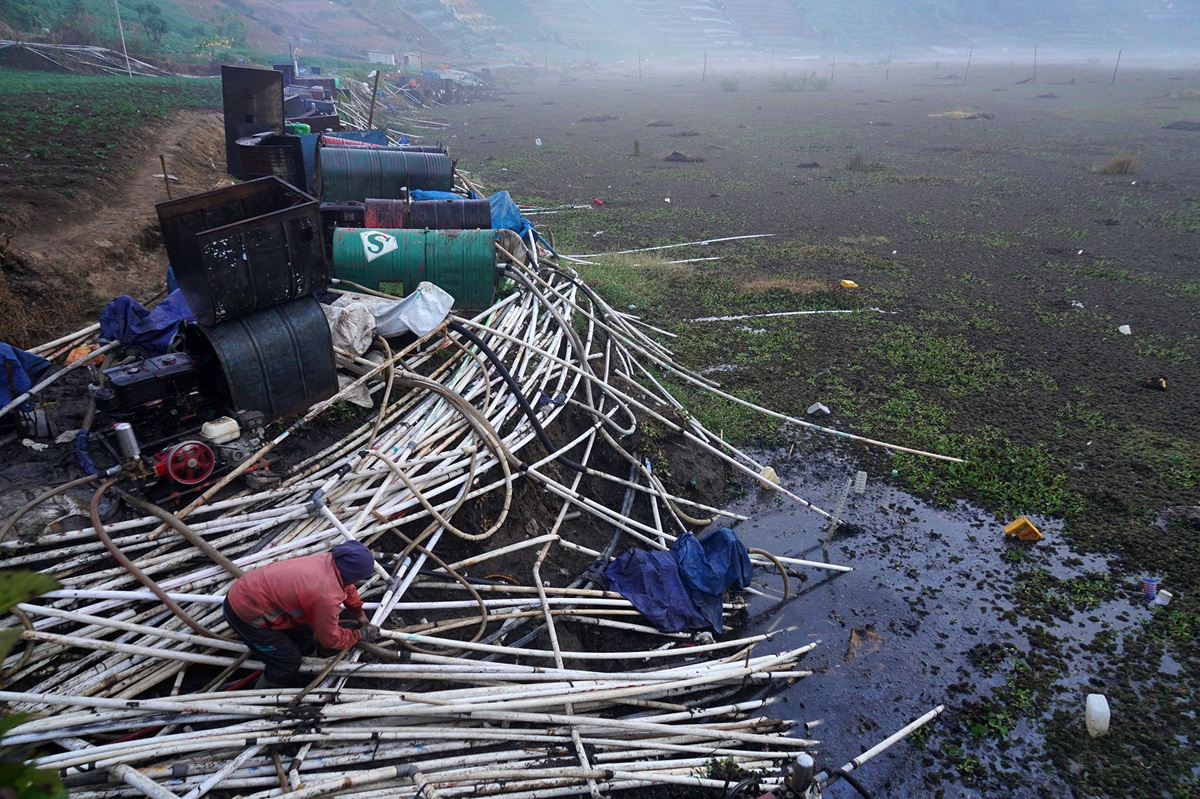
The water volume of Lake Merdada in the Dieng Plateau, Banjarnegara Regency, Central Java, continues to shrink due to a prolonged drought influenced by the El Nino Godzilla phenomenon. The condition is beginning to threaten irrigation for the farmland of hundreds of farmers around the lake area.
At least 200 farmers from the villages of Karangtengah, Buntu, and Bakal rely on Lake Merdada to irrigate their crops, especially potatoes. As other water sources begin to dry up, farmers are forced to use pumps to draw water from the lake.
Zaenuri, a farmer from Karangtengah Village, said the water level of Lake Merdada has been declining for about the past two months. He described the shrinking water volume as quite worrying because the water needs for potato plants remain high. “We have been pumping water from Lake Merdada for about two months because the water for agriculture has dried up,” Zaenuri said.
To irrigate a potato field of about 2,500 square metres, Zaenuri must use a pump that requires about seven litres of fuel per day. With the price of pertalite fuel at around Rp11,000 per litre, the operational cost of the pump becomes an additional burden for farmers.
In a month, the fuel requirement for irrigation reaches about 50 litres. Meanwhile, for larger fields, fuel needs can reach 100 litres until the plants enter the harvest period.
According to Zaenuri, farmers from the three villages of Karangtengah, Buntu, and Bakal are currently all relying on Lake Merdada. If the dry conditions continue, the lake’s water volume is expected to become increasingly critical within the next one to two months.
Another farmer from Buntu Village, Hanif, said water pumping from Lake Merdada has been carried out for about two months. Pumps are used to keep potato plants supplied with water. “We have been pumping for two months, we have to use water. If the lake condition is still sufficient, maybe it will still be safe for another month,” Hanif said.
The lake’s surface has also begun to be overgrown with aquatic plants, including water hyacinth. Nevertheless, Lake Merdada remains the farmers’ mainstay for maintaining their crops during the dry season.
Farid, a farmer from Karangtengah Village, said he began using water from Lake Merdada in May to irrigate potato crops on more than one hectare of land.
He operates three pump machines with a fuel requirement of about 15 litres per day. Each machine requires about five litres of fuel. “The diesel requirement is about 15 litres. There are three machines, on average one machine uses five litres. We pump every day,” he said.
According to Farid, the irrigation needs are expected to last for about four months. He hopes the dry season will not last too long because the lake’s condition is expected to recede further. “The water is still sufficient, if the dry season is not long. If it goes on for another two months, it seems it will have receded,” he said.
Fuel costs are also one of the problems farmers must bear. Farid mentioned the price of diesel used is around Rp6,800 per litre. On the other hand, the price of potatoes at the farm level currently ranges from Rp12,000 to Rp13,000 per kilogram.
Another farmer, Kasno, 43, said pumping water from Lake Merdada is the chosen option because potato plants need an adequate water supply, especially during the dry season.
According to him, the dry conditions mean farmers cannot rely solely on natural water sources. If the plants do not receive regular watering, potato growth can be disrupted and potentially reduce yields.
“We started pumping water in mid-July. I channel water from Lake Merdada to my potato field about one kilometre away,” Kasno said.
To operate the pump, Kasno must prepare diesel fuel. In one operation, he needs about five litres of diesel at a price of Rp10,000 per litre.
He usually runs the pump every two to three days. Watering is carried out from the time the potato plants are planted until they enter the harvest period.
“I pump water from Lake Merdada every two to three days, starting from when the potato plants are zero days old,” he said.
Kasno said the high water demand means production costs in the dry season increase compared to the rainy season. For a potato field of about 5,000 square metres or 0.5 hectares, at least 15 waterings are needed until the plants are ready for harvest.
Each time watering is done, farmers must account for the fuel costs to run the pump as well as other operational costs. This condition increases farmers’ expenses amid uncertainty over harvest yields.
“In the dry season, we do have to spend higher production costs compared to the rainy season,” Kasno said.
Solikin, 52, a farmer from Bakal Village, Batur District, experienced a similar situation. He said the drought has made pumping water from Lake Merdada a necessity to keep potato plants from lacking water.
Solikin admitted he must prepare around Rp100,000 to buy diesel every three days. The pump is used to channel water from the lake to his potato field of about one hectare.
“I need Rp100,000 to buy diesel. Every three days I have to pump water to save the potato crops on about one hectare of land,” Solikin said.
For farmers in the Dieng area, water availability is one of the important factors in maintaining horticultural crop productivity. During the dry season, this need drives farmers to utilise remaining water sources, including Lake Merdada.
However, using pumps also means farmers must bear additional production costs. The longer the dry season lasts and the less frequent the rain, the greater the burden on farmers.
Source: jawawa.id (https://jawawa.id/newsitem/lake-merdada-water-levels-critical-as-farmers-continue-pumping-to-save-potato-crops-1787097026)
Originally published by Media Indonesia (https://mediaindonesia.com/nusantara/923369/air-telaga-merdada-makin-kritis-petani-terus-sedot-untuk-selamatkan-tanaman-kentang), translated from Indonesian