
Labour Unions Propose 7.5% - 9.5% Minimum Wage Increase for 2027
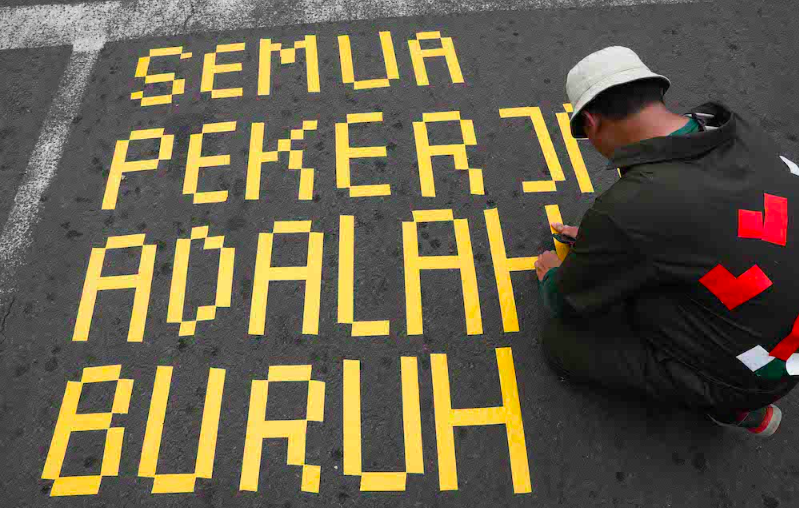
The Confederation of Indonesian Trade Unions (KSPI) and the Labour Party have proposed a minimum wage increase of 7.5% to 9.5% for the year 2027. This proposal applies to both Provincial Minimum Wages (UMP) and Regency/City Minimum Wages (UMK), taking into account the differences in inflation and economic growth across various regions.
KSPI President and Labour Party President, Said Iqbal, stated that the proposal needs to be presented early. This is because the 2027 UMP is scheduled to be determined by 1 November 2026, while the UMK and sectoral minimum wages are scheduled for determination by 10 November 2026.
“We will fight for this figure within the Wage Council and through various constitutional channels,” Said Iqbal said during an online press conference on Wednesday (16/9).
Said Iqbal explained that there are three main components used by KSPI and the Labour Party to calculate the proposed 2027 minimum wage increase: the annual national average inflation (year-on-year), the national average economic growth, and a specific index.
For the specific index, KSPI is using a figure of 0.9. This is in accordance with the range of specific indices stipulated in Government Regulation Number 49 of 2026, which ranges from 0.5 to 0.9.
“In proposing the minimum wage and sectoral minimum wage increases for 2027, KSPI is using the national average inflation, the national average economic growth, and a specific index of 0.9. The government regulation provides a range of 0.5 to 0.9, so the use of 0.9 is well-founded,” Said Iqbal asserted.
The data used covers the period from October 2025 to September 2026. However, as September 2026 data has not yet been published by BPS (Statistics Indonesia), the preliminary calculation uses the latest available data up to August 2026.
According to Said Iqbal, based on official BPS data collected for the period of October 2025 to August 2026, the national average inflation stands at 3.20%, while the national average economic growth is at 5.43%.
“Even when the September data is released, we expect the figures will not differ significantly. Therefore, for now, we are using a national average inflation of 3.20% and national economic growth of 5.43%,” he said.
By incorporating a specific index of 0.9 into the calculation method used by KSPI, the resulting national average increase is approximately 7.7%. This figure serves as the basis for determining the lower limit of the proposed minimum wage increase at 7.5%.
“On a national average, the calculation yields approximately 7.7%. However, because some regions have economic growth lower than the national average, we have adjusted our proposed lower limit to 7.5%,” he explained.
Said Iqbal emphasised that the economic conditions of every province and regency/city differ. For instance, inflation and economic growth in West Java are not the same as in North Maluku.
Similarly, the economic conditions in Bekasi Regency are not the same as in Gresik Regency. Therefore, KSPI is not proposing a single fixed figure, but rather an increase range of 7.5%–9.5%.