
Labour Unions Demand Labour Protection Bill Guarantees Decent Wages for Workers
Until now, there has remained a very wide disparity in minimum wages between different regions.
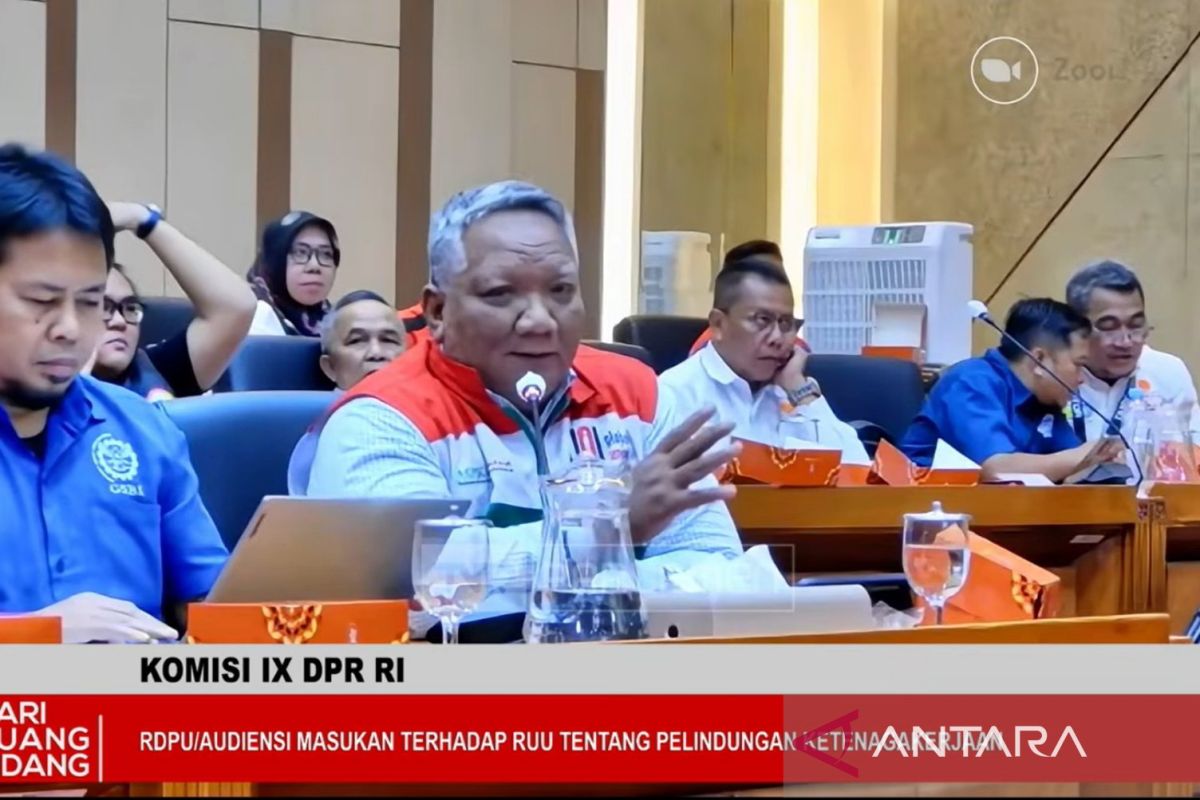
The President of the ASPEK Indonesia Confederation, Muhamad Rusdi, requested that the Labour Protection Bill serve as a momentum to correct Indonesia’s wage system, which over the past 12 years has been deemed to be based on a policy of cheap wages under the pretext of attracting foreign investment.
“We must revisit the fundamental question: what is the actual function of the minimum wage? Is its function a safety net to ensure that workers’ lives and incomes remain below the lower limit that should guarantee workers can meet their basic needs decently?” he stated in a briefing in Jakarta on Sunday.
Rusdi cited Article 2nd, paragraph (2) of the 1945 Constitution, which affirms that every citizen has the right to work and a decent living for humanity. This principle is also strengthened by Article 28D, paragraph (2), regarding the right of every person to work and to obtain fair and decent compensation and treatment in employment relationships.
“Therefore, the measure of wage adequacy must not stop at annual increase figures. The measure must return to the basic needs for a decent life. The KHL (Basic Cost of Living) must be the foundation, while inflation and economic growth serve as adjustment factors,” he said.
Wage data for 2026 shows a vast range in minimum wages between one region and another. In the national compilation, there are 514 regencies/cities, with some regions setting their own regency/city minimum wage (UMK) and others using the provincial minimum wage (UMP) as the minimum threshold.
Among the regions that set their own UMK, there are still areas with a minimum wage below Rp2.5 million. Conversely, several industrial zones have established a UMK above Rp5 million.
In East Java, for example, Surabaya, Gresik, Sidoarjo, Pasuruan, and Mojokerto have exceeded Rp5 million, while Situbondo, Sampang, and Bondowoso remain below Rp2.5 million.
Therefore, ASPEK Indonesia is pushing for KHL surveys to be conducted correctly, transparently, and measurably, using clear and accountable guidelines that consider the real characteristics of each region.
He also warned that saving jobs should not be used as an excuse to maintain cheap labour politics.
“Suppressing wages does not automatically prevent layoffs. Layoffs can occur due to decreased demand, changes in production, restructuring, efficiency, technological changes, or business conditions. Therefore, do not simplify the issue as if cheap wages are the cure for all labour problems,” said Rusdi.
Yassierli ensured that the government will also discuss the matter transparently so that labourers can follow the progress of the Bill’s deliberations.
“So, in line with the expectations of the workers, we want the process to be transparent; our colleagues can follow it, and we certainly hope for the best outcome—where industry advances and workers prosper,” said Yassierli.