
Labour Union Rejects 'Ojol' as MSMEs, Says Drivers Do Not Need KUR
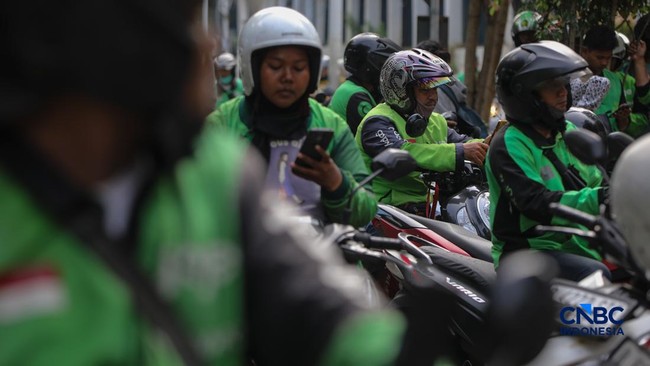
The Indonesian Transport Workers Union (SPAI) has rejected the plan to categorise online motorcycle taxi (ojol), online taxi, and cargo courier drivers as Micro, Small, and Medium Enterprise (MSME) actors. This rejection is based on the argument that the relationship between online drivers and application platforms is an employment relationship.
SPAI Chairperson Lily Pujiati emphasised that the relationship between drivers and platform companies constitutes an employment relationship as regulated under Law Number 13 of 2003 concerning Manpower, specifically Article 1, Paragraph 15. She noted that this relationship meets the three essential elements of employment: work, wages, and orders. All three elements are present in the driver applications.
“The element of work involves delivering passengers, goods, and food. The element of wages is the income earned from every completed order. The element of orders is present in the form of suspensions and partner terminations if the driver fails to execute orders,” Lily stated in a written statement received on Tuesday (7/7/2026).
Furthermore, President Prabowo committed during the last May Day to protecting online drivers through Presidential Regulation 27/2006 regarding the Protection of Online Transportation Workers. This regulation should cover all online motorcycle taxi, taxi, and cargo courier drivers identified as workers in the online transportation sector.
Additionally, during the 114th International Labour Conference (ILC) at the ILO in June, the Ministry of Manpower agreed to the ratification of ILO Convention 193 regarding Platform Workers, which includes online drivers and couriers. To ensure legal protection and the fulfilment of rights, the union calls for the government to immediately ratify ILO Convention 193 and for the Ministry of Manpower and Commission IX of the DPR to include online drivers as workers in the new Manpower Law revision.
Consequently, online drivers do not need micro-loan facilities such as the People’s Business Credit (KUR) being offered by the Minister of MSMEs. What online drivers need is recognition as workers so they can receive rights such as a decent regional minimum wage (UMP) to ensure monthly income certainty.
Tax incentives also have no impact on their income, as it remains below the tax-free threshold, with average driver earnings at approximately Rp 100,000 per day (well below the Non-Taxable Income threshold of Rp 4,500,000 per month). This low income level has persisted for a long time.
Classifying them as MSMEs would instead allow platforms to evade their responsibilities regarding workers’ rights. “The workers’ rights being ignored by platforms include the minimum wage (UMP), 8-hour working days, religious holiday allowances (THR), overtime pay, menstrual and maternity leave, support for workers with disabilities, social security, the right to form unions, and collective bargaining agreements,” she asserted.
Regarding the MSME classification, on 1 July 2026, the Minister of MSMEs, Maman Abdurrahman, confirmed that the government intends to categorise online motorcycle taxi drivers as micro-business actors in online transportation. Under this status, drivers would be entitled to various incentives and facilities provided to MSMEs, including access to People’s Business Credit (KUR).
“Moving forward, our online taxi friends will be treated as micro-entrepreneurs in online transportation. This means they will be included in the micro-entrepreneur category and are entitled to all incentives and facilities received by MSME actors,” Maman said when met by reporters at the Ministry of MSMEs Office.
Under this status, he added, online drivers would also receive various tax incentives. He noted that the majority of driver income remains below Rp 500 million per year, meaning they are not subject to tax or are subject to a 0% tax rate.
In addition to tax incentives, the government is preparing various empowerment programmes for online drivers, including access to financing, such as KUR, business capacity building, and training. Maman explained that the government wants drivers to not only rely on income from online transportation services but also to be able to develop other businesses.
“We hope they will not only continue to work in online motorcycle taxis but can also expand into other businesses,” he concluded.