
Labour Protest Demands Fixed-Term Contracts Be Limited to One Year Maximum
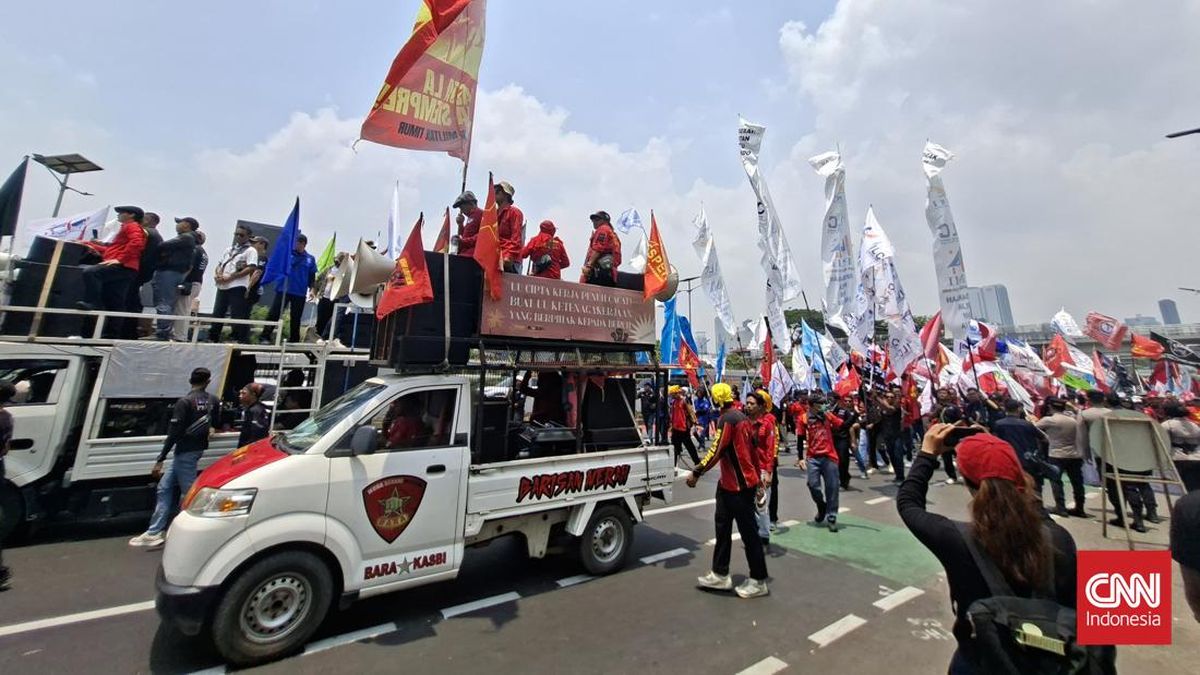
The Great Coalition for the Struggle of Indonesian Labour (KBPBI) has proposed that the duration of Fixed-Term Employment Agreements (PKWT) be limited to a maximum of one year within the Draft Labour Protection Bill, which is scheduled for ratification in early October.
This demand was conveyed by the Presidium of the KBPBI and Chairman of the Indonesian Labour Union Confederation, Rudi HB Daman, during a labour protest in front of the DPR RI Building, Senayan, Jakarta, on Tuesday (29/9). According to him, the current PKWT duration of up to five years carries the potential for exploitation.
“The great coalition demands that PKWT should not be five years, as this has led to exploitation and many other issues. The coalition proposes that PKWT should only be valid for one year, with a period for extension,” said Rudi in front of the DPR building on Tuesday (29/9).
Representing thousands of workers, he stated that PKWT workers must still receive a payment of 25 per cent of their wages upon the expiry of their contract. “They must still receive an additional 25 per cent of their wages when the contract ends, along with compensation, as such.”
Furthermore, Rudi mentioned other demands presented during today’s protest, which include the abolition of outsourcing, the elimination of certain apprenticeship models, and the provision of a decent wage.
Rudi also revealed that the labour unions intend to meet with representatives of the DPR RI. They aim to enquire about the progress of their aspirations and seek information regarding the List of Problem Inventories (DIM) within the Draft Labour Protection Bill.
“It is true, we are expected to be received by the leadership of the DPR RI today. Our goal is to ask about the process of our input and to see what the government’s DIM is regarding the discussion of the Draft Labour Protection Bill,” said Rudi.
He also emphasised the deadline for the formulation of the Draft Labour Protection Bill. He argued that labour aspirations must be addressed before 30 October or before the issuance of a Government Regulation in Lieu of Law (Perppu). “Because if this is not resolved, it will be handled via Perppu, and we do not want that. A Perppu is a unilateral decision by the President.”
If the demands presented by the workers are not realised in the Draft Labour Protection Bill, Rudi stated that they would organise even larger protests. “Regardless of the deadline, if the content does not align with these 11 points, our comrades are prepared to organise a national action.”
The Great Coalition for the Struggle of Indonesian Labour (KBPBI), comprising 18 Labour Union Confederations, held the demonstration on Tuesday (29/9) in front of the DPR RI Building. The action was organised to monitor the discussion of the Draft Labour Protection Bill resulting from the meeting between Commission IX and the DPR RI Legislation Committee.
KBPBI assesses that there remains a substantive gap between the draft Bill planned by the DPR and the formulation advocated by the KBPBI. “Labour laws must serve as a tool to protect those who work, not as a tool to further facilitate the exploitation of labour,” the official KBPBI statement read on Thursday (24/9).
The 11 demands presented during the labour protest are as follows:
Limiting Fixed-Term Employment Agreements (PKWT) only to temporary work for a maximum of one year.
Limiting Outsourcing/Subcontracting, including a ban on labour supply; it should only be for specific subcontracted works between companies; workers in companies receiving such subcontracts must have permanent status (PKWTT); and the types of subcontracted work must be limited to supporting roles such as cleaning services, security, catering, and employee shuttle drivers.
Limiting apprenticeships to students (pupils/university students) in accordance with educational curricula, and prohibiting them from becoming formal employment relationships.
Protecting digital platform workers by clarifying the employment relationship between workers and applicators as a relationship between employee and employer.
Overseeing minimum wage regulations, including calculating the minimum wage based on economic growth and inflation, strengthening wages for those with over one year of service, rejecting minimum wage calculations based on certain indices, and ensuring Sectoral Minimum Wages are at least 5% higher than the general minimum wage.
Overseeing Layoffs (PHK). Layoffs must be negotiated with the Trade Union, and if no agreement is reached, they must go through a legally binding Industrial Relations Court decision. Wages must continue to be paid monthly until a final/appeal decision is reached.
Implementation/Placement of Severance Pay Reserves, where severance pay for workers at the end of their employment is paid monthly by the employer and managed by BPJS Ketenagakerjaan.
Establishing a Supervision Commission consisting of Tripartite elements.
Allocating the State Budget (APBN) for job training.
Providing menstrual leave for female workers for two days without requiring a doctor’s note, with full pay maintained.
Ensuring that violations of PKWT regulations are subject to sanctions as per applicable legal provisions.