
Labour Protection Law Officially Enacted: Union Leader Responds
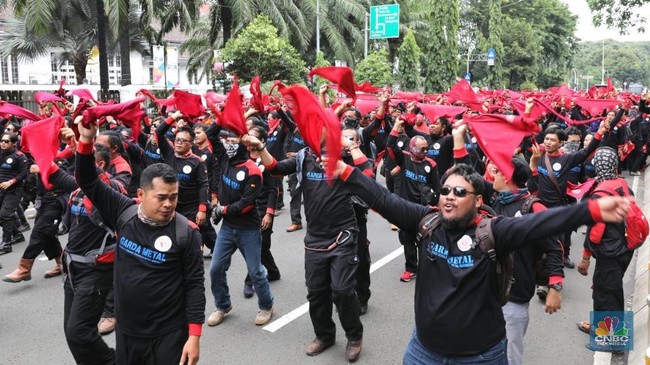
Jakarta, CNBC Indonesia — The All-Indonesia Workers’ Union Association (ASPIRASI) has expressed its appreciation and thanks to the Government, particularly President Prabowo Subianto, following the passage and promulgation of Law No. 27 of 2026 on Labour Protection on 28 October 2026. The law was signed by Prabowo.
“For us, the publication of the Labour Protection Law is an important moment in the development of industrial relations and the struggle to protect workers’ rights in Indonesia. The existence of a separate law specifically governing employment is expected to provide a new foundation for building fairer industrial relations, ensuring legal certainty, and making the protection and welfare of workers an important part of national development,” ASPIRASI President Mirah Sumirat said in a written statement on Tuesday (10 November 2026).
She said the law must not merely be a legal document, but must serve as an instrument of the state to ensure workers’ rights are genuinely respected, protected and fulfilled in day-to-day employment relations.
With Law No. 27 of 2026 now promulgated, the Government is entering the next important stage: drafting the various implementing regulations that will provide technical and operational guidance for the law.
“In this regard, ASPIRASI hopes and asks the Government, particularly the Ministry of Manpower, to involve representatives of trade unions meaningfully and substantively in drafting all the implementing regulations,” she said.
The involvement of trade unions must not be a mere formality or a way of satisfying consultation requirements. Unions must be given scope to present their views, input and criticism, as well as the real-world experiences of workers.
Why is this important? Those who best understand employment issues are not only the Government and employers, but also workers, who face workplace relations, wages, employment status, termination of employment, social security, occupational safety and health, and many other issues every day.
“Implementing regulations must not reduce, restrict or obscure the spirit of protection established by this law,” she said.
Mirah also stressed that the biggest challenge after the law’s enactment would be ensuring that all its provisions are actually implemented by every stakeholder. The Government, she said, must act as both regulator and firm enforcer.
Employers must comply with the law and fulfil workers’ rights. Workers and trade unions, meanwhile, must understand and exercise their rights and meet their obligations in accordance with the law.
“We must not end up with a law that looks good on paper but whose implementation on the ground falls far short of expectations. Workers must not once again be left to fight alone to secure rights that are already guaranteed by law,” she said.
ASPIRASI called on all stakeholders — including the central and regional governments, the House of Representatives, employer organisations, trade unions, academics and the wider public — to monitor and oversee the implementation of the Labour Protection Law together.
Oversight must be continuous and not limited to the initial period after the law takes effect. It is necessary to examine how the law is being applied in companies, how violations are monitored, how workers’ complaints are resolved, and whether workers are actually receiving the rights guaranteed to them.
ASPIRASI will also carry out its organisational role in overseeing the law’s implementation, gathering reports and concerns from members and workers across the regions, and presenting its findings and assessments to the Government and relevant institutions if it identifies any gaps in implementation.
“We want to ensure that this law not only provides legal certainty, but also delivers justice and tangible benefits for millions of workers and their families,” she said.
“We hope this will be a good start towards building a more humane, fair and dignified future for employment in Indonesia, one that brings greater welfare to workers,” she added.
For ASPIRASI, the struggle does not end with the law’s promulgation. The next stage is to ensure that every article and provision is genuinely implemented. The law was created to protect workers; its implementation must not leave them less protected.
Source: jawawa.id (https://jawawa.id/newsitem/labour-protection-law-officially-enacted-union-leader-responds-1794293426)
Originally published by CNBC Indonesia (https://www.cnbcindonesia.com/news/20261110113149-4-783839/uu-pelindungan-ketenagakerjaan-resmi-dirilis-ini-respons-bos-buruh), translated from Indonesian