
Lab 45 Launches Book "Indonesia's Hourglass" Gauging the Nation's Future
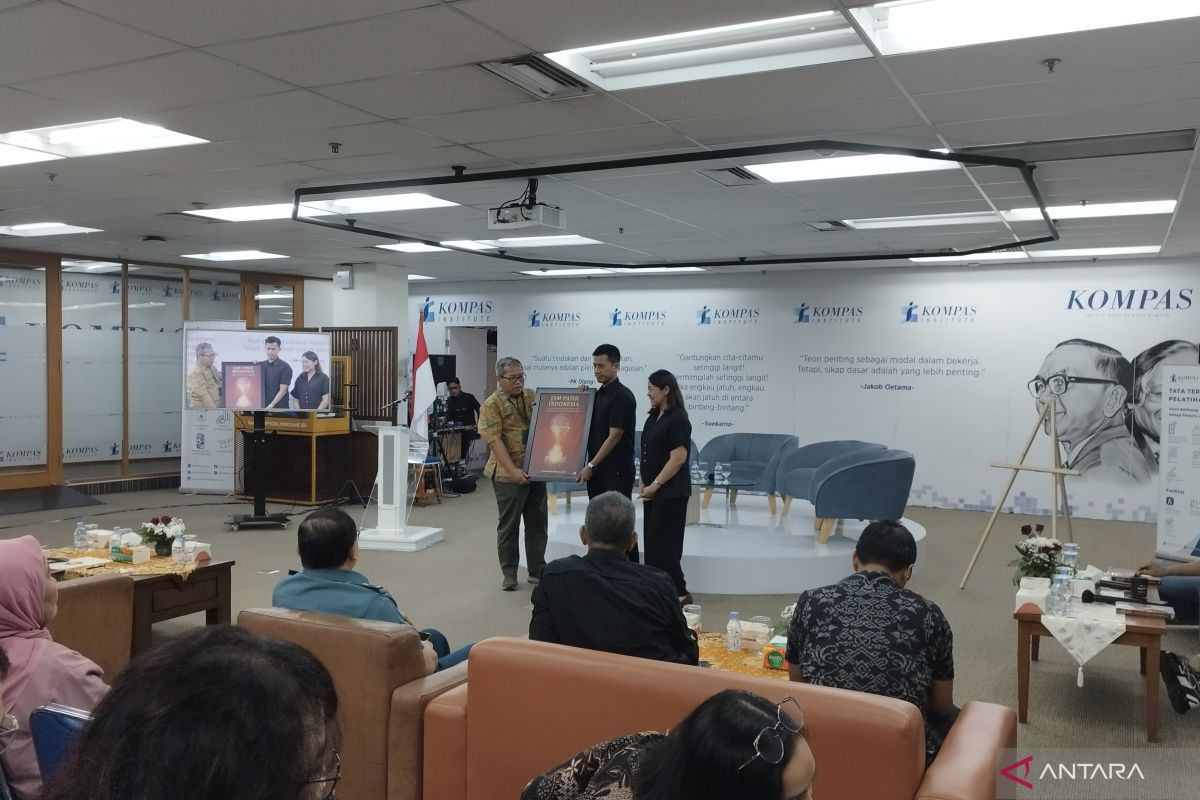
Jakarta (ANTARA) - The strategic research institute Laboratorium Indonesia 2045, or Lab 45, has launched a book titled “Indonesia’s Hourglass: Gauging Indonesia’s Future from Grains of Power and Inequality,” which contains scenario projections towards Golden Indonesia 2045.
Senior advisor of Lab 45 and author of the book, Hariyadi, explained that Indonesia’s historical journey has been marked by struggles involving many variables, which can either complement or negate each other. The book, he said, examines phases of Indonesia’s development as well as the nation’s future trajectory.
“I, along with Mas Andi Widjajanto, attempted to analyse the trajectory towards Indonesia 2045, and we project at least three main scenarios,” said Hariyadi during the book launch discussion event in Jakarta on Monday.
He explained the first scenario, namely sustained oligarchic consolidation. Should this scenario occur, he believes the Golden Indonesia 2045 vision would nearly fail.
If the oligarchic consolidation is sustained, he predicts Indonesia will experience a phenomenon where the middle class shrinks. Meanwhile, if the middle class declines, one of the risks, he said, is social unrest or unavoidable stability disruptions.
“Similarly, we will see that if oligarchic consolidation is sustained, innovations for the good of Indonesian-ness will certainly be hindered,” he said.
Furthermore, if the first scenario occurs, he believes the second scenario will emerge, namely identity conflicts and civilisational conflicts. He warned that the first and second scenarios are undesirable by all parties.
Therefore, he said the only scenario that serves as the best way out for Indonesia is the reinstitutionalisation of democracy scenario. With strong democracy, he is convinced the Golden Indonesia 2045 vision will be achieved.
Meanwhile, Lab 45 Head Jaleswari Pramodhawardani said her organisation wishes to convey a special meaning in the use of the “hourglass” metaphor in the book. According to her, the “hourglass” runs in one direction and cannot go back, while also representing limited space because the sand will run out.
“It combines two truths that we often separate: that we have choices, and that those choices have time limits,” said Jaleswari.
Through the book, she wishes to convey a philosophical foundation, namely that optimism is not without criticism, nor a parade of despair, but rather a rational vigilance that Indonesia can still advance but not automatically.
“We agree on a simple working principle that a think tank’s task should be to provide an honest thinking space with academic discipline, social empathy, but without intellectual amnesia,” she said.
The 426-page book consists of 12 chapters, each written by different authors, ranging from academics with backgrounds in economics, politics, anthropology, to former bureaucratic expert team members, including former Governor of the National Resilience Institute (Lemhannas) of Indonesia, Andi Widjajanto.