
KY-Surakarta Palace Sign MoU to Realise Clean Judiciary
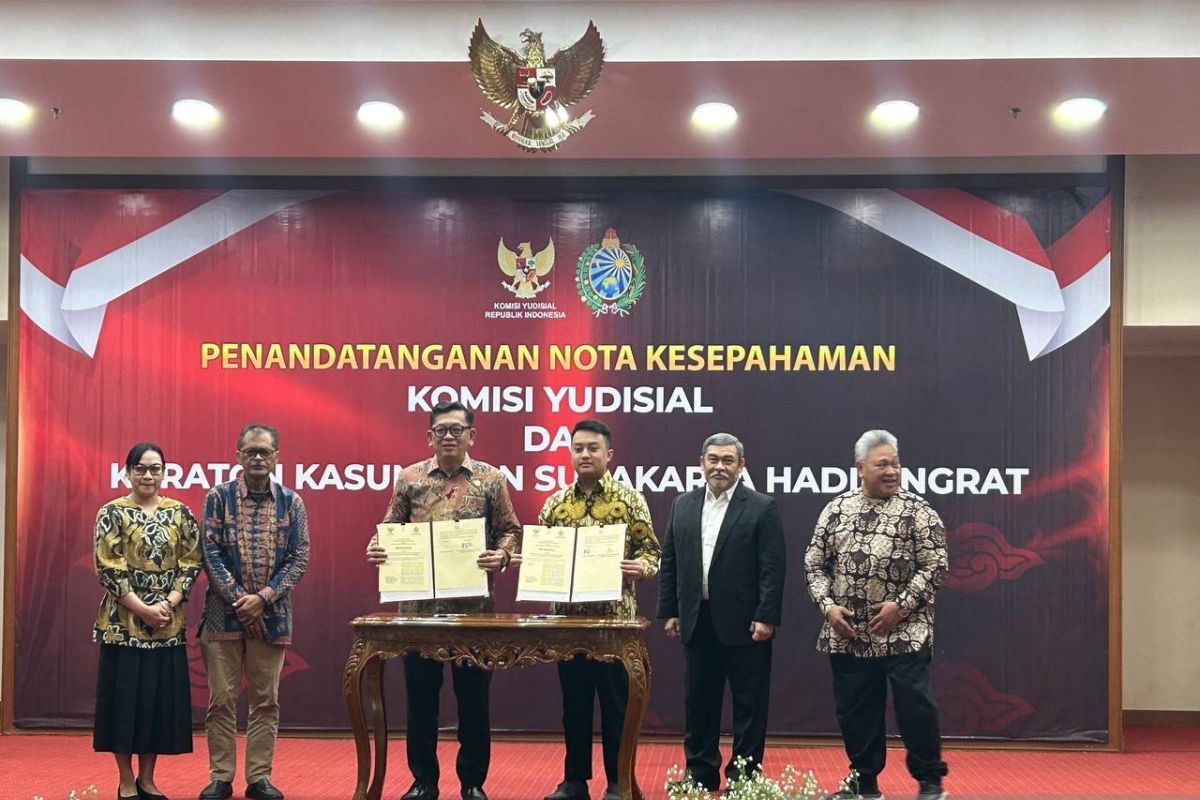
Jakarta (ANTARA) - The Judicial Commission (KY) has signed a Memorandum of
Understanding (MoU) with the Keraton Kasunanan Surakarta Hadiningrat to realise a clean judiciary involving indigenous communities and cultural groups.
The signing ceremony took place at the KY Hall in Jakarta on Thursday, led by the Chairman of the KY, Abdul Chair Ramadhan, and Sri Susuhunan Pakubuwono XIV, witnessed by several officials from both parties.
KY Secretary General Mulyadi explained that today’s signing is a follow-up to the Chairman of the KY’s recent visit to the Keraton Kasunanan Surakarta Hadiningrat. During that visit, discussions were held regarding opportunities to strengthen the duties and functions of both institutions, particularly in reinforcing legal culture, ethical integrity, and the socialisation of local wisdom to achieve a clean judiciary.
“Both parties have agreed to develop cooperation in the form of a memorandum of understanding,” he said.
He noted that the MoU will be valid for three years, with a scope encompassing the enrichment of legal literacy and ethics based on culture through academic studies and cultural explorations of leadership philosophy, integrity, and traditional Nusantara justice.
The scope of the agreement also includes socialisation and education through collaborative activities such as seminars, symposiums, workshops, or briefings regarding the Code of Ethics and Conduct for Judges (KEPPH) and the role of the KY in realising a clean judiciary.
“The next scope involves empowering and socialising members of the royal family, indigenous community elements, and the public to respect the judicial process—or court awareness—and to support an independent judiciary,” said Mulyadi.
According to Mulyadi, there are four benefits to be gained from this MoU. First, it aims to increase public education and awareness regarding the importance of maintaining the honour, dignity, and conduct of judges as part of the effort to realise a clean judiciary.
The second benefit is to explore and strengthen ethical values and the indigenous wisdom and culture of the Nusantara that are relevant to strengthening national law and integrity.
Thirdly, the agreement seeks to encourage the participation of indigenous communities and cultural groups in supporting the creation of a judiciary that is clean, maintains integrity, and is trusted by the public.
“And finally, fourth, to strengthen synergy and collaboration between parties in building a legal culture and increasing collective awareness regarding the importance of integrity in the administration of justice,” said Mulyadi.
He expressed hope that through this cooperation, the synergy between the KY and the Keraton Kasunanan Surakarta Hadiningrat can be continued and developed to provide significant benefits to both parties.
“Through cooperation in exploring, preserving, and socialising the noble values of custom, culture, and Nusantara philosophy that are relevant to ethics and integrity, it is hoped that these values can support the strengthening of character and integrity in national life,” said Mulyability.
Meanwhile, the Chairman of the KY, Abdul Chair Ramadhan, stated that the MoU aligns with the role of the KY as a high state institution tasked with realising an independent judiciary.
“An independent judiciary is a primary feature of upholding a rule-of-law state based on prosperity,” he said.
In turn, Sri Susuhunan Pakubuwono XIV stated that the MoU is not merely an administrative process, but a connection of value systems between local wisdom (paugeran) and modern Indonesian law.
He stated that the Keraton Kasunanan Surakarta Hadiningrat stands upon the philosophy of meaningful custom, family law, and justice rooted in noble character. According to him, justice for the Keraton Kasunanan Surakarta Hadiningrat cannot be formed solely through formal legal contexts, but must be supported by a solid ethical foundation, moral awareness, and cultural values living within the community.
“Through this MoU, two forces have been brought together: primarily integrity and noble values, integrating the philosophy of Nusantara justice—such as the spirit of virtue, honesty, and ethical excellence—into the strengthening of legal culture and the socialisation of judicial independence,” he said.