
KUR Lending in Java-Bali-Nusa Tenggara Still Concentrated in Java
With the year-end approaching, I encourage all stakeholders to accelerate KUR disbursement, particularly to the production sector, to meet the target for new borrowers, and to ensure a more even distribution in Bali and Nusa Tenggara.
JAKARTA (ANTARA) – The Ministry of Micro, Small and Medium Enterprises is promoting a more even distribution of People’s Business Credit (KUR) across Java, Bali and Nusa Tenggara, as financing remains concentrated on Java.
Deputy Minister for Micro, Small and Medium Enterprises Helvi Moraza said in a statement in Jakarta on Wednesday that the Java, Bali and Nusa Tenggara region accounted for Rp150.5 trillion, or around 57 per cent of national KUR disbursement as of 23 October 2026.
However, lending in the region is still dominated by Java. Central Java, East Java and West Java together accounted for around 78 per cent, while Bali, West Nusa Tenggara (NTB) and East Nusa Tenggara (NTT) received only around 12 per cent.
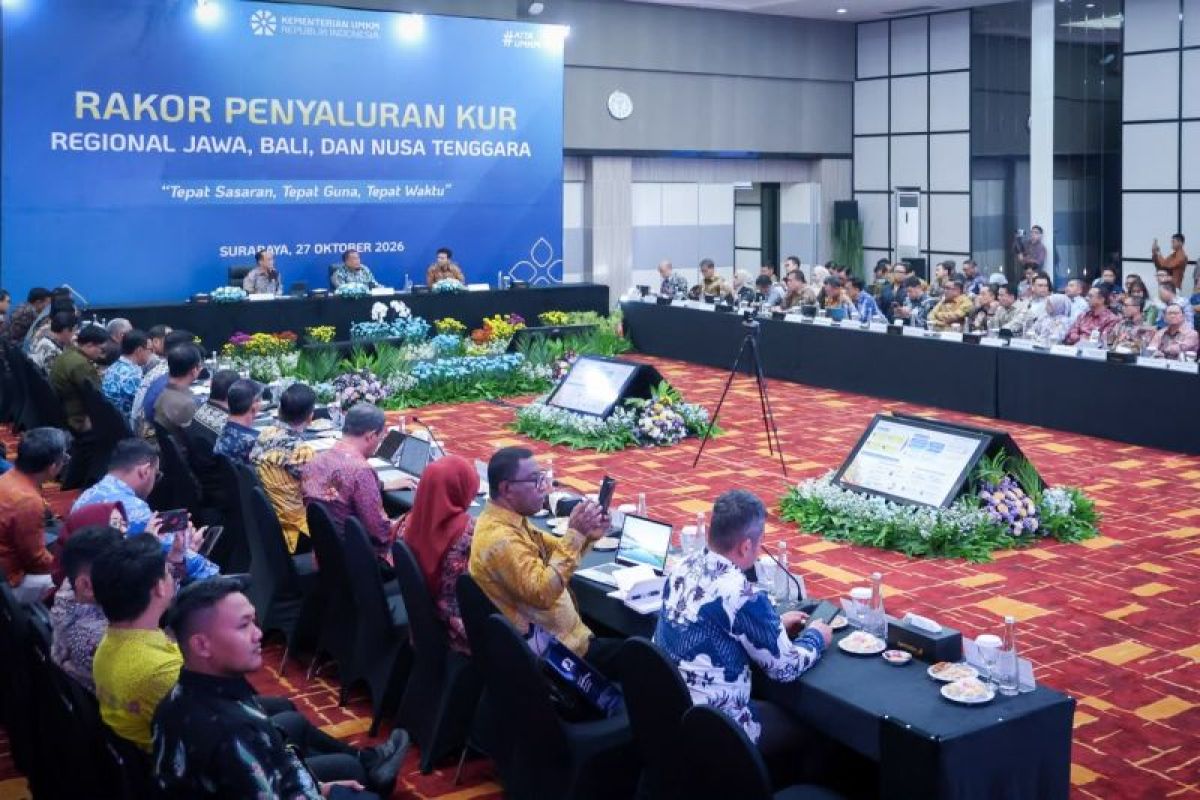
“With the year-end approaching, I encourage all stakeholders to accelerate KUR disbursement, particularly to the production sector, to meet the target for new borrowers, and to ensure a more even distribution in Bali and Nusa Tenggara,” Helvi said at the KUR disbursement coordination meeting for Java, Bali and Nusa Tenggara in Surabaya on Tuesday (27 October).
She said national KUR disbursement had reached Rp262.4 trillion as of 23 October 2026, or 91 per cent of the Rp290 trillion target, benefiting 4.07 million borrowers.
Nevertheless, the production sector’s share of KUR lending in Java, Bali and Nusa Tenggara stood at just 61.1 per cent, below the national target of 65 per cent.
Meanwhile, the number of borrowers who had graduated to a higher business class had reached only 64 per cent of the target.
To address these challenges, the ministry is seeking to improve businesses’ readiness to access financing by facilitating the issuance of Business Identification Numbers (NIB), providing support with financial record-keeping, and strengthening financial literacy.
The ministry has also asked local governments to take a more active role in identifying potential borrowers and entering their details into the Programme Credit Information System (SIKP), while mapping regional industry potential to ensure KUR is better targeted.
Helvi stressed that expanding access to KUR should not focus solely on lending, but must also deliver tangible benefits to the public through business development and job creation.