
Kudatuli After Three Decades: A Reflection on Democracy
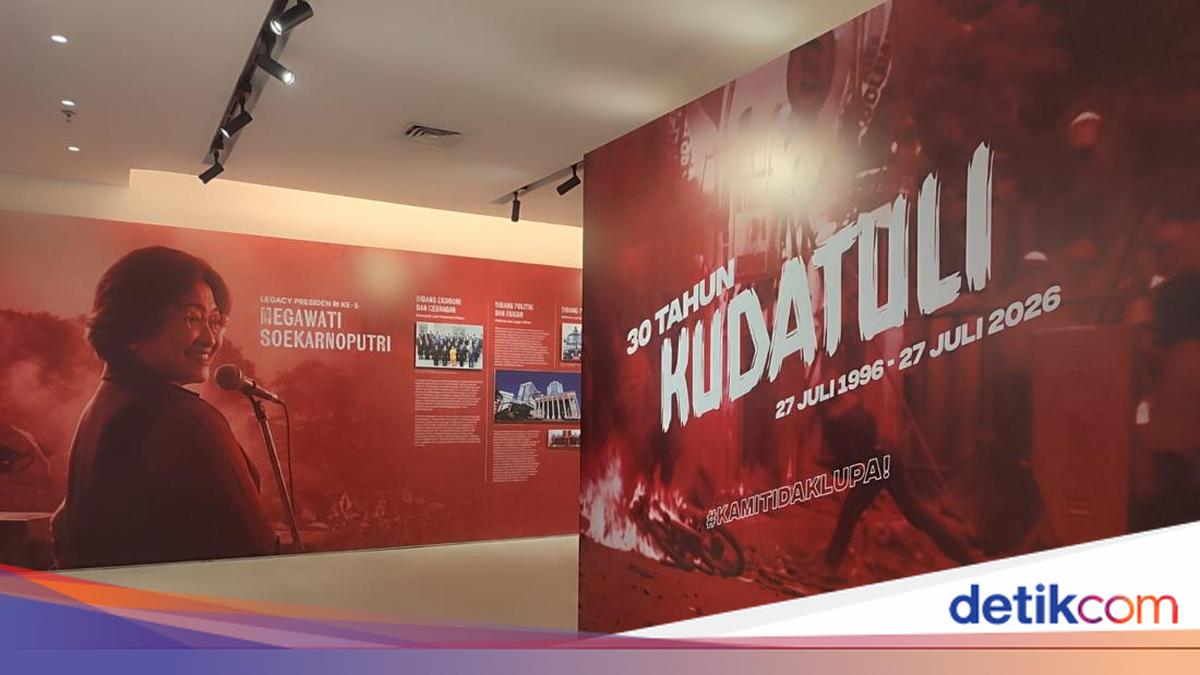
Among the dozens of photographs displayed at the Three Decades of Kudatuli commemoration titled ‘Paving the Way for Democracy’, one image made me pause for quite a long time. The photo shows Megawati Soekarnoputri sitting on the edge of a bed belonging to a survivor of the 27 July 1996 Riot (Kudatuli). Wearing a pink-striped shirt, she chats warmly with the survivor. Her gaze is calm, as if wanting to emphasise that the wounds from that event must not be forgotten by history.
Not far from there, on one of the exhibition walls, a sentence is written in large letters: ‘Young People of Indonesia, Remember! Conviction, Determination, Courage, Patience… Must always be in your heart. These four become one called: The Truth Will Surely Prevail.’ The sentence was written and signed by Megawati at the exhibition opening on 21 July 2026.
Another photo that left me silent for a longer time was the work of the late Ivan Haris P. Kurnia, my superior during my time at Tempo. The photo shows a row of graves with red earth that still looks freshly dug. On the blue-painted wooden headstones, a brief inscription reads: ‘T.D. Kenal’, accompanied by an identity number. One of them bears the number 1169. The photo is almost without narrative, yet it feels so deeply moving. Amid the three-decade commemoration of Kudatuli, the image serves as a reminder that every tragedy always leaves behind questions that are not entirely resolved.
Besides the photos, in one corner there is a mini studio. Visitors are invited to watch a documentary film lasting more than 30 minutes produced by the Indonesian History Agency of the PDI Perjuangan Central Executive Board. The video presents testimonies from several historical actors of Kudatuli, including Petrus Hariyanto, Ribka Tjiptaning, and Jonata Yani. The documentary is also enriched with analysis by senior journalist Widiarsi Agustina and BRIN historian Dr Asvi Warman Adam. For those who did not experience the 1996 events directly, the documentary serves as an important introduction. For me, it actually reawakens fragments of memories stored away: the hustle and bustle of Jalan Diponegoro, the tension in the newsroom, and the news that the newspaper where I worked was burned by a mob. From there, my memory leaps back three decades.
When Kudatuli erupted in 1996, I was still a day-afternoon journalist at Harian Terbit. After the 11:00 deadline, I was almost every day around the PDI Central Executive Board Office on Jalan Diponegoro. Together with other journalists like Kinoy, Taryono Asa, Munif, and several other names, we waited for political developments that changed almost daily. There was also Andus Simbolon, our senior who was close to several PDI elites such as Taufik Kiemas and Haryanto Taslam. Through Andus, we often got a picture of the dynamics taking place inside the party office.
Although it was in the same media group as Pos Kota, owned by Minister of Information Harmoko, Harian Terbit actually gave quite broad space to reporting on Megawati and PDI. Under the leadership of B. Sudarmanto, Joko Lestari, and Neta S. Pane, the afternoon newspaper often felt more independent than many imagined. I still remember one morning when Editor-in-Chief Tarman Azzam came to the newsroom. With a face flushed as if holding back emotion, he asked for a headline that roughly read, ‘Megawati’s Camp Ready to Fully Control PDI Headquarters on Jalan Diponegoro’ to be changed. Neta S. Pane tried to offer an alternative because the printing deadline was very tight, but the decision was made: the title had to be changed. The layout room atmosphere suddenly became tense. When the newspaper was published that afternoon, the meaning of the title had reversed from the original plan.
A few days before 27 July, my colleagues and I were even reminded not to wear our Harian Terbit identity cards when approaching the PDI Central Executive Board office. The masses gathered there were angry about one of Harian Terbit’s reports. I have forgotten the title of the news. What still sticks in my memory is only the remark of a fellow journalist: ‘Your newspaper was burned by the mob.’
Thirty years have passed. Some of the historical actors have passed away. Others have become national figures. Yet the questions left by Kudatuli remain alive: has Indonesia truly learned from that event? The final report of the National Commission on Human Rights recorded five people dead, 149 injured, and 136 detained in the riot. These figures became the state’s official record. But history is always broader than statistics. Behind every number, there is a family that lost someone, a fear that is passed down, and wounds that time does not completely heal.
Kudatuli should not only be remembered as a political tragedy that befell one party or one figure. It is a reminder that democracy can be wounded when power begins to see criticism as a threat. Democracy does not collapse overnight. It weakens little by little when criticism is suspected, when the security apparatus loses its neutrality, when the law is applied differently depending on who is in power. Kudatuli showed how seemingly small political justifications can lead to violence against citizens.
Therefore, remembering Kudatuli is not merely looking back. This three-decade commemoration is actually a mirror to assess the quality of Indonesia’s democracy today. Is criticism still seen as a healthy part of national life? Or is it slowly being considered a threat to stability again? Democracy does provide space for differences of opinion. However, criticism must be directed at policies and the use of power, not at destroying personal dignity through slander or hate speech. At the same time, the state must ensure that the security apparatus remains professional and does not become a tool for anyone’s political interests. Professionalism is not only about carrying out orders, but also the courage to refuse orders that contradict the law and the constitution.