
KSSK Meeting Results: Indonesia's Fiscal, Monetary, and Financial Systems Remain Stable
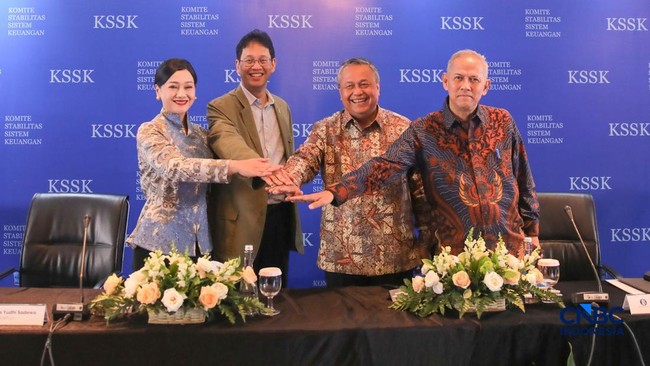
Jakarta, CNBC Indonesia - The Financial System Stability Committee (KSSK) has concluded its quarterly meeting for the first quarter of 2026. The results of the meeting, announced directly by KSSK Chairman and Finance Minister Purbaya Yudhi Sadewa on Thursday (8 May 2026), indicate that fiscal conditions, monetary policy, and the financial sector during the first quarter of 2026 remain stable.
“The KSSK assessment shows that fiscal, monetary, and financial sector conditions during the first quarter of 2026 remain stable, amid increasing global financial market volatility following the escalation of conflicts in the Middle East,” said Purbaya, quoted on Friday (8 May 2026).
Purbaya stated that entering April 2026, the dynamics of resolving the Middle East conflict continue to be the primary factor driving global financial market volatility, particularly the surge in energy prices.
Based on these developments, the KSSK, comprising the Finance Minister, Governor of Bank Indonesia (BI), Chairman of the Financial Services Authority (OJK) Board of Commissioners, and Chairman of the Deposit Insurance Corporation (LPS) Board of Commissioners, stated that it will continue to monitor and conduct forward-looking assessments of the current economic and financial sector performance.
This focus is aimed at addressing the increasing risks of global economic uncertainty. The committee also assured that it will undertake coordinated mitigation efforts, both among KSSK member institutions and with other ministries and agencies.
According to Purbaya, the KSSK quarterly meeting results have indeed observed that the global economic outlook is weakening further due to the Middle East conflict. The conflict’s impact on global supply disruptions has driven up world oil prices and several other key commodities, thereby affecting the smooth flow of international trade supply chains.
With these developments, the KSSK considers that global economic growth will slow to 3.1% in 2026 from 3.4% in 2025, with global inflation projected to rise to 4.4% in 2026 from 4.1% in 2025, according to the International Monetary Fund’s (IMF) forecast in the April 2026 edition of the World Economic Outlook.
Nevertheless, for the Indonesian economy, Purbaya emphasised its resilience, as evidenced by first-quarter 2026 growth reaching 5.61%, higher than the previous quarter’s 5.39% year-on-year.
He also assured that throughout this year, the KSSK is committed to maintaining a faster growth trend approaching 6% by the end of 2026, supported by the government’s fiscal stability that remains resilient.
“If we look at the state budget, the target is 5.4% this year. We will continue to push it upwards, hopefully approaching 6% by the end of the year,” said Purbaya.
Meanwhile, regarding monetary stability, BI Governor Perry Warjiyo emphasised that it needs to be continuously strengthened in response to rising global uncertainties due to the Middle East conflict. Considering that foreign portfolio investment experienced net outflows of US$1.7 billion throughout the first quarter of 2026.
These foreign capital outflows triggered pressure on the rupiah exchange rate, which was pushed up to around Rp17,400/US$.
Perry assured that policies to stabilise the rupiah exchange rate continue to be strengthened amid the increasing global financial market uncertainties. BI has increased the intensity of foreign exchange interventions (both Non-Deliverable Forward-NDF offshore, spot transactions, and Domestic Non-Deliverable Forward-DNDF in the domestic market) and strengthened the interest rate structure of monetary instruments to attract foreign portfolio inflows.
This policy is reinforced by adjustments to foreign exchange transaction thresholds since April 2026. With these measures, the rupiah exchange rate can be maintained relatively stable at Rp17,415 per US dollar on 5 May 2026.
In the early second quarter (up to 30 April 2026), foreign capital flows recorded net inflows of US$3.3 billion, particularly in Bank Indonesia Rupiah Securities (SRBI) and Government Securities (SBN), driven by increased yields on both instruments. Indonesia’s foreign exchange reserves position at the end of March 2026 stood at US$148.2 billion, equivalent to financing 6.0 months of imports and above the international adequacy standard of around 3 months of imports.
“BI continues to strengthen its policy mix to maintain macroeconomic and financial system stability as well as to encourage sustainable economic growth, which is closely synergistic with the KSSK and the Government’s Asta Cita Programme,” stressed Perry.
Meanwhile, regarding financial system stability in the capital market, OJK Chairman Friderica Widyansati stated that it remains dynamic in the first quarter of 2026 in line with increasing global uncertainties.
The Composite Stock Price Index (IHSG) closed at 7,048.22 as of 31 March 2026, experiencing a quarter-to-quarter correction of 18.49% but still showing positive year-on-year growth of 8.26%. Entering May 2026, the IHSG has shown a strengthening trend and closed at 7,057.11 as of 5 May 2026, thus the index has appreciated by 1.44% month-to-date.
Domestic corporations’ fundraising in the capital market also remained strong. As of 5 May 2026, the value of funds raised in the capital market has reached Rp59.35 trillion year-to-date.
“This achievement demonstrates the maintained interest in fundraising in the capital market, dominated by the issuance of Debt Securities and/or Sukuk (EBUS) worth Rp58.90 trillion. Meanwhile, the number of capital market investors in the first quarter of 2026 increased to 24.74 million Single Investor Identifications (SID), or a year-to-date growth of 21.51%,” said Friderica.
In the banking sector as well, she stated that its resilience remains strong, as seen from the capital adequacy ratio (CAR) in March 2026 at a high level of 25.09%.
Bank liquidity in March 2026 remained adequate with a Loan to Deposit Ratio (LDR) of 84.64%, Liquid Assets/Non-Core Deposit (AL/NCD) and Liquid Assets/Third-Party Funds (AL/DPK) recorded at 122.55% and 27.85% respectively, well above the thresholds.