
KSSK: Financial System Remains Stable in Q2 Amid Geopolitical Conflicts
Entering the second quarter of 2026, external pressure rose once again, in step with escalating geopolitical conflict, high energy price increases, global financial market volatility, and pressure on the exchange rate and capital flows.
Jakarta (ANTARA) — The Financial System Stability Committee (KSSK) has judged that fiscal, monetary and financial sector conditions remained sound throughout the second quarter of 2026, despite renewed geopolitical conflict, supported by close policy coordination and synergy among the authorities.
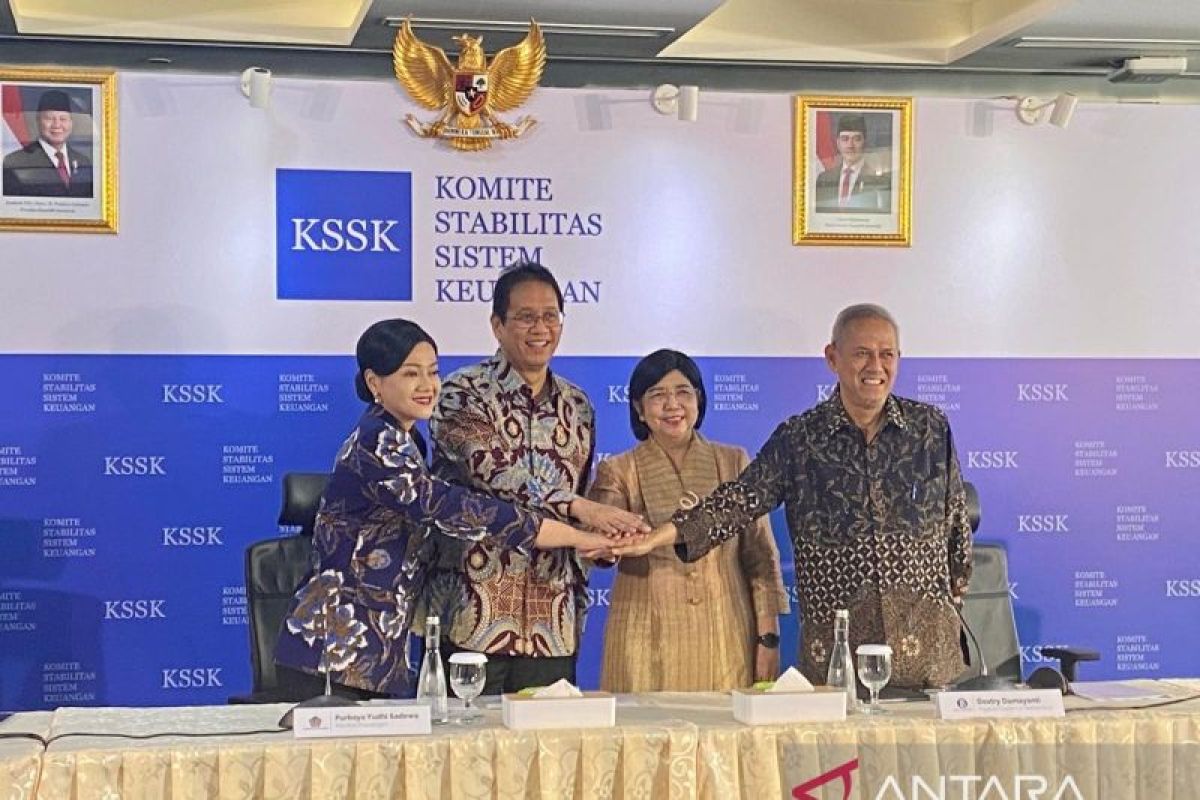
“Entering the second quarter of 2026, external pressure increased once again, in line with the escalation of geopolitical conflict, high energy price increases, global financial market volatility, as well as pressure on the exchange rate and capital flows,” said the Finance Minister and KSSK Chair, Purbaya Yudhi Sadewa, at a press conference on the results of the KSSK’s periodic meeting in Jakarta on Monday.
Although external pressure has risen again, Purbaya added that the domestic economy continues to demonstrate resilience. This is reflected in solid economic growth and a well-maintained financial sector.
“Given these developments, external risks to macroeconomic and financial system stability are seen as requiring continued vigilance in order to maintain high economic growth momentum,” said Purbaya.
He went on to explain that the global economy in the second quarter of 2026 still faced challenges, with uncertainty surrounding the geopolitical conflict in the Middle East affecting energy supply disruptions, rising oil and strategic commodity prices, and increased risks to trade flows and global supply chains.
These conditions have driven inflationary pressure and narrowed the room for monetary policy easing in a number of advanced economies.
In the United States, expectations of a rise in the Fed Funds Rate (FFR) have increased amid growing inflation risks and uncertainty over the direction of trade and fiscal policy, which has also weighed on market sentiment.
In financial markets, volatility remains fairly high and flight-to-safety behaviour has strengthened again, reflected in the strengthening of the US dollar, rising bond yields, and pressure on capital flows to developing countries.
Entering July 2026, global risks rose again as the US–Iran conflict continued. Traffic through the Strait of Hormuz, which had briefly improved following the interim deal between the United States and Iran in mid-June 2026, was once again hampered after the re-escalation of hostilities between the two countries in early July 2026.
In its July 2026 World Economic Outlook Update, the IMF projects global economic growth of 3 per cent (year on year/yoy) in 2026, slightly lower than the April 2026 projection of around 3.1 per cent (yoy), amid renewed global inflation.
On the other hand, Indonesia’s economy in the second quarter of 2026 is projected to continue growing strongly despite global economic challenges.
Public purchasing power remains well maintained in supporting household consumption, underpinned by the role of the state budget (APBN) as a shock absorber in driving the effectiveness of social protection programmes, food and energy price stabilisation, job creation, and stimulus during the school holiday period.
Furthermore, investment is expected to grow strongly, supported by high value-added downstreaming projects and infrastructure development under the government’s priority programmes.
In addition, government consumption is also projected to grow positively, in line with the pace of spending on priority programmes such as the payment of the 13th-month salary for civil servants (ASN) and the distribution of social assistance.
Purbaya said policy coordination between the government and Bank Indonesia continues to be strengthened to safeguard adequate liquidity in the economy and the banking system.
This is reflected in the strong growth of primary money (M0) throughout the second quarter of 2026, which continued to grow 15.4 per cent in the third week of July 2026, accompanied by improving banking intermediation.
Meanwhile, manufacturing activity moderated somewhat at the end of the second quarter, but resumed expansion in July 2026 with the Manufacturing PMI at 50.2, indicating a recovery in business optimism.
Purbaya affirmed that going forward, policy synergy among KSSK member institutions will continue to be strengthened to sustain the growth momentum.
“With such policy synergy, economic growth for the whole of 2026 is projected to be within the range of 5.6–6 per cent (yoy), underpinned by various policy synergies between the government and other KSSK member institutions to maintain continued growth momentum,” said Purbaya.