
KSBSI: Labour market requires adaptive regulation for Indonesia's economy
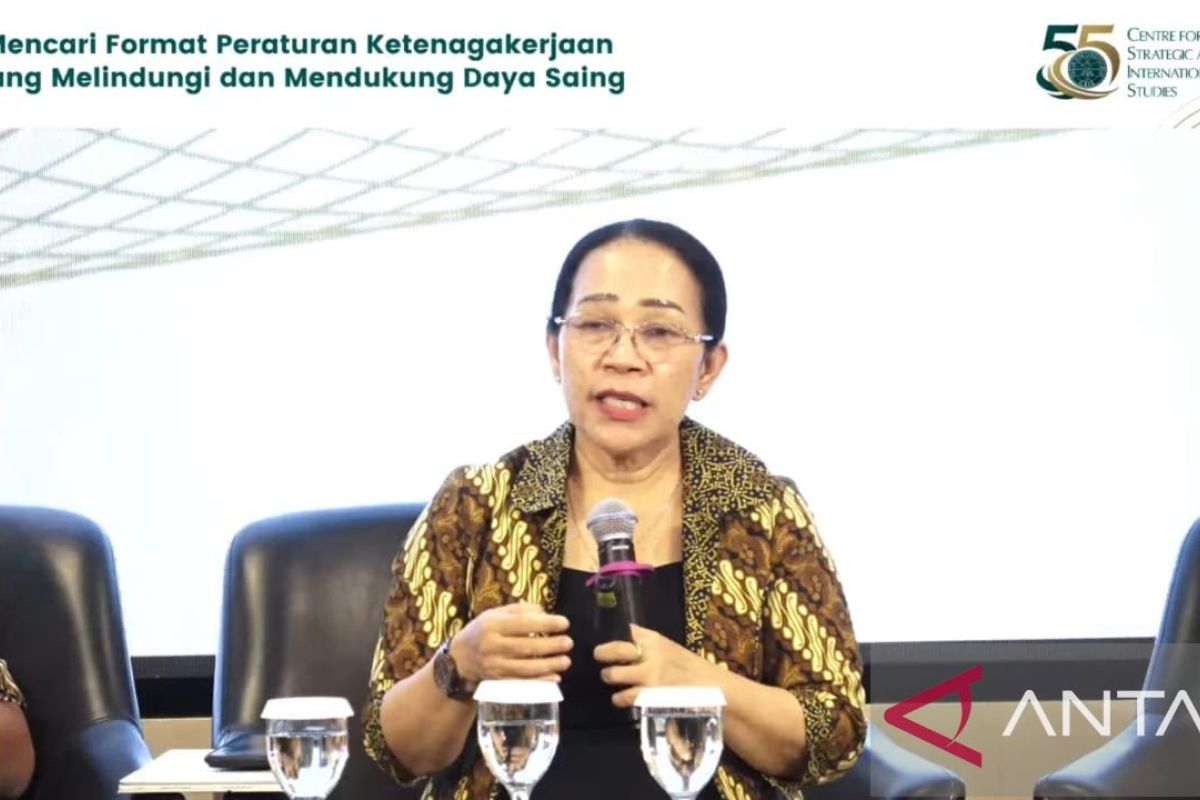
The President of the Confederation of All Indonesian Trade Unions (KSBSI), Elly Rosita Silaban, stated that the transformation of the national labour market requires an adaptive regulatory model that combines flexibility and protection (flexicurity) to guarantee Indonesia’s future economic sustainability.
Elly emphasised the importance of moving away from a mindset that differentiates between the interests of labourers and employers so that the business world can compete globally.
“Future regulations cannot be positioned as only pro-labour or only pro-business. Both support each other; if the business climate grows healthily, jobs are created and workers secure a livelihood. Our real need today is to bring together flexibility with protection, where social protection is directed towards driving productivity,” Elly said during a discussion with CSIS regarding the direction of labour policy, held online in Jakarta on Thursday.
One of the main pillars for strengthening the social safety net is the improvement of severance pay management and the risks of termination of employment (PHK). She noted that conventional severance schemes often burden company cash flow liquidity during crises, while the actual realisation of workers’ rights on the ground is often suboptimal.
Elly encouraged the strengthening of an integrated job loss insurance scheme through BPJS Ketenagakerjaan. This risk-pooling-based scheme is considered capable of providing dual certainty: companies are protected from the risk of financial instability due to the burden of sudden layoffs, while workers still obtain a financial safety net and certainty of rights without having to undergo lengthy disputes.
“When labour protection is managed structurally through a strong social security system, the certainty of workers’ rights is guaranteed without putting pressure on business actors when they must undergo restructuring,” said Elly.
In addition to income protection, Elly highlighted the importance of increasing labour market competitiveness, which must go hand-in-hand with improving the quality of human resources (SDM). Synergy between the government, the business world, and trade unions is seen as necessary, focusing on the agenda of reskilling and upskilling.
This step is crucial to bridge the business world’s concerns regarding skill mismatches and low productivity, while simultaneously opening opportunities for workers to achieve performance-based and tenure-based wage growth.
“The minimum wage should maintain its function as a basic safety net for new workers, while long-term income increases are driven through a fair and competency-based wage scale structure,” said Elly.
A flexible regulatory model is also deemed urgent to respond to Indonesia’s current labour landscape, which is dominated by the informal sector, accounting for approximately 60 per cent of the total 148 million workers, as well as the high population of young job seekers and digital economy workers (the gig economy).
Therefore, Elly stated that social protection must be universal and accessible to workers across all sectors, including formal, independent, and platform workers. To achieve this, close collaboration is required between trade unions, employers, and regulators through a social dialogue approach to produce high-quality, data-driven regulations.
Source: jawawa.id (https://jawawa.id/newsitem/ksbsi-labour-market-requires-adaptive-regulation-for-indonesias-economy-1790268854)
Originally published by Antara (Indonesian) (https://www.antaranews.com/berita/5757483/ksbsi-pasar-tenaga-kerja-butuh-regulasi-adaptif-demi-ekonomi-ri), translated from Indonesian