
Kredivo's Initiatives Strengthen Credit Access and Drive Socio-Economic Impact
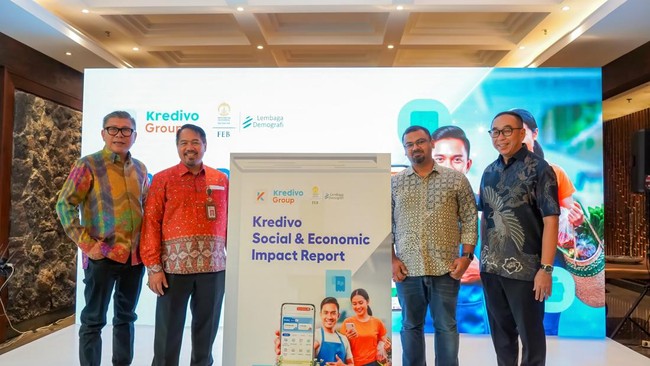
After a decade of operating in Indonesia, Kredivo Group, through its flagship product Kredivo, has demonstrated that digital credit services not only expand access to formal credit but also deliver tangible social and economic impacts. To further examine these effects, Kredivo Group, in collaboration with the Demographic Institute of the Faculty of Economics and Business, University of Indonesia (LD FEB UI), has compiled the Kredivo Social and Economic Impact Report.
The study shows that the credit access provided by Kredivo through its PayLater and Cash Loan services (via KrediFazz) has helped drive more productive credit utilisation, responsible borrowing behaviour, and the empowerment of MSMEs.
Umang Rustagi, Co-Founder & President Director of Kredivo Indonesia, stated that the joint study with LD FEB UI demonstrates that the contribution of the digital credit industry is no longer measured solely by the volume of credit disbursed, but also by the resulting social and economic impact.
“Ten years ago, Kredivo Group emerged amidst a wide credit gap, with a vision to bridge public access to easy, fast, and affordable credit services. Since then, we have grown alongside millions of users, merchants, and partners to not only open access but also to empower socially and economically. This study with LD FEB UI serves as a reflection of that journey, while confirming that digital credit is now part of the financial infrastructure that helps the public build credit histories, meet productive needs, and develop businesses,” Umang stated in an official release on Friday (11/09/2026).
Expanding Access as a Foundation for Broader Impact
The study indicates that Kredivo is helping to bridge the formal credit access gap. In 2025, the number of users accessing credit for the first time through Kredivo increased tenfold compared to 2019. Of these findings, 48% were women and 57% were under the age of 30—two groups that have historically struggled to access credit services due to a lack of financial history.
Furthermore, 23% of users reported that Kredivo facilitated their access to other formal credit services. In the MSME segment, 40.6% of business capital borrowers obtained their first business credit through Kredivo. These findings suggest that Kredivo functions as a gateway to a wider financial ecosystem, particularly for segments of society that have traditionally been underserved by formal financial services.
Paksi Walandouw, Deputy Head of Research and Training at LD FEB UI, noted that women, the younger generation, and MSME owners are the groups most difficult to reach via the formal financial system, yet they represent a significant portion of first-time credit recipients through Kordivo.
“The most important aspect is not merely the opening of access, but how that access is utilised to increase the economic capacity of the community and business owners. That is where the social and economic impact begins to take shape,” explained Paksi.
Paksi further explained that more than half of the credit disbursed through Kredivo is used for productive purposes, indicating that digital credit is evolving from a short-term necessity tool into an instrument for long-term economic capacity building. This is supported by increasing financial literacy and prudent risk management practices.
“With this foundation, the contribution of digital credit to the national economy has significant room for growth, especially for groups of people not yet reached by formal financial services,” Paksi detailed.
Amidst the increasing ease of access to digital credit, Kredivo users are demonstrating healthy and responsible borrowing behaviour. The average Debt-to-Income Ratio remains within the 10-19% range of total income, which is considered very safe. Approximately 58.7% of users who were active and transacting in 2023 received credit limit increases due to disciplined payment records, while 65.7% of users are classified as financially well-literate.
These findings show that the ease of digital credit access does not push user loan ratios beyond safe limits, provided it is accompanied by disciplined and responsible usage. Indina Andamari, Head of Marketing at Kredivo, noted that Kredivo views PayLater as a starting point for the public to build their financial reputation.
“Our focus is to ensure that this access is utilised responsibly through education, product innovation, and prudent lending practices. When access is paired with healthy financial behaviour, the benefits can be felt through expanding economic opportunities for users,” said Indina.
The study also shows an increase in the use of credit for productive needs. The proportion of productive credit disbursed through Kredivo rose from 52.3% in 2019 to 54.3% in 2025, covering needs such as healthcare, education, home renovations, and business capital. During the same period, the number of users utilising credit as business capital increased fifteenfold.
These findings indicate that digital credit is increasingly trusted as a tool for long-term financial management and as a source of public financing. During 2025, Kredivo’s PayLater contributed 30% to the total national PayLater outstanding as of February 2026.
Through its Cash Loan service, Kredivo also contributed approximately 30% of the total outstanding value and 20% of the total fintech lending user accounts nationally in December 2025. This contribution confirms Kredivo Group’s position as one of the primary drivers of growth in Indonesia’s digital credit industry.
Beyond its business scale, the study also highlights the economic impact generated by Kredivo. In 2025, Kredivo contributed approximately Rp33 trillion to Indonesia’s Gross Domestic Product (GDP), an increase of nearly tenfold compared to 2019.
Source: jawawa.id (https://jawawa.id/newsitem/kredivos-initiatives-strengthen-credit-access-and-drive-socio-economic-impact-1789099054)
Originally published by CNBC Indonesia (https://www.cnbcindonesia.com/tech/20260911101800-37-767143/aksi-kredivo-perkuat-akses-kredit-hingga-dampak-sosial-ekonomi), translated from Indonesian