
Krayan Highlands, Organic Rice, and the Vital Role of the National Park
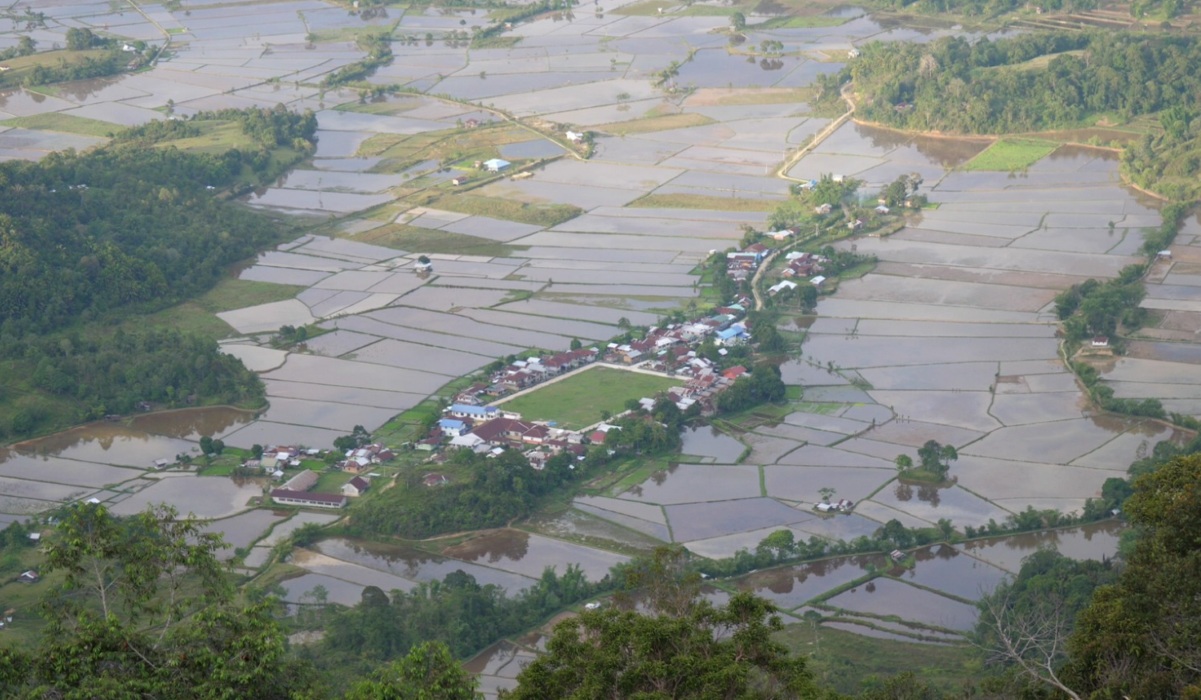
There is a unique place on the island of Borneo. While the world’s third-largest island is typically known for its lowlands and great rivers, Krayan is the anomaly. Krayan is located in Nunukan Regency, North Kalimantan. This area is mountainous, with an average elevation of 1,000 metres above sea level for its settlements. Residents’ homes, mostly surrounded by rice fields, sit beneath the mountains. Some are even flanked by two mountains or nestled between their folds. The scenery is exceptionally beautiful. The mountains range from 1,400 to 1,800 metres above sea level, with some peaks reaching 2,000 metres.
“Krayan is currently divided into five sub-districts. All share the same topography,” said Hery Gunawan, Head of National Park Management for Region 1 of Kayan Mentarang National Park, beginning a conversation with Media Indonesia in mid-July.
On this highland directly bordering Malaysia, the Dayak Lundayeh community cultivates Adan rice, a superior local variety grown entirely organically using clear mountain water. Its distinctive taste and aroma have made rice from this extreme landscape a highly sought-after premium commodity, even in neighbouring countries. “We never lose buyers; in fact, we struggle to meet market demand, especially from Malaysia,” said Otnel Akun, chairman of the Batu Pun Bersama Forest Farmers Group in Long Pua Village, West Krayan District.
Seen from above, Krayan’s topography resembles a giant bowl. Flat expanses of paddy fields are tightly surrounded by mountain walls, forming an unusual landscape. Unlike other highland areas that rely on terracing on steep slopes, the community here farms on a flat valley floor fed by abundant water. Hery Gunawan explained that the geological formation and the forest ecosystem surrounding the area are the main keys to the fertility of local agriculture.
“The rainforest on the upper mountains functions like a giant sponge. The dense canopy captures rain clouds, absorbs the water, and then releases it slowly through a network of small streams to the valley floor. This natural cycle ensures that residents’ rice fields remain irrigated throughout the year without ever experiencing drought,” Hery explained.
The geographical isolation caused by this extreme landscape has indirectly served as a protective shield for Krayan’s purity. The lack of overland access to major cities in North Kalimantan has kept this border region free from industrial pollution and dependence on synthetic chemical fertilisers.
The Krayan landscape presents a complete harmony: protected customary forests on the mountain peaks, the green belt of Kayan Mentarang National Park along the slopes, and expanses of wet rice fields on the valley floor that serve as both the community’s livelihood and a bastion of food sovereignty.
The agricultural and settlement landscape of the Krayan Highlands directly borders the virgin forests of Kayan Mentarang National Park. This mutually dependent geographical position means that the survival of agriculture in the valley depends entirely on the preservation of the upstream ecosystem. Protecting Kayan Mentarang National Park is no longer merely a matter of wildlife conservation; it is an absolute requirement to guarantee the continuity of the water supply that irrigates the Krayan community’s organic rice fields.
Hery Gunawan stressed that the existence of Adan rice cannot be separated from the green fortress surrounding it. The organic character of this premium rice arises because the water flowing down from the mountain peaks is still very pure and free from pollutants.
“For indigenous communities on the border, Kayan Mentarang National Park is the lifeblood of their agriculture. All the wet rice paddies on this highland depend heavily on the natural hydrological cycle regulated by the density of the forest above. If the trees in the upstream area are disturbed, the natural water system will be damaged,” Hery explained.
This ecological dependence has created a strong collective awareness among local communities to help protect forest boundaries. The combination of strict Dayak Lundayeh customary law and the protected status of the national park area has ultimately formed a robust environmental defence system. As long as the forest on the mountain slopes remains intact, clear water will continue to flow to the valley floor, ensuring food sovereignty and the heritage of Krayan organic rice cultivation endure across generations.
The concrete steps taken by the Kayan Mentarang National Park Office go beyond paper-based protection campaigns. As if to complement the abundant natural gifts, farmers around this border area are also provided with modern agricultural equipment and packaging technology capable of boosting the economic value of their local rice products.
“We were helped with rice milling machines and hand tractors. All of this makes our work much easier,” said Otnel. While walking along the paddy bunds, Otnel then pointed out several hand tractors busily roaring, turning over the soil and working the paddy mud. In mid-July, the Krayan community was indeed busy preparing their rice fields. Their target was clear: by early August, all the wet plots had to be ready and begin to be planted with new rice seedlings simultaneously. This modernisation of tools has brought significant changes to the work productivity of traditional farmers amid a shortage of labour.
“Usually with manual equipment, we could only work one plot of paddy. But with the help of hand tractors from the Kayan Mentarang National Park Office, I can now cultivate up to two plots,” admitted Arifin, a member of the Batu Pun Bersama Forest Farmers Group.
Source: jawawa.id (https://jawawa.id/newsitem/krayan-highlands-organic-rice-and-the-vital-role-of-the-national-park-1787122236)
Originally published by Media Indonesia (https://mediaindonesia.com/nusantara/923466/dataran-tinggi-krayan-beras-organik-dan-peran-penting-taman-nasional), translated from Indonesian