
Krakatoa Erupts, Earth Changes Completely - 36,000 Killed Instantly
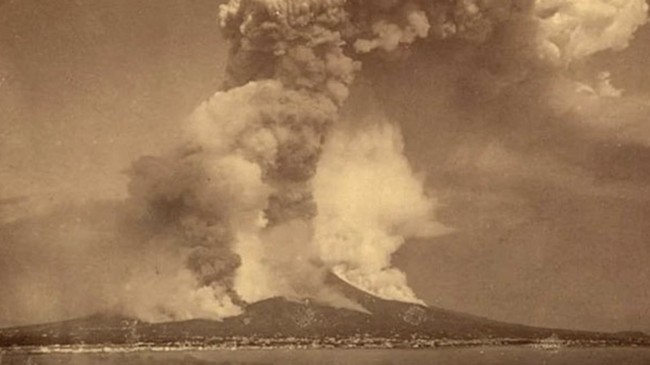
A natural phenomenon that occurred in Indonesia once shook the world in 1883. The eruption of Mount Krakatoa in August 1883 killed more than 36,000 lives and caused the Earth’s overall temperature to drop by an average of 0.6 degrees Celsius for several months afterwards.
It is no wonder that the volcano in the Sunda Strait, which connects the Java Sea and the Indian Ocean, possessed an explosive force equivalent to a 200-megaton bomb. The resurgence of Krakatoa in 1883 remains one of the deadliest volcanic eruptions in modern history, surpassed only by the eruption of Tambora in 1815, which killed 60,000 people.
The impact was felt worldwide and even reached deep into the stratosphere, causing the Moon to appear blue at night. Quoting the official Natural History Museum website, the eruption released sulphur dioxide and other particles, such as ash, into the air. These particles filtered the colours of sunlight reaching the Earth.
Different colours have different wavelengths, with red being the longest, violet being the shortest, and other colours falling in between, following the order of the rainbow. The volcanic particles were smaller than one micron, approximately one hundred times smaller than the thickness of a human hair. However, these particles were slightly wider than the wavelength of red light.
When dispersed, these particles absorbed red light while allowing other colours to pass through. This produced dream-like vistas and triggered various ‘Blue Moon’ phenomena. “The Krakatoa eruption is a striking example of irresistible natural force,” said Dr Martin Manglar, Scientific Assistant at the Natural History Museum. “In the blink of an eye, a volcanic eruption can change the shape of an entire planet in various ways, and the Blue Moon phenomenon may be the most beautiful and least dangerous.”
Although the Krakatoa eruption more than a century ago affected the climate and the world’s colour palette for years, its impact has now subsided. The reason the Moon appears blue occurs because other volcanoes have erupted since then, sometimes releasing particles of the same size as those produced by Krakatoa. Additionally, some forest fire events produce a similar combination of sulphur dioxide and ash, creating a similar effect. Depending on the intensity of the cause, these particles can be carried across countries, creating Blue Moon phenomena for people in other parts of the world.