
Krakatau Steel Urges FTA Implementation to Strengthen Industry and Competitiveness
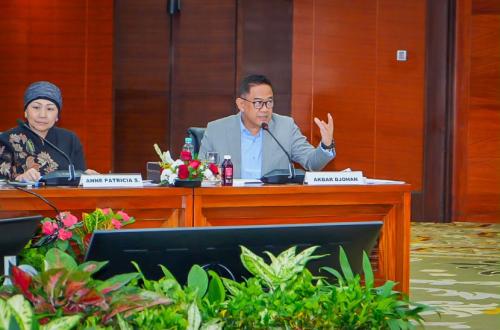
Free trade agreements (FTAs) are considered to need to be accompanied by strengthening of domestic industry so that market openness not only increases trade flows but also has an impact on national industrial capacity. This strengthening includes investment, downstreaming, technology transfer, labour, and supply chain sustainability.
President Director of PT Krakatau Steel (Persero) Tbk, Akbar Djohan, said that FTA implementation needs to consider its impact on the performance of national industry. Akbar conveyed this in a Focus Group Discussion (FGD) entitled ‘The Impact of Free Trade Agreements (FTAs) on Indonesia’s Economic Performance and Industrialisation’ at the Ministry of Finance, Jakarta, Thursday (20/8/2026).
In the FGD, which was also attended by Minister of Finance Purbaya Yudhi Sadewa, the government highlighted the need for a data-based approach in measuring the impact of FTAs on the industrial sector. Mapping of affected sectors is one of the bases for determining industrial strengthening strategies and preparing an industrialisation roadmap and manufacturing revitalisation.
Akbar said that market openness through FTAs needs to go hand in hand with increasing the competitiveness of domestic industry.
‘FTAs must open markets while strengthening the competitiveness of national industry. What we need to look at is not only how trade becomes more open, but how that openness provides real benefits for the national economy and industry,’ Akbar said in his statement, Monday (24/8/2026).
According to Akbar, the steel industry has broad linkages with supply chains and other industries. Every activity worth 1 US dollar in the steel industry is said to be able to drive around 2.5 US dollars in the supply chain and up to 13 US dollars in related industries.
Therefore, according to him, the impact of FTAs needs to be seen not only from the trade side, but also on investment, industrial utilisation, labour absorption, and the sustainability of the national supply chain.
Akbar also encouraged trade policies that can expand market access while supporting investment, downstreaming, technology transfer, and improving industrial competitiveness. The application of responsive trade remedies and strengthening of Rules of Origin (ROO) are considered to be instruments in safeguarding the interests of national industry.
‘Ultimately, any policy or scheme must be seen from its real benefits for national industry and the economy. FTAs must be an instrument to open markets, but at the same time strengthen the foundation of Indonesia’s industrialisation,’ said Akbar, who also serves as Chairman of the Indonesian Iron & Steel Industry Association (IISIA) and Chairman of the Indonesian Logistics & Forwarders Association (ALFI/ILFA).
This industrial strengthening is in line with the government’s agenda to continue downstreaming and industrialisation to increase the added value of domestic production.