
Krakatau Steel COO: Affordable clean energy is key to green steel transition
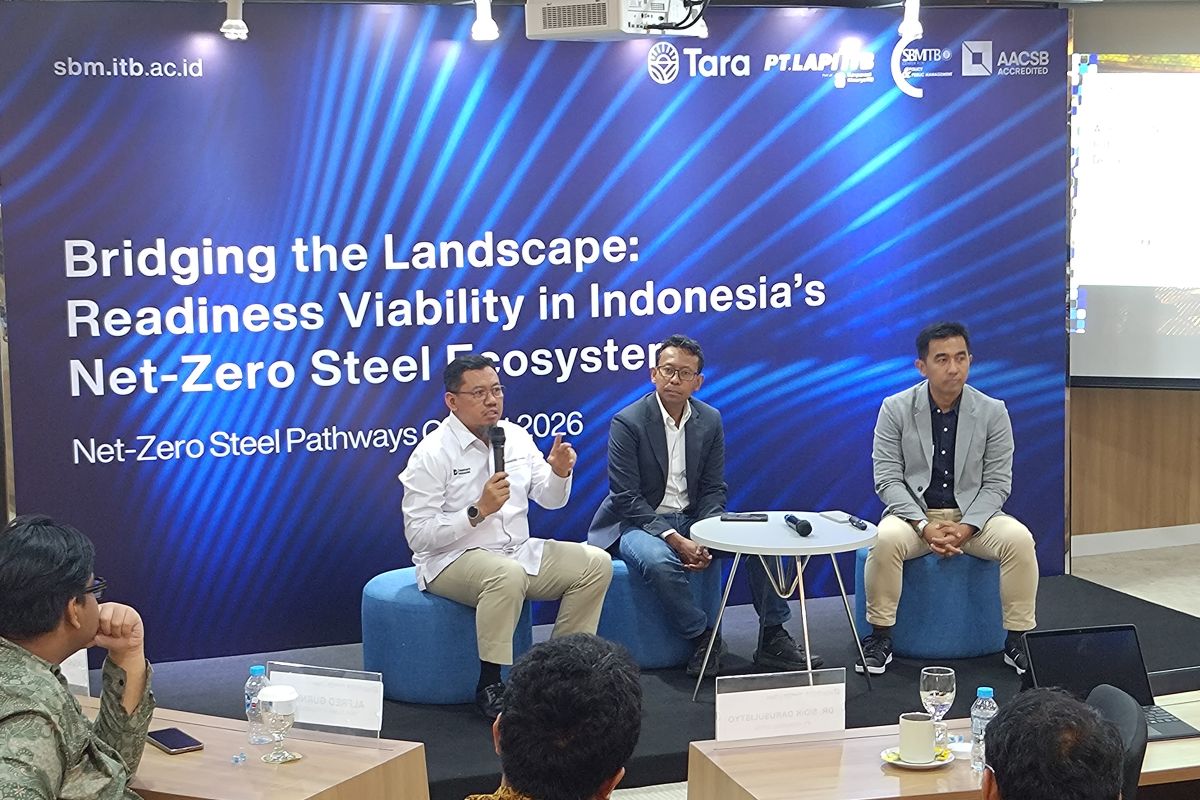
Jakarta (ANTARA) - PT Krakatau Steel Tbk’s Chief Operating Officer, Sidik Darusulistyo, considers the availability of safe and affordable clean energy as the primary factor in supporting the steel industry’s transition to low-emission production or green steel.
“In the end, there are three things that must be considered. Energy must be secure (safe), then affordable, and only then green,” said Sidik during a discussion at the Bandung Institute of Technology (ITB) School of Business and Management Jakarta Campus on Thursday.
According to him, the transition to a green steel industry cannot be rushed because companies must still maintain profitability and competitiveness amid high energy and raw material costs.
He stated that the steel industry has relatively thin profit margins, around 5-7% for operational profit before interest, taxes, depreciation, and amortisation (EBITDA), and net profit of about 3-5%, making companies more cautious in selecting decarbonisation technologies.
“Because the margins are thin, we will not take too great a risk. We must use technologies that are already mature and proven,” said Sidik.
He explained that the steel industry’s cost structure is heavily influenced by energy and raw material prices, while natural gas prices in Indonesia are still higher than in several competing countries.
According to him, natural gas prices in Indonesia can reach around $6.5 per million British Thermal Units (MMBTU), even higher when using liquefied natural gas (LNG), whereas in China they are below $2 per MMBTU.
“Raw materials and energy drive steel costs. We must stay competitive,” he said.
Sidik added that Krakatau Steel is currently beginning to prepare decarbonisation steps to face global carbon trade policies such as the Carbon Border Adjustment Mechanism (CBAM), which has started to be implemented in several export destination countries.
The company has also prepared a gradual decarbonisation roadmap until 2050 through energy efficiency, industrial digitalisation, utilisation of renewable energy, reactivation of Direct Reduced Iron-Electric Arc Furnace (DRI-EAF) facilities, and development of low-carbon technologies such as carbon capture utilisation and storage (CCUS) and hydrogen.
“CBAM has been in effect since last January, and penalties for CO2 (carbon dioxide) production will develop. So this is one of our considerations to continue exporting,” revealed Sidik.
On the same occasion, ITB Professor Emeritus in the Faculty of Mining and Petroleum Engineering, Prof. Zulfiadi Zulhan, said that developing green steel requires support from large amounts of clean energy, especially to support green hydrogen production.
According to him, the price of green hydrogen is currently still in the range of $5-7 per kilogram, while to be competitive for the steel industry, it ideally needs to be below $1 per kilogram.
He explained that producing 1 million tonnes of hydrogen-based steel is estimated to require around 75,000 tonnes of hydrogen and an electricity supply of up to around 453 megawatts to support the production and steel melting process.
“If that (energy supply issue) is not resolved yet, don’t talk about green steel first. Energy is the most important,” said Zulfiadi.
In addition to energy challenges, he assessed that Indonesia still faces technology dependencies from abroad, including electrolysis technology, electric arc furnace (EAF), and hydrogen-based burner technology for the steel industry.