
KPTDP and PANRB Ministry Discuss Digital Government Progress with Tony Blair
Indonesia has in recent years built an important foundation that provides strategic direction for Digital Government. This effort represents a fundamental change in governance, how policies are formulated, how services are delivered, and how the state interacts with society. Achieving public welfare is the highest performance target of the government (Human-Centered Design in Government).
To obtain input regarding digital government, the Digital Transformation Acceleration Committee (KPTDP), led by Chairman Luhut Binsar Pandjaitan, held a discussion with former UK Prime Minister and Executive Chairman of the Tony Blair Institute (TBI), Tony Blair, at the National Economic Council (DEN) office on Monday (6/7/2026). The meeting discussed efforts to accelerate bureaucratic digitalisation to support improvements in the quality of public services.
KPTDP Chairman Luhut Binsar Pandjaitan stated that digitalisation combined with the application of artificial intelligence (AI) helps integrate various sectors and provides solutions to problems on the ground. With the implementation of Digital Public Infrastructure (DPI) as the foundation of the technological system, it is believed to facilitate access to public services, with one use case being the social protection system.
“The implementation of digital government supported by AI is the best solution for executing every priority programme of the President. We do not want to miss the moment, because with digital government, we can be efficient, transparent, and reduce face-to-face interactions,” he said.
It was conveyed that through digital government, the state is present in a simpler, faster, and more trustworthy manner. It is not merely about modernising systems, but transforming the public service experience. The KPTDP has piloted the digitalisation of social assistance in Banyuwangi Regency and is preparing to expand implementation to 42 regencies/cities, with the addition of Batam City and Bali Province. The implementation has provided important lessons regarding the acceleration of processes and the strengthening of transparency in the distribution of social assistance.
Collaboration with Tony Blair and his team is expected to increase the scale of AI application in the fields of social protection, health, education, and ease of doing business. It also aims to strengthen AI governance for security, accountability, and compliance with data protection. The collaboration is also expected to target capacity building for local government officials regarding digitalisation, ethics, and security.
“Our focus is on a safe and trustworthy digital ecosystem for the public, as well as the preparation of a forthcoming presidential regulation to formalise the digital government framework. AI plays a vital role in analysing data from digital identities, improving efficiency, and optimising tax revenue,” he said.
On the occasion, former UK Prime Minister Tony Blair appreciated Indonesia’s achievements in implementing digital government. He noted that every country faces its own challenges in executing digital government, such as Indonesia’s large population and its geographical nature as an archipelagic nation.
“The most important part of digital government is how the technology is applied. I think Indonesia already has that, as I heard earlier about the administrative service process being cut from what used to take quite a long time to just a few days,” he said.
He stated that the streamlining of services in Indonesia is very good, considering Indonesia is not a small country, and this is not an easy feat. However, with collaboration from various elements, the digitalisation implemented can run well. He added that human resources must possess strong digital skills and a digital mindset to support the success of the digital transformation. His party is open to assisting Indonesia in various sectors, including digitalisation.
“Integration between government programmes must be carried out, and most importantly, the team executing it must be educated and have a digital mindset,” he said.
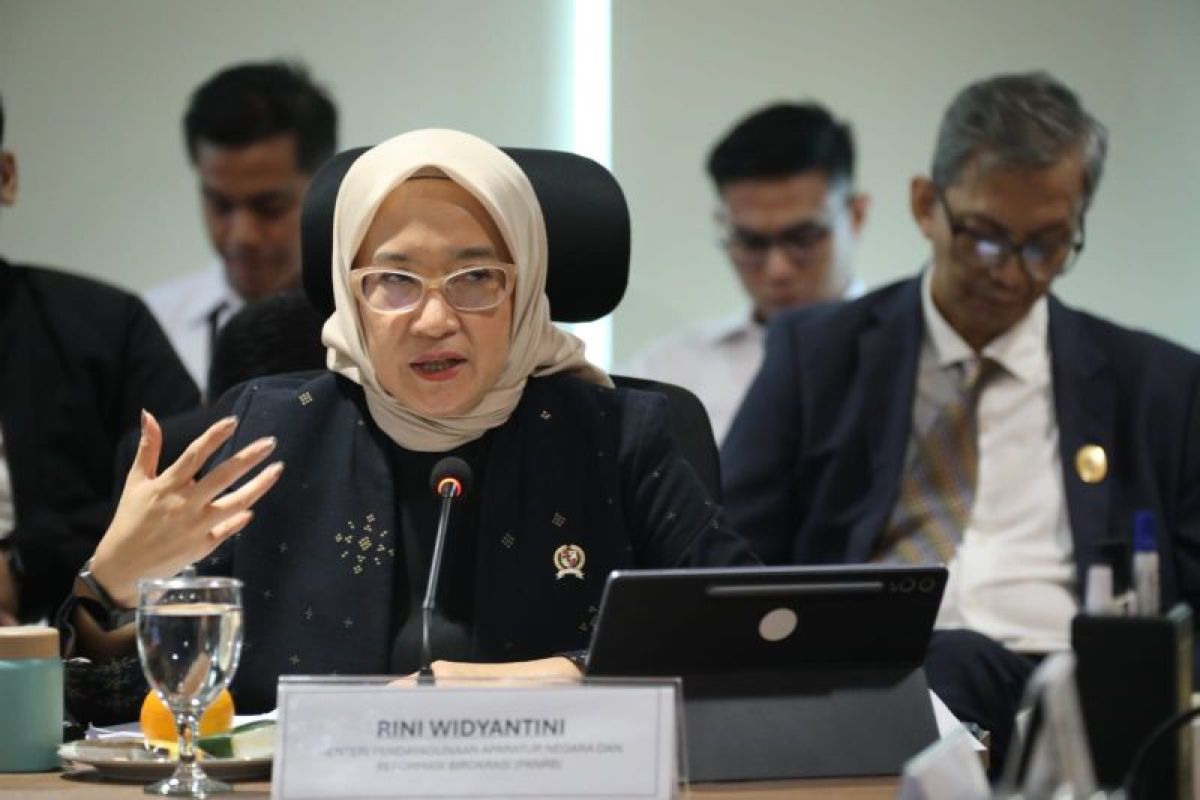
Meanwhile, Minister of Administrative and Bureaucratic Reform Rini Widyantini stated that government digital transformation and development data governance are crucial, supported by the utilisation of Digital Public Infrastructure (DPI) which serves as the backbone of various government services. DPI consists of digital identity, data exchange, and digital payments, maintained in line with the principles of personal data protection and cyber security.
She explained that the digital transformation of social protection integrates digital identity, trusted data exchange, digital payments, and the Social Protection Portal into a single integrated service flow. The goal is not merely to digitise existing processes, but to fundamentally redesign service delivery to be simpler, more transparent, accountable, and better targeted.
According to her, the efforts undertaken by various parties are not just about digitalising social assistance, but serve as the foundation for a more integrated, transparent, and citizen-centred social protection system. The most important part is ensuring that these lessons are realised in sustainable national implementation through appropriate policies, effective governance, and strong institutional collaboration, supported by dedicated strategies and institutions to guarantee the sustainability of the digital transformation.
She expressed confidence that the success of digital government transformation depends on three mutually reinforcing elements: leadership, strong institutional governance, and an implementation approach driven by use cases. Based on experience, digital transformation is not just about technology, but a governance agenda. Technology merely…