
KPK: Corruption in procurement can lower development quality
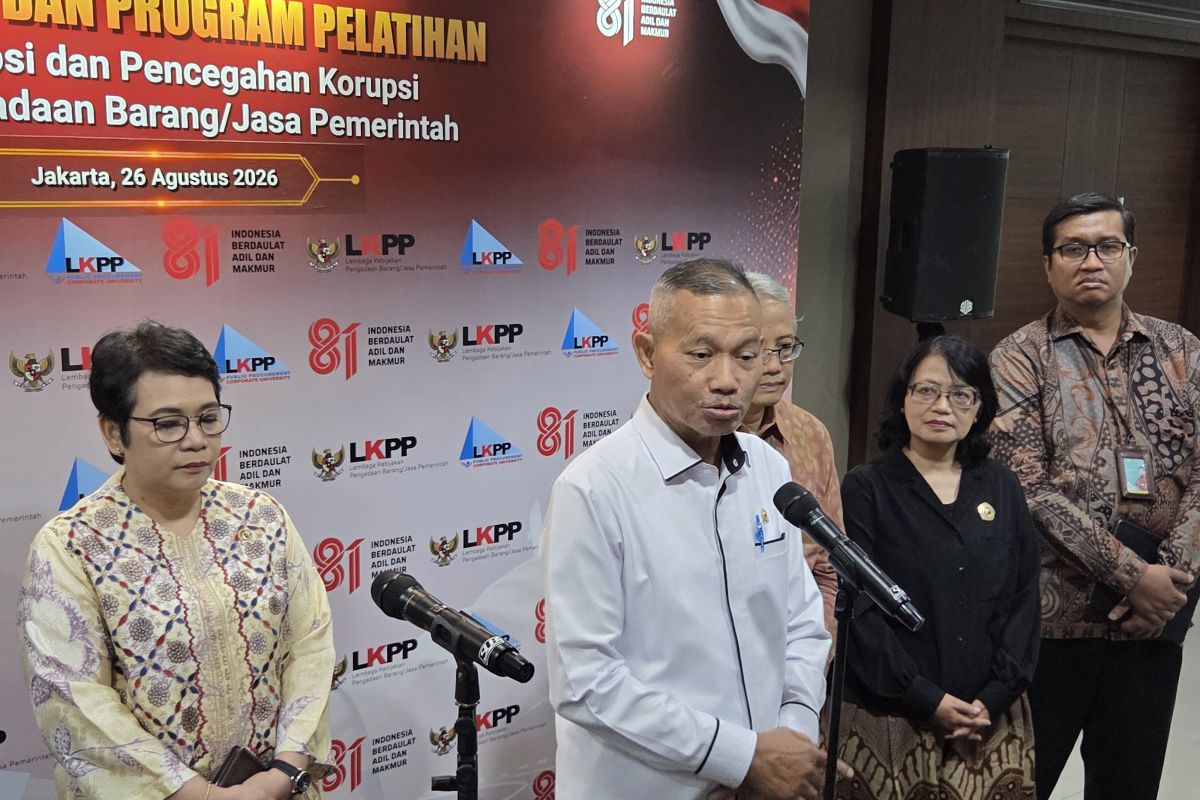
Corruption in procurement can occur when the goods or services delivered do not match the specifications or quality set out in the original contract.
“What should be number one quality is delivered with number four quality. Yes, this happens a lot. Even those who knowingly provide low quality,” said Ibnu at the launch of the Anti-Corruption and Corruption Prevention Training Programme (AKPK) in Government Procurement of Goods and Services (PBJP) in Jakarta on Wednesday.
According to him, such practices can occur due to collusion between parties involved in the procurement process, from the commissioning party, the goods and services provider, to those carrying out oversight.
If this happens, development that should provide optimal benefits to the public instead produces low quality results.
This condition ultimately reduces the benefit of government spending that should return to the public in the form of quality services and development.
Based on KPK data from 2004 to the second quarter of 2025, there were 426 corruption cases related to the procurement of goods and services. This figure places procurement of goods and services as the second most common corruption offence after gratuities and bribery, which reached 1,068 cases.
Furthermore, Ibnu explained that the risk of corruption in procurement does not only arise when the tender process takes place. The potential for irregularities can occur from the budget planning stage, approval, selection of providers, to the execution of works.
In the selection of providers (tender), for example, he highlighted the practice whereby one company has been prepared as the winner, while several other companies are used merely as companions so that the procurement process appears competitive.
In addition, intervention by leadership in the procurement unit to direct the winner is also one of the risks that needs to be watched. Therefore, strengthening anti-corruption prevention at all stages of government procurement of goods and services is necessary.
“Integrity-based procurement is not only free from corruption, but ensures every rupiah returns to the people in the form of benefits,” he explained.
To that end, the KPK supports the implementation of the Anti-Corruption and Corruption Prevention Training Programme (AKPK) in Government Procurement of Goods and Services (PBJP).
The programme is organised by the National Public Procurement Agency (LKPP) in cooperation with the National Institute of Public Administration (LAN).
The KPK will play a role in monitoring the programme, while LAN supports strengthening the competence and integrity of officials involved in the training process.