
KPI Fit and Proper Test: Candidate Calls for Digital Democracy Quality Boost
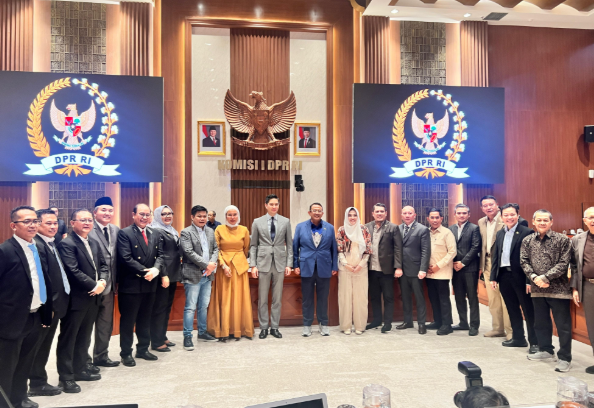
The selection process for the new leadership of the Indonesian Broadcasting Commission (KPI Pusat) has entered the fit and proper test stage before House of Representatives (DPR RI) Commission I on Tuesday (14 July). One of the key issues highlighted was the importance of strengthening the quality of Indonesia’s digital democracy.
Central KPI commissioner candidate Ferdi Setiawan proposed a major transformation of the commission’s role amid the rapid development of digital media. He argued that KPI can no longer merely act as a broadcasting regulator, but must evolve into a driver of collaboration across the entire media ecosystem.
He believes the momentum of the ongoing revision of the Broadcasting Law should serve as a strong foundation for addressing the challenges of global media convergence.
“The revision of the Broadcasting Law should not only broaden the definition of broadcasting, but must also build a democratic digital media governance system,” he said before members of Commission I.
He argued that the changing media landscape demands a shift in how the commission’s function is viewed.
For this reason, he presented his guiding theme of institutional transformation: “From Regulation Towards an Adaptive, Intelligent, and Competitive Broadcasting Ecosystem.”
In his presentation, Ferdi offered the concept of KPI as an Ecosystem Orchestrator — an institution that not only performs oversight, but also leads collaboration between regulators, the broadcasting industry, digital platforms, government, academics, and society.
“The ideal concept of KPI’s authority is to transform from regulator into an Ecosystem Orchestrator that can lead collaboration across the entire broadcasting ecosystem,” he said.
Ferdi also highlighted the serious challenges facing the conventional broadcasting industry. According to him, many broadcasters are under economic pressure due to the shift in advertising spending towards digital platforms, which have so far operated under a different regulatory regime.
This situation, he said, creates regulatory asymmetry: two types of media with similar social impact being governed by different standards.
“Going forward, broadcasting regulation must not be unbalanced. Regulatory asymmetry can no longer be tolerated. Two types of media with the same social impact should not have different rules. There needs to be a breakthrough towards regulatory equality, particularly in accountability standards proportionate to the public interest in the digital era,” he asserted.
As a policy direction, Ferdi introduced the idea of KPI Smart as the foundation for the commission’s institutional transformation. The concept is designed to strengthen the quality of digital democracy through five main pillars: Smart Regulation, Smart Monitoring, Smart Society, Smart Industry, and Smart Institution.
“I want KPI to truly become the guardian of the quality of Indonesia’s digital democracy. Through the KPI Smart programme, we can achieve healthy Indonesian broadcasting, a critical and empowered society, and a broadcasting industry that increasingly enlightens,” he said.
Ferdi’s proposals drew the attention of Commission I members, who considered them to offer a fresh perspective on the future of national broadcasting amid media convergence and the dominance of digital platforms.
The fit and proper test for central KPI commissioner candidates held by Commission I forms part of the process to select the commissioners who will lead the institution in the coming term.
The series of fit and proper tests is scheduled to run for three days. In this agenda, Commission I is examining the vision, mission, and resilience of the strategies of 26 commissioner candidates in steering the central KPI as it confronts the challenges of global digitalisation.