
KPEI records 48 percent rise in daily exchange settlement value
The increase is one indicator of the growing need for instruments supporting liquidity and transaction activity in the market.
Jakarta (ANTARA) - PT Kliring Penjaminan Efek Indonesia (KPEI) recorded an average daily exchange settlement value of Rp6.65 trillion in January-July 2026, an increase of 48 percent compared to the 2025 average of Rp4.5 trillion.
KPEI President Director Antonius Herman Azwar said the increase in transaction activity needs to go hand in hand with settlement efficiency, strengthening risk management, and collateral management.
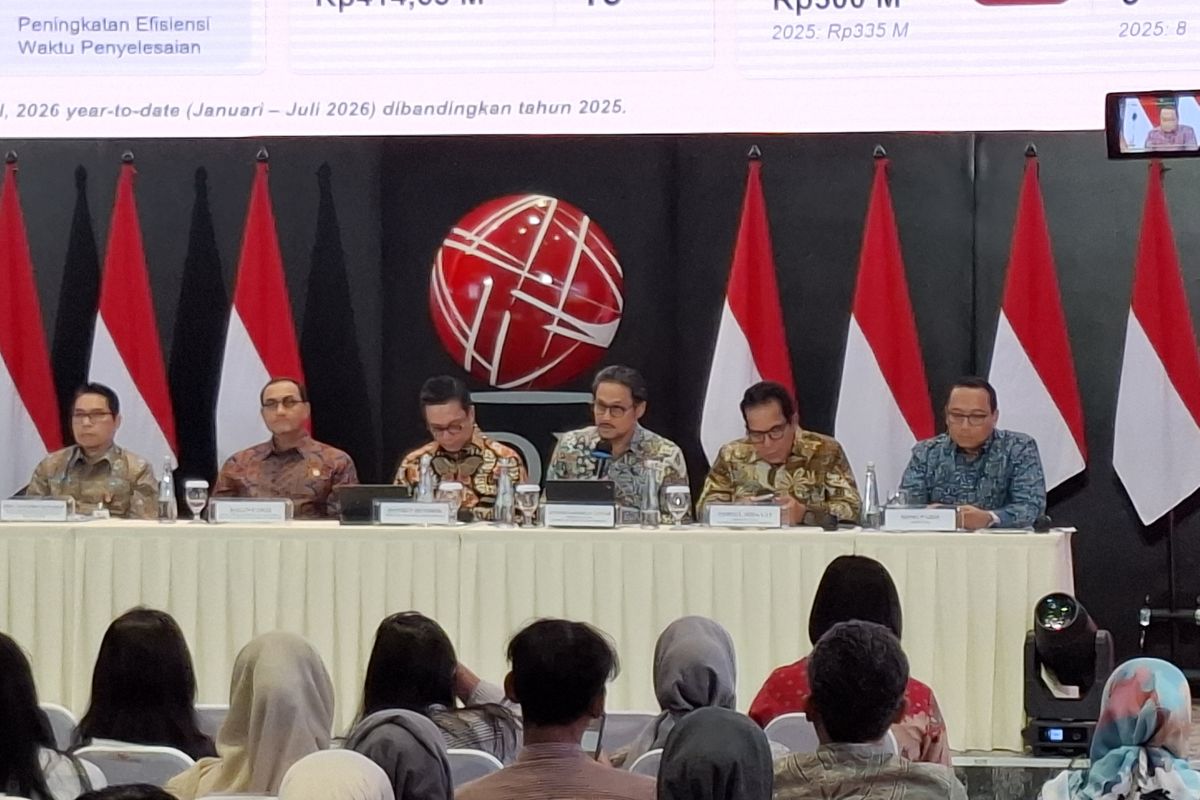
“Market activity growth indeed needs to be balanced with high efficiency, strong risk management, and increasingly integrated market infrastructure,” said Antonius at the Press Conference Commemorating the 49th Anniversary of the Reactivation of the Indonesian Capital Market in Jakarta, Monday.
In line with the increase in transaction value, the average efficiency of daily exchange settlement value rose to 65.43 percent from 61.81 percent in 2025.
KPEI also implemented a settlement mechanism at the Clearing Member level since 15 June 2026 to improve the efficiency of the transaction settlement process.
Antonius said that since its implementation, the mechanism has recorded an average settlement instruction efficiency of 96 percent and an improvement in settlement time efficiency of 86 percent.
In addition to exchange transaction settlement, the total value of KPEI securities lending and borrowing in January-July 2026 reached Rp109.24 billion, an increase of approximately 269 percent compared to the same period in 2025.
The volume of securities lending and borrowing in that period reached 31.18 million shares, growing approximately 171 percent compared to 11.01 million shares in the same period the previous year.
“The increase is one indicator of the growing need for instruments supporting liquidity and transaction activity in the market,” he said.
Meanwhile, the outstanding value of triparty repo in January-July 2026 reached Rp414.63 billion with a total of 16 participants.
KPEI also expanded its role in the money and foreign exchange markets after officially carrying out the Central Counterparty function for the Money Market and Foreign Exchange Market (CCP PUVA) since 30 September 2024.
Based on KPEI’s presentation, the notional value of Domestic Non-Deliverable Forward (DNDF) transactions through CCP PUVA in January-July 2026 reached 5.21 billion US dollars, or approximately Rp90.5 trillion.
This value increased by approximately 310 percent compared to the same period the previous year, which was recorded at 1.27 billion US dollars, or approximately Rp22.1 trillion.
The frequency of DNDF transactions reached 912 transactions, an increase of 158 percent compared to 354 transactions in the same period the previous year. The number of CCP PUVA members also increased to 11 members from the previous eight members.
According to Antonius, this growth in activity shows the increasingly developing role of KPEI from the main capital market infrastructure to infrastructure that also supports the integration and strengthening of Indonesia’s financial market.
In its 2026-2030 development direction, KPEI plans to transform from a clearing provider into a Central Clearing, Risk Management and Collateral Management Hub that integrates financial market services. The plan is contained in KPEI’s official presentation.
The development includes expanding clearing and guarantee services, integrated collateral management, developing new products in the capital market as well as the money and foreign exchange markets, and increasing domestic, regional, and global market connectivity.
In 2026, KPEI is also preparing the integration of triparty repo services with the Alternative Market Organiser System (SPPA), integration of CCP PUVA with Refinitiv, implementation of mutual fund securities lending and borrowing, and online securities lending and borrowing.
Furthermore, Antonius mentioned that KPEI’s development direction until 2030 focuses on efficiency, reliability, security, and increasing market confidence.