
Kowani strengthens food security with first sorghum harvest in Bogor
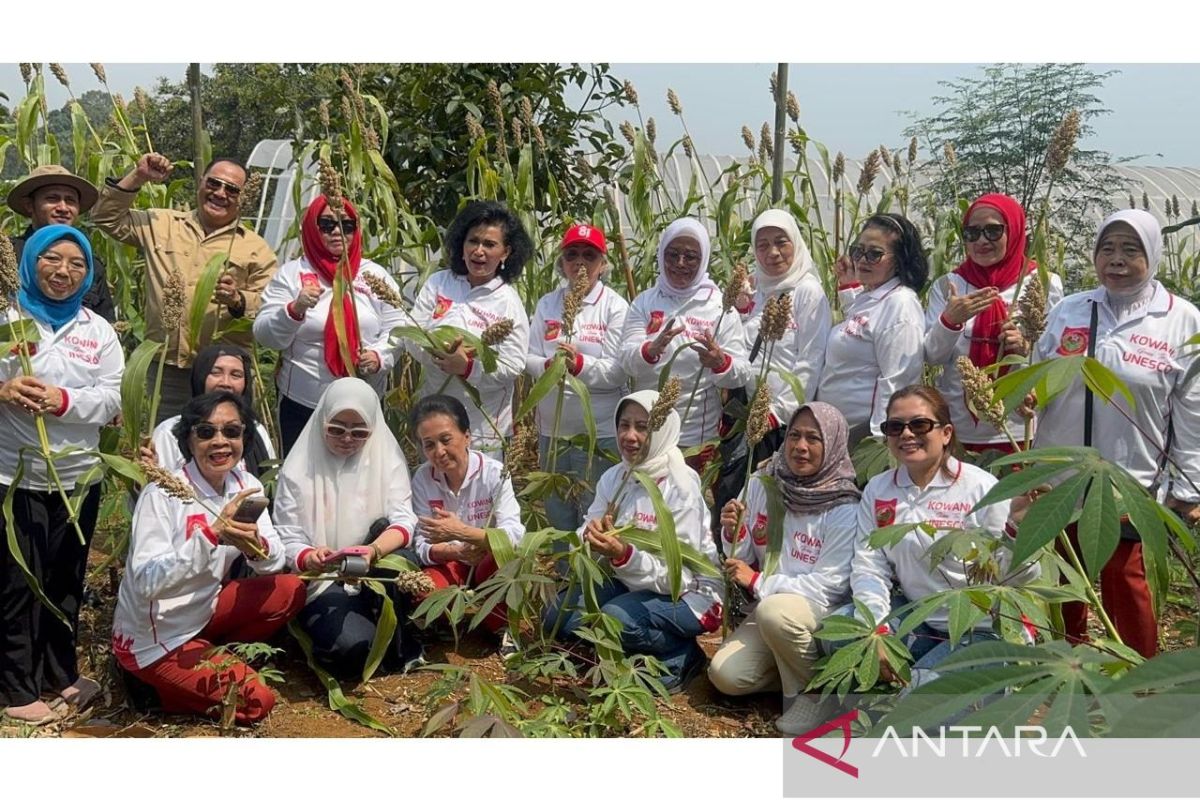
The Indonesian Women’s Congress (Kowani) is strengthening its commitment to supporting national food security through the development of agricultural demonstration plots and the first sorghum harvest in Bogor Regency, West Java.
“Food security is essential for realising the welfare of society, families, and all citizens, so that our lives become safe, prosperous, tranquil, and peaceful. All of this can be achieved thanks to fertile land, land that is utilised well, and land that has value and benefits for the community,” said Kowani Chairwoman Nannie Hadi Tjahjanto in a statement in Jakarta on Friday.
According to her, the activity is not merely about cultivation and harvesting.
The land development is directed towards becoming part of an integrated food security ecosystem, encompassing production, processing, the empowerment of women and farmers, the strengthening of MSMEs and cooperatives, and the expansion of market access.
She emphasised that the productive use of every inch of land can provide direct benefits to the community while supporting national food security.
“We continue to implement and realise the Asta Cita programme through various Kowani activities, including efforts to prevent stunting and drug abuse. God willing, through these concrete steps, we can provide greater benefits for society and the nation,” said Nannie Hadi Tjahjanto.
Meanwhile, Director of PT DASS and Kowani Expert Staff member Anneke Runtulalo explained that the demonstration plot was developed with the concept of productive and sustainable land use.
Various commodities are planted at the site, ranging from mustard greens, cassava, chillies, melons, and cucumbers to fruit trees such as durian.
According to Anneke, the success of the demonstration plot cannot be measured solely by the harvest yield.
“This is one of our future programmes. Not just chillies like these, but we will develop these chillies into Kowani products that have added value, one of which is through rica roa products,” she said.
The development of processed products, Anneke continued, opens up wider market opportunities.
She noted that there is demand for rica roa products from Singapore and Malaysia.
“Singapore is requesting rica roa made with chillies like the ones we grow here. This rica roa is quite expensive. For a small package alone, it can reach around Rp50,000,” said Anneke.
Therefore, her team will connect production at the demonstration plot with the raw material needs for processed products.
With this model, farmers not only produce agricultural commodities but also have the opportunity to gain added value through downstream processing.