
Kowani Launches National Movement to Support Tempe's UNESCO Recognition
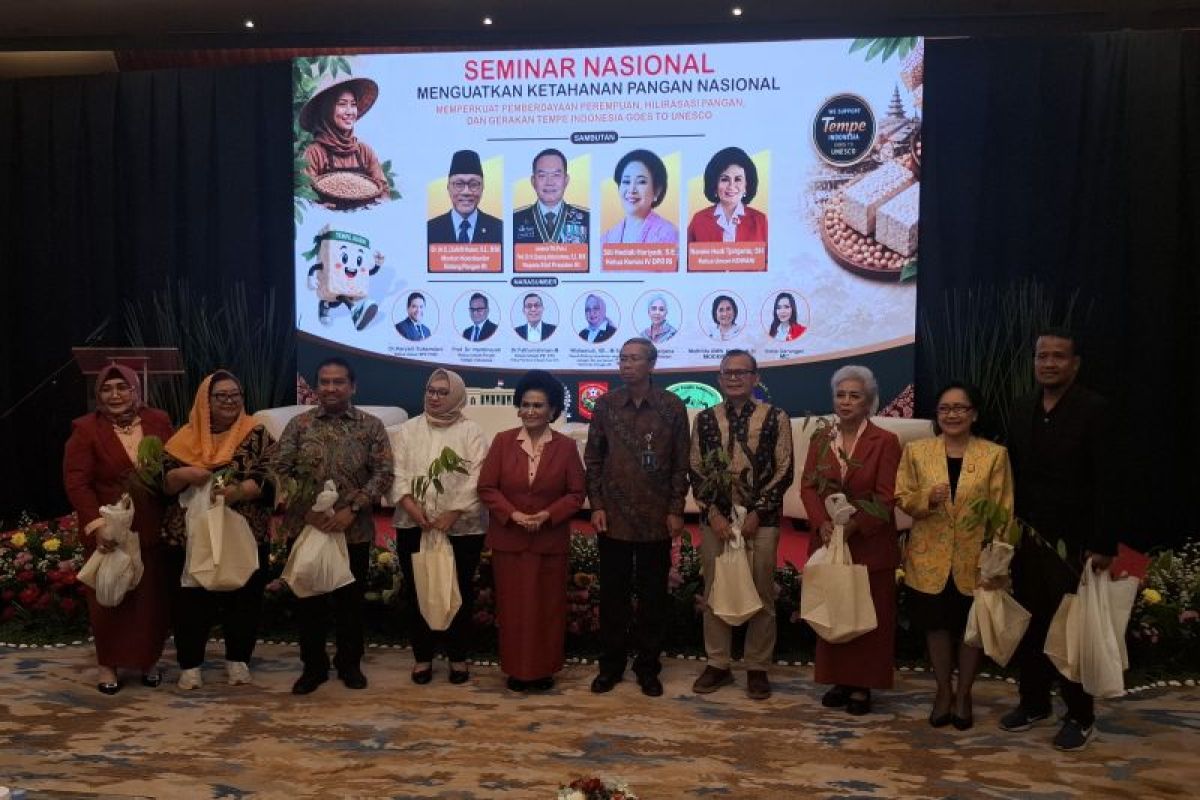
The Indonesian Women’s Congress (Kowani) has launched a national movement to support the nomination of tempe as UNESCO Intangible Cultural Heritage through strengthening food security, women’s empowerment, and the downstream processing of local food.
Kowani Chairwoman Nannie Hadi Tjahjanto stated that the movement is part of four initiatives prepared by the organisation towards its 100th anniversary in 2028, while also expanding women’s contribution to national development. “Today Kowani launches four integrated national strategic movements as the foundation for entering the second century of Indonesian women’s struggle and civilisation,” Nannie said during a seminar on Strengthening National Food Security at the Coordinating Ministry for Food, Jakarta, Monday.
The four movements include the Kick-Off of the Kowani Grand Harvest Festival to strengthen national food security, the Kick-Off of Kowani Car Free Day through the Fun Walk for the National Tempe Goes to UNESCO Movement to be held on 9 August, the Development of Kowani Scoutmasters as a character-building regeneration movement on 14 August, and digital transformation through the official website and the Ruang Perempuan portal.
Nannie explained that the Grand Harvest Festival agenda is the first step in building an ecosystem of women’s empowerment based on food security that does not stop at ceremonial activities. “We do not want to stop at ceremonies. We want to build a system, build a model, and build proof of success,” she said.
She explained that Kowani will develop assisted villages as pilot projects for women’s empowerment, family resilience, village development, and the people’s economy that can be replicated in various regions. The programme includes strengthening women’s farming groups, cooperatives, micro, small, and medium enterprises (MSMEs), downstream processing of local food, the application of appropriate technology, and the development of a green and circular economy.
According to Nannie, food security was chosen as the starting point of the movement because it is directly related to health, family welfare, the sustainability of farmers and fishers, and the strengthening of the community’s economy. She added that women play an important role in the entire food chain, from production and processing of agricultural products to managing household consumption and food businesses.
Data from the Coordinating Ministry for Food shows that women account for 41.7 percent of the agricultural workforce. Furthermore, more than 30 percent of women are involved in managing agricultural land and home gardens, while over 60 percent play a role in providing family food. “Food security is not just about ensuring food is available; food security is about ensuring every family obtains food that is healthy, nutritious, safe, affordable, and sustainable,” she said.
Regarding the Tempe Goes to UNESCO Movement, Nannie said her organisation is providing support because tempe is not only a traditional Indonesian food but also sustains many women MSME players. “We hope that tempe will be recognised globally as local wisdom, becoming an intangible cultural heritage by UNESCO,” Nannie said.
At the same event, Secretary of the Coordinating Ministry for Food Kasan, representing Coordinating Minister for Food Zulkifli Hasan, said that women’s empowerment is an important part of strengthening the national food system. “No country can build robust food security if women still face limited access to land, financing, technology, education, or markets,” Kasan said.
He stated that downstream processing is necessary so that agricultural products are not only sold as raw materials but are processed into value-added products that can improve the welfare of farmers and business actors. The Coordinating Ministry for Food also appreciated the Tempe Indonesia Goes to UNESCO movement, as it is considered capable of strengthening Indonesia’s food diplomacy while introducing traditional knowledge and local wisdom to the global community.
“Tempe is a product of Nusantara cultural innovation that combines traditional scientific knowledge, local wisdom, health values, and environmental sustainability. Therefore, the effort to promote tempe as UNESCO intangible cultural heritage is not merely about international recognition but also a strategy to strengthen Indonesia’s food diplomacy at the global level,” Kasan said.
Acting Deputy II of the Presidential Staff Office Popy Rufaidah encouraged Kowani to make the Grand Harvest Festival a movement to absorb local farmers’ products at fair prices. She also urged Kowani-assisted MSMEs to become food suppliers for the Nutrition Fulfilment Service Units, as well as to develop local food, women’s cooperatives, and home gardens at the village level.
Regarding food security, Popy conveyed that the government’s rice reserves as of 1 July 2026 reached 5.17 million tonnes, while the national rice production projection for January-August 2026 is estimated at 25.28 million tonnes. Additionally, the government is targeting the establishment of 80,000 Merah Putih Village/Sub-district Cooperatives, with around 35,000 cooperatives targeted to begin operations by August 2026 as food distribution nodes and absorbers of village harvests.