
Koster Urges AI Progress to Go Hand in Hand with Balinese Culture
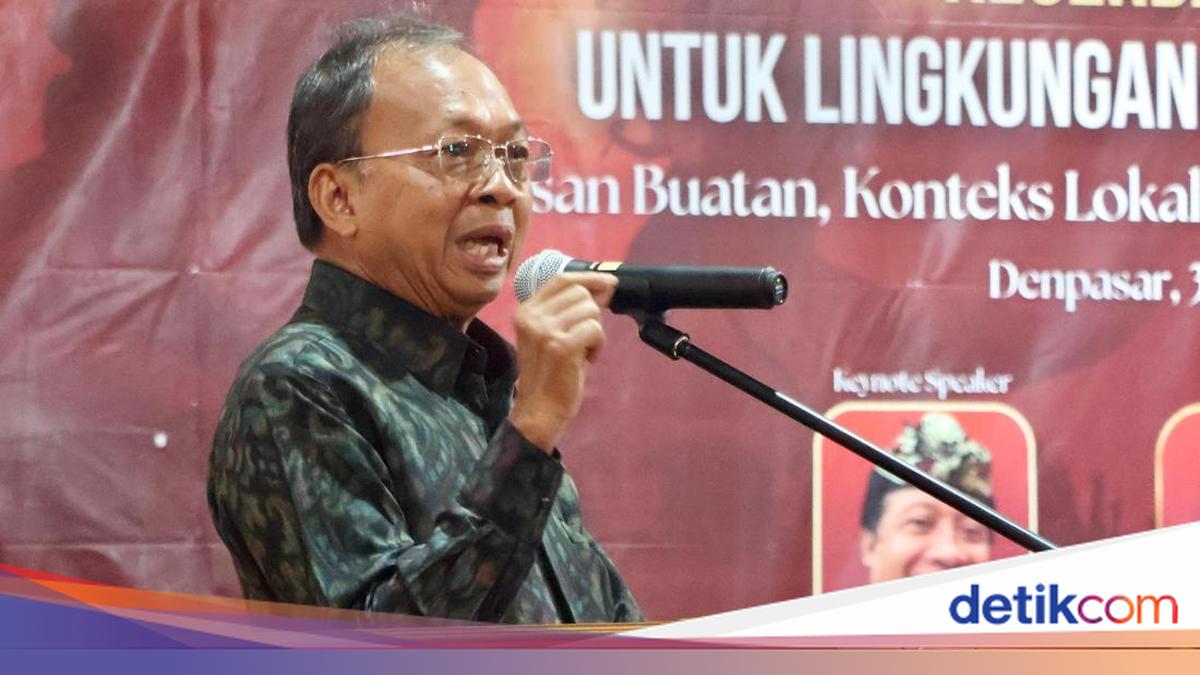
Bali Governor Wayan Koster has stated that developments in artificial intelligence (AI) must go hand in hand with human intelligence and cultural intelligence. He emphasised that the use of technology must not eliminate values, identity, traditions, the character of the community, or the harmonious relationship between humans and nature.
“Artificial intelligence must not replace cultural intelligence. On the contrary, artificial intelligence must be positioned as an instrument to strengthen human intelligence and cultural intelligence,” Koster said in a statement on Monday (7/9/2026).
He made the remarks whilst opening the 14th Scientific Meeting of the Indonesian Association of Built Environment Researchers (TI IPLBI) at the Postgraduate Hall of Udayana University in Denpasar on Friday (4/9). The event carried the theme ‘Cultural Intelligence for a Sustainable Built Environment: Artificial Intelligence, Local Context, and Sustainable Development Goals’.
Furthermore, Koster revealed that this principle is important in the development of Bali’s built environment amid rapid technological advancement, climate change, disaster threats, and various future development challenges.
For this reason, Koster stressed that Bali’s development must remain rooted in Balinese character and identity, as directed in the Bali 100-Year Development Plan 2025-2125, namely by sustainably preserving Bali’s nature, its people, and its culture.
Koster added that the values of Sad Kerthi also need to be placed as an ethical and ecological foundation in the development of Bali’s built environment. In this way, development is not merely oriented towards physical progress, but also maintains the balance between humans, nature, and culture.
In his address, Koster also encouraged universities and researchers to continue exploring and developing Balinese local knowledge, including Traditional Balinese Architecture and Subak, through research, innovation, and the use of technology.
“Culture-based modernisation is not about returning to the past, but about bringing the best values of the past to answer the challenges of the future,” he said.
Koster also requested that research on the built environment should not stop at academic publication. According to him, research results must be translated into concrete solutions in the form of prototypes, designs, standards, policies, technologies, and development models that can be applied and provide real benefits to society.
He revealed that these efforts are also directed towards realising a Balinese built environment that is increasingly resilient and adaptive to climate change and disasters, whilst also being green, low-carbon, and sustainable.
To achieve this, Koster emphasised the importance of collaboration between government, universities, researchers, architects, planners, the business community, customary villages, society, and the younger generation in building an innovation ecosystem for the built environment.
Through such collaboration, he hopes Bali can develop into a laboratory for the development of the future built environment, bringing together technological and AI advancement with culture, local knowledge, and sustainability principles.
“Bali 100 Years is not merely a development project. Bali 100 Years is a civilisation project,” Koster asserted.
Agenda of the 14th TI IPLBI
Chair of the 14th TI IPLBI organising committee, Prof. Ni Ketut Agusintadewi, said the IPLBI Scientific Meeting serves as a space to bring together various perspectives, ideas, research results, and practices concerning the future of the built environment.
She said the 14th TI IPLBI is directed at encouraging collaboration between technology, locality, and culture in a contextual and mutually complementary manner, particularly in addressing various future challenges in built environment development.
The 14th TI IPLBI ran for three days, from 3 to 5 September 2026, with a programme comprising a national seminar, a masterclass on phenomenology and AI, workshops, a photography competition, book publications, and an architectural field trip.
Prof. Ni Ketut expressed hope that the staging of the 14th TI IPLBI can strengthen academic capacity and networks whilst producing high-quality, innovative, and sustainable built environment research and practice without losing local character.
Also in attendance were the Chair of IPLBI for the 2024-2027 period, Dr. Ir. Susilo Kusdiwanggo, together with researchers, academics, architects, planners, practitioners, and participants of the 14th TI IPLBI.
Source: jawawa.id (https://jawawa.id/newsitem/koster-urges-ai-progress-to-go-hand-in-hand-with-balinese-culture-1788762325)
Originally published by detikcom (https://news.detik.com/berita/d-8651885/koster-dorong-kemajuan-ai-berjalan-beriringan-dengan-budaya-bali), translated from Indonesian