
KOSPI Plunges 10% Amid AI Monetisation Fears and Tech Bubble Concerns
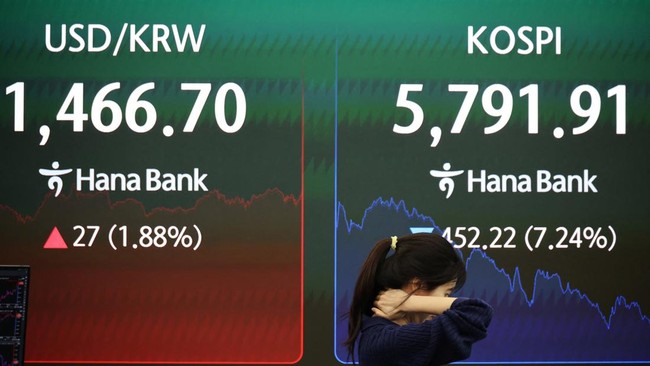
The South Korean stock market experienced a sharp correction on Monday (23/6/2026) after concerns over the ability of major US technology companies to monetise artificial intelligence (AI) triggered a global sell-off. The KOSPI index, which had previously recorded a strong rally, fell below the psychological level of 9,000 points.
According to Korea Exchange (KRX) data, the KOSPI opened at 9,083.54, down 31.01 points (0.34%) from the previous close of 9,114.55. Selling pressure from the start of trading pushed the index further down to 8,203, a plunge of 10%.
The KOSDAQ index, dominated by technology and growth stocks, also weakened as investor sentiment deteriorated following the Nasdaq’s fall on Wall Street. The day’s market direction was dictated by aggressive selling from foreign and institutional investors. The sharp correction in major US tech stocks prompted market participants to reduce exposure to risky assets and realise profits in the domestic market.
Foreign investors were the main drag on the market, with net selling reaching 1.18 trillion won to 1.8 trillion won in the early session. Institutional investors also offloaded shares worth 65 billion won to 205 billion won, accelerating the index’s decline. Programme trading activity also showed a dominance of sell orders worth more than 1.67 trillion won, making it difficult for the market to hold the 9,000-point level.
Amid the pressure, retail investors were the only group actively buying. Individual investors recorded net purchases of between 1.24 trillion won and 1.97 trillion won, taking advantage of the market correction to accumulate stocks. However, the scale of retail buying was insufficient to offset the selling wave from foreign and institutional investors, only managing to slow the pace of the index’s decline during morning trade.
Market attention also focused on South Korea’s two semiconductor giants, Samsung Electronics and SK hynix. Both were in the spotlight after SK hynix surpassed Samsung Electronics in common stock market capitalisation for the first time in about 25 years. Samsung Electronics shares opened down 0.57% at 351,500 won and continued to fall, dropping 12.31% near the close. SK hynix initially rose 0.31% on the back of gains in the Philadelphia semiconductor index and a surge in Micron shares in the US, before reversing to plunge 12.47% following the overall market weakness.
Some market participants began comparing SK hynix’s rise to the top market capitalisation position with the dot-com bubble era of 2000, when Cisco briefly surpassed Microsoft before the market suffered a major correction. However, several analysts assessed that current conditions differ because the AI sector rally is still supported by strong earnings growth. Kiwoom Securities analyst Han Ji-young noted that investors should not focus solely on the change in the largest market capitalisation position, but rather on whether share price increases are driven by excessive valuations or improvements in corporate earnings fundamentals.
Amid the semiconductor sector’s weakness, some stocks benefiting from corporate value-up programmes and battery stocks actually recorded gains. LG Energy Solution rose 2.59%, Samsung Life Insurance surged 5.44%, Samsung C&T gained 3.46%, and HD Hyundai Heavy Industries added 2.52%. Conversely, Hyundai Motor shares fell 0.86% due to profit-taking by foreign investors after the stock had recorded significant gains recently, sparking valuation concerns.
The South Korean market correction followed mixed movements on US exchanges. The Dow Jones Industrial Average managed to gain 0.29% to 51,712.71, but the Nasdaq plunged 1.33% to 26,166.60 and the S&P 500 fell 0.37% to 7,472.79. The Nasdaq’s decline was triggered by investor concerns over the effectiveness of massive AI capital expenditure at giant tech companies. Alphabet fell 4.99%, while SpaceX plunged 16.43% following news of a large corporate bond issuance.
In the foreign exchange market, the won weakened against the US dollar, opening at 1,539.4 per dollar compared to the previous close of 1,537 and moving in the high 1,530 range throughout the session. The dollar’s strength was driven by expectations that the Federal Reserve will maintain tight monetary policy, increasing exchange rate loss risks for foreign investors and encouraging capital outflows from the South Korean stock market.
Commodity prices weakened after positive developments in post-conflict negotiations between the US and Iran. Easing geopolitical risks reduced demand for safe-haven assets, pushing oil and gold prices lower. West Texas Intermediate (WTI) crude for July delivery fell 2.32% to US$74.82 per barrel, its lowest level since March, driven by expectations of increased Iranian oil supply. Gold futures fell 1.10% to US$4,199.10 per ounce, pressured by a stronger US dollar and rising US government bond yields.