
KontraS: Screening of 'Pesta Babi' Protected by Constitution
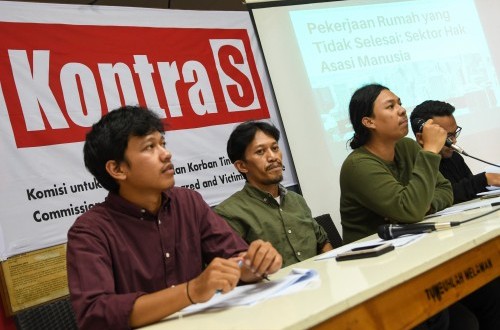
REPUBLIKA.CO.ID, JAKARTA – The Commission for the Disappeared and Victims of Violence (KontraS) has condemned the authorities’ actions in dispersing a discussion and group viewing of the documentary film Pesta Babi. KontraS views these actions as a violation of citizens’ freedom of expression guaranteed by the constitution.
KontraS Coordinator, Dimas Bagus Arya, who is also part of the Police Reform Coalition (RFP), stated that the expression conveyed in the film is a legitimate form of opinion that should be protected by the state.
“The expression in the film ‘Pesta Babi’ is a legitimate expression protected by the constitution and is part of efforts to educate the public or enlighten citizens,” Dimas said on Monday (11/5/2026).
According to him, the dispersal of the film screening activity demonstrates restrictions on civil space in society. Therefore, KontraS deems the authorities’ actions in the incident unjustifiable.
“Thus, this dispersal activity is certainly a violation of freedom of expression and the civil freedoms held by citizens,” he said.
Dimas emphasised that watching a documentary film is a pure form of citizen expression guaranteed by the constitution. Therefore, the state should provide protection, not carry out dispersals.
“We also convey that the process of citizens’ expression through watching the film ‘Pesta Babi’ is a pure expression, an expression protected by the constitution, and therefore should be protected by the state, not dispersed,” he said.
KontraS also condemned the involvement of police and TNI members in the dispersal of the activity. According to Dimas, the action is considered excessive and shows a political situation that instils fear in society.
“We strongly condemn the dispersal actions by the police and TNI members in the ‘Pesta Babi’ film. Because in our view, this is an excessive action that further reinforces that today there is a political situation of fear being carried out by those in power or the ruling regime,” he said in conclusion.
Previously, several TNI personnel were reported to have dispersed a group viewing (nobar) event of the film Pesta Babi in Ternate, North Maluku, on Friday (8/5/2026). The dispersal was carried out directly by the Commander of Military District 1501/Ternate, Colonel Inf Jani Setiadi.
In an Instagram post from the account @wachtdoc_insta, Jani admitted to monitoring social media regarding the many rejections of the film by Dandhy Laksono and Cypri Dale. The film, which tells the story of the indigenous Papuan people’s struggle, is considered provocative.
“What I highlighted was the provocative title. The provocative banner. That’s all,” he said when stopping the screening held at Benteng Oranje in Ternate.
In the explanation, it was stated that the nobar activity was ultimately dispersed by the TNI. The reason for the dispersal was cited as an effort to maintain conduciveness.
National Human Rights Commission (Komnas HAM) Chair, Anis Hidayah, stated that the film is part of artistic work that cannot be separated from freedom of expression. The nobar activity is also seen as part of freedom of opinion and expression.
“It should not have been dispersed, and the government does not need to be reactive, and in this case, the TNI has no authority to disperse the public who are holding a nobar, and usually after nobar there is a discussion,” she said to reporters on Sunday (10/5/2026).
According to her, the TNI’s action in dispersing the nobar activity is a desecration of democracy. Because all such activities are considered protected by the constitution.
“Things like this should not happen; society must have a safe space to watch films, to discuss, because that is part of the rights guaranteed in the constitution,” she said.
Pesta Babi is known as a documentary film by Dandhy Laksono and Cypri Dale that discusses indigenous land conflicts and environmental damage in South Papua. The film highlights indigenous resistance against major government and corporate projects.