
KONI Launches Sports Intelligence Book, Marciano Urges Data and AI Revolution for Performance
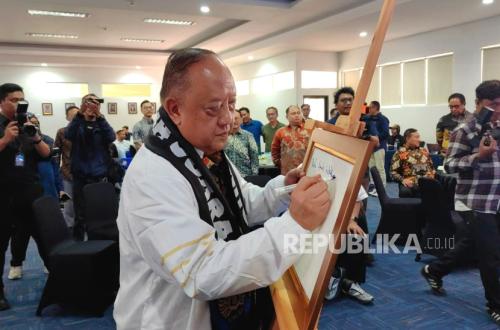
The Central Board of the Indonesian National Sports Committee (KONI Pusat) officially launched the Sports Intelligence book as a strategic guide for developing national sports performance. The launch was marked by a book review held by Surabaya State University (UNESA) at the Auditorium of the Faculty of Sports Science and Health (FIKK), Surabaya, on Tuesday (7/7/2026). KONI Pusat Chairman Marciano Norman, who attended as the keynote speaker, began his presentation by expressing appreciation to UNESA Rector Prof. Nurhasan and his staff for their support and the campus’s openness, which made the book review possible. The Sports Intelligence book is the brainchild of Marciano Norman, compiled together with four authors: Eman Sungkowo, Syarif Hidayat, Jerry Indrawan, and Irandito Abdul Hakim Malik. Marciano explained that the idea for the book originated when he first served as Chairman of KONI Pusat in 2019. At that time, he often stated that the media plays an important role as part of sports intelligence because it has a wide network for gathering various information needed for national sports development. ‘I took the initiative to combine the concept of intelligence with sports, thus giving birth to the sports intelligence division at KONI Pusat and, of course, this Sports Intelligence book,’ said Marciano, who also served as Head of the State Intelligence Agency (BIN) from 2011 to 2015. According to him, the book is not only academic literature but also a strategic guide for the future of Indonesian sports performance. Marciano assessed that modern sports competition is no longer solely determined by the physical ability of athletes on the field, but also by intelligence in managing data, information, and strategy. He explained that technological developments have transformed sports into a data-based competition. Therefore, Sports Intelligence is expected to be a bridge between the sports science approach and the utilisation of digital technology such as artificial intelligence (AI) and big data. In its implementation, Marciano emphasised that KONI Pusat, together with regional KONI offices and national sports federations, will be the operational backbone in applying this concept to support the improvement of Indonesian sports achievements towards ‘Indonesia Emas’ and to support the fourth Asta Cita of President Prabowo Subianto. The activity report was previously delivered by UNESA Rector Nurhasan, represented by Vice Rector IV and Chairman of the East Java Provincial Board of the Indonesian Petanque Sports Federation (FOPI), Dwi Cahyo Kartiko. He said the book launch took place on a special momentum, namely 7 July 2026, coinciding with the 7th day of the 7th month of 2026. According to Cahyo, the spirit promoted in Sports Intelligence is in line with UNESA’s vision of developing innovation-based science. ‘Hopefully, this work will become an important reference for academics, policymakers, and all Indonesian sports stakeholders,’ he said. On the same occasion, KONI Pusat and UNESA also renewed their cooperation through the signing of a memorandum of understanding. During the book review session, the Head of the Writing Team and Head of the Sports Intelligence Division at KONI Pusat, Eman Sungkowo, explained that sports intelligence is the utilisation of strategic information that enables athletes and coaches to understand the strengths, weaknesses, and patterns of opponents through accurate information. Meanwhile, one of the authors, Syarif Hidayat, stressed that the Sports Intelligence concept will only be beneficial if implemented in policies gradually with the support of relevant data. Another author, Jerry Indrawan, explained the importance of building an integrated national sports data ecosystem. According to him, all sports data should ideally be collected in one system so that it can be utilised by the Ministry of Youth and Sports as the policymaker, KONI as the implementer, and the national sports federations as the spearhead of athlete development. He also emphasised the strategic role of regional KONI offices and universities in strengthening athlete development, as the quality of regional training is the foundation of national sports achievement. The book, which spans over 500 pages and consists of 12 chapters, also positions KONI as the main aggregator of national sports data, a hub for central and regional synergy, and one of the pillars of the 2021-2045 National Sports Grand Design. The series of events concluded with the reading of the Indonesian Sports Intelligence Declaration led by Prof. Nurhasan and followed by all participants, including students. The declaration is expected to serve as a shared commitment to optimising the implementation of Sports Intelligence to improve Indonesia’s sports achievements in the future.