
Komnas HAM Urges Resolution of Gross Human Rights Violations Through Courts
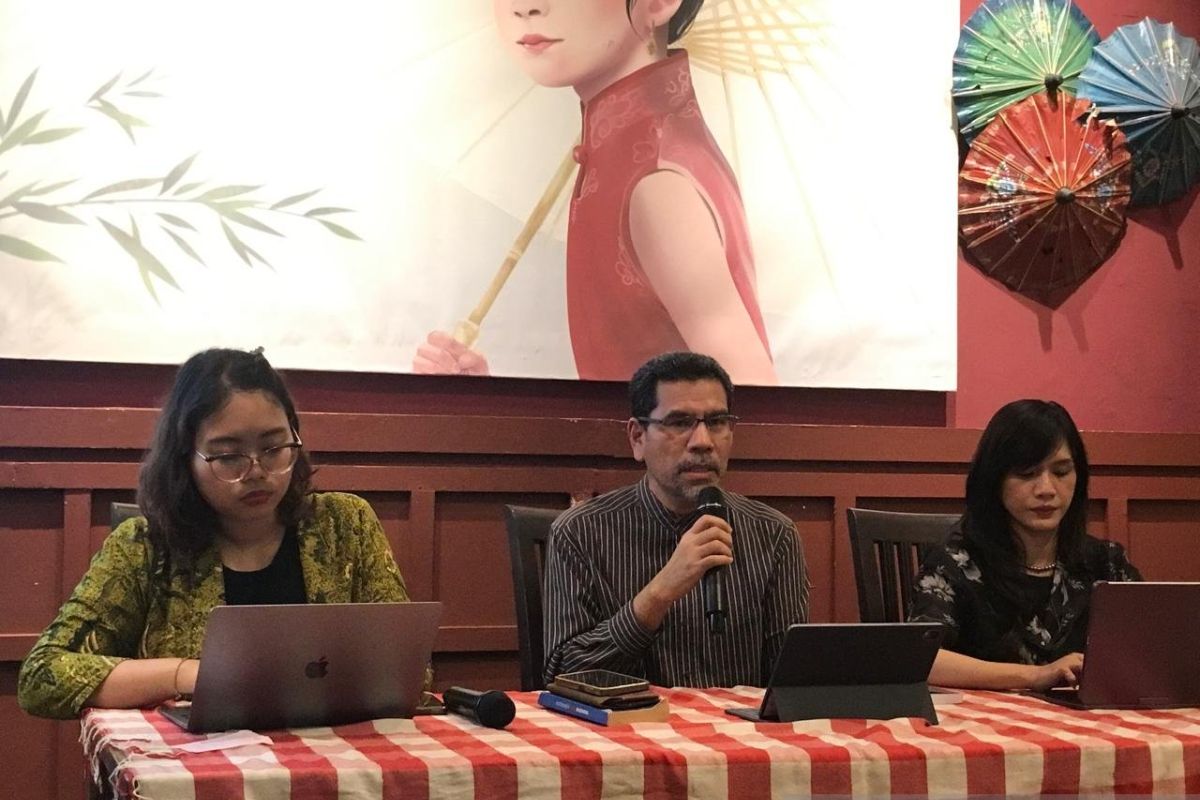
Jakarta (ANTARA) - Amiruddin Al Rahab, a member of the National Commission on Human Rights (Komnas HAM), is urging the resolution of gross human rights violation cases through the judicial process, alongside continued efforts to provide recovery for victims.
During a discussion titled “Human Rights Court: An Agenda Awaited by Victims” in Jakarta on Thursday, Amiruddin stated that Komnas HAM has completed investigations into 17 incidents of gross human rights violations or crimes against humanity occurring between 196lar5 and 2014, spanning from Aceh to Papua.
According to him, the subsequent stages involve investigation and prosecution, which fall under the authority of the Attorney General’s Office before cases can be heard in court.
“Whether or not the issue of gross human rights violations is resolved, the initial process has been completed by Komnas HAM. The final resolution is determined by the judge’s gavel. However, judges can never preside over trials because the Attorney General never conducts investigations and prosecutions,” said Amiruddin.
He assessed that non-judicial handling should not halt the legal process. He noted that the government’s 2022 policy regarding non-judicial resolution was intended for victim recovery.
“President Jokowi’s Presidential Instruction regarding non-judicial measures must be read in a context that does not aim to stop the Human Rights Court. If anyone interprets it as a means to stop it, that is a major error,” he said.
Amiruddin stated that victims are still awaiting certainty regarding justice for these cases. He added that the legal process is essential to ensure accountability and to prevent the recurrence of similar violations.
“If in a country a criminal act is declared a crime, but no legal process is carried out, it is equivalent to either allowing it to happen or providing an opportunity for it to recur,” he remarked.
Eko Riyadi, a lecturer at the Faculty of Law, Universitas Islam Indonesia (UII), stated that resolving gross human rights violations faces both normative problems and strong political dimensions. He noted that the process of establishing Human Rights Courts often revolves around several stages, ranging from DPR (Parliament) recommendations and investigations by the Attorney General to the issuance of Presidential Decrees for ad hoc Human Rights Courts.
“We are circling within four boxes: the recommendation from the DPR, the investigation by the Attorney General, the Presidential Decree on the formation of an ad hoc court, and the establishment of the ad hoc court itself. This is what causes the back-and-forth,” said Eko.
He argued that public advocacy remains necessary to push for case resolutions, while victim recovery is also urgent given that many victims are elderly and facing critical health conditions.
“The formation of a resolution team that produced recommendations for the President at that time does not seem to have increased the victims’ sense of relief. Their recovery process is very important, as many are aging and their conditions are becoming critical,” Eko added.
Meanwhile, Jane Rosalina Rumpia, Head of the Impunity Monitoring Division at KontraS, assessed that regulatory issues and law enforcement mechanisms still hinder the resolution of gross human rights violation cases. She highlighted Law Number 26 of 2000 concerning Human Rights Courts, specifically regarding the application of the concept of command responsibility, which she believes can narrow the scope of legal accountability.
“The lack of clarity in this norm and the inaccurate translation of the concept of command responsibility is one of the factors that weakens accountability and creates space for impunity within the Law 26/2000 regulation,” said Jane.
Jane also pointed out that the handling of cases is often hindered by failures to meet material and formal requirements, as well as administrative reasons. She stated that these material and formal obstacles result in cases not proceeding to either the Human Rights Court or ad hoc Human Rights Courts. She emphasised that strengthening accountability mechanisms is necessary so that the handling of gross human rights violations does not stop at victim recovery but also provides legal certainty for the investigated events.
Source: jawawa.id (https://jawawa.id/newsitem/komnas-ham-urges-resolution-of-gross-human-rights-violations-through-courts-1790251313)
Originally published by Antara (Indonesian) (https://www.antaranews.com/berita/5756952/komnas-ham-dorong-penuntasan-pelanggaran-ham-berat-lewat-pengadilan), translated from Indonesian