
Komling: Door-to-Door Organic Waste Collection in South Jakarta Alleys
April 2026 marks a turning point for the waste management system in DKI Jakarta. Through Gubernatorial Regulation (Ingub) Number 5 of 2026, the Jakarta Provincial Government has mandated that residents sort waste at the source, which includes the independent management of organic waste.
For most people, organic waste is synonymous with unpleasant odours. Managing it can seem cumbersome, especially amidst the busy lives of city dwellers and the lack of available space for storage.
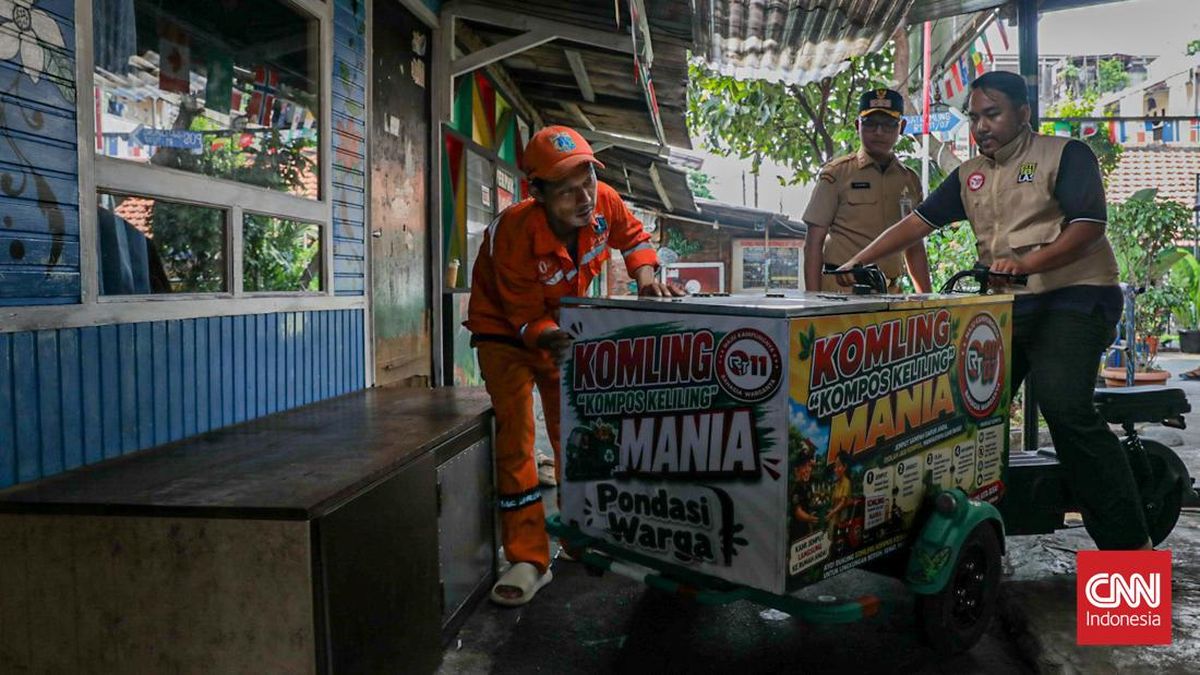
Recognising these challenges, Imam Basori, the head of RT 11 RW 7 in Gandaria Utara, Kebayoran Baru, South Jakarta, decided to launch a programme to collect organic waste directly from homes. He calls this activity ‘Komling’, short for ‘Kompos Keliling’ (Mobile Composting).
“We are tackling the problem at the upstream level, from house to house, through the alleys, by taking a proactive approach. We go door-to-door to communicate with the community and educate them on waste sorting,” said Imam Basori, known as Ibas, during a visit by CNNIndonesia.com.
To provide context, the neighbourhood led by Ibas is a densely populated area where houses are tightly packed. The alleys are narrow, only wide enough for about two motorcycles to pass.
Despite this, the atmosphere in this neighbourhood is cool, green, and vibrant. Upon entering the alley, visitors are greeted by murals on the walls depicting Indonesian and Betawi culture, alongside infographics regarding neighbourhood programmes.
Furthermore, the alleys are lined with rows of plants arranged in tiered structures. Further into the alley, there is an open space serving as a community security post (satkamling) and a gathering spot for residents. This area features a whiteboard, a reading corner with books, and tools for smart composting and independent composters.
Rotating Duty Shifts
Ibas explained that the Komling activity is a pillar of the environmental component within the ‘Bangjali’ (Bareng Jaga Lingkungan—Together We Guard the Environment) innovation in RT 11 RW 7 Gandaria Utara.
He noted that Komling was born from the desire to address organic waste issues despite the limited space available for traditional composting pits (Teba).
“In a densely populated environment like this, we don’t have the space to build Teba. Therefore, we adopted a technological approach. In this way, we can transform organic waste directly into compost,” he said.
Every day, a resident is assigned a duty shift for the Komling programme. At 5:00 PM, the Komling team patrols using an electric cart equipped with a composter, a portable generator, and a loudspeaker.
“The Komling duty is similar to the community security duty. It rotates daily. Each team consists of a person in charge and approximately eight members,” he added.
After the waste is collected from residents, the Komling composter can convert it into compost within just six hours.
Capacity and Jingles
If the volume of organic waste on a given day exceeds the Komling’s capacity, it is stored in ‘Koma’ (independent composters). According to Ibas, these independent composters can hold at least 100 kilograms of organic waste.
The resulting compost is used as growing media to support local food security. Residents utilise this compost to cultivate tomatoes, chillies, and spinach.
Ibas explained that the ‘door-to-door’ method was intentionally chosen to ensure every house is visited and informed. “By going door-to-door, we discovered many things. Initially, during the first three weeks, many residents did not understand how to sort waste. Through this proactive technique, we were able to provide immediate education and practical demonstrations,” he explained.
Beyond just collecting waste, Ibas admitted they use engaging methods to educate residents. This includes socialisation and discussions during routine community meetings, placing stickers on the carts, organising waste-sorting competitions, and even creating their own jingle. The promotional jingle is played through loudspeakers as the Komling cart passes, serving as a ‘signal’ for residents to prepare their organic waste.
“Mobile compost mania / Clean village, no trouble / Residents pour it in, even cooler / In the morning, the brother smiles / The mothers are all present / Kitchen waste, sorted neatly / So that the week becomes cleaner,” is a snippet from the jingle created by Ibas and his team to enliven the Komling cart.
Arief (23), a local resident, expressed his enthusiasm for the Komling initiative in his neighbourhood.
“As a resident, I am very enthusiastic about this innovation. It makes it much easier for us to dispose of organic waste or bottles. With this system, residents do not litter,” Arief told CNNIndonesia.com in September.
Arief, who is also part of the local Youth Organisation (Karang Taruna), has been volunteering for the Komling programme for the past few months.
“The Komling operation starts at 5:00 PM. Every day at 5:00 PM, we patrol. As a volunteer, I mainly guide the duty shifts. If I am busy with other activities, the residents handle it themselves,” said Arief.
“Even if the men cannot take their shift one day, it can be replaced by the women and children. Sometimes the children even help out. They learn which is organic waste, which is inorganic, and which cannot be recycled,” he added.
Source: jawawa.id (https://jawawa.id/newsitem/komling-door-to-door-organic-waste-collection-in-south-jakarta-alleys-1790236746)
Originally published by CNN Indonesia (https://www.cnnindonesia.com/nasional/20260922040332-20-1406567/komling-penjemput-sampah-organik-rumah-ke-rumah-dalam-gang-di-jaksel), translated from Indonesian