
Komdigi Strengthens Social Media Task Forces to Boost Public Participation in Health Programmes
BREBES – The accurate dissemination of health information through social media is considered important for increasing public participation in government programmes. The Ministry of Communication and Digital Affairs (Komdigi) is encouraging local-government Social Media Task Forces (Satgas Medsos) to communicate the Quick Best Results Programme (PHTC) in the health sector more actively, particularly its Free Health Check (CKG) initiative and tuberculosis (TB) control efforts.
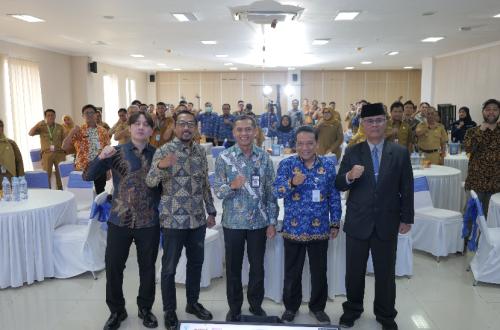
Strengthening the task forces’ role was the focus of a technical guidance session entitled “Optimising Social Media Task Forces to Make the Quick Best Results Programme (PHTC) in the Health Sector a Success”, held at the Integrated Government Office building in Brebes Regency, Central Java, on Tuesday (10 November 2026). The event, held both in person and online, brought together representatives of communications and informatics offices, health offices, local-government public communications teams and social media practitioners from Central Java, the Special Region of Yogyakarta and East Java.
Representing the Director of Institutional Communication Partnerships and Public Relations at Komdigi, Government Communications Institutions Team Leader Agus Tri Yuwono said social media task forces had a strategic role in connecting government programme information with the needs of the public. Government social media, he said, should be used for more than publicising activities or programme achievements.
The information shared must also build understanding and encourage people to take practical steps to protect their health. Marking Heroes’ Day, Agus likened government social media managers to modern-day fighters who contribute in the digital space.
“One well-judged post can encourage someone to get a health check and prompt neighbours or colleagues to take part in the Free Health Check,” Agus said.
He also urged the task forces to strengthen collaboration with religious and community leaders, members of the Family Welfare Movement (PKK) and local communities. Such partnerships are expected to broaden the reach of information about CKG and TB control.
Lilik Henry Ristanto, head of the Central Java Provincial Communications, Informatics and Digital Office, highlighted the importance of the government adapting to changes in the digital communications ecosystem. Evolving social media algorithms, media convergence, platform monetisation and the use of artificial intelligence (AI) require public communications to be managed more professionally, responsively, creatively and humanely.
Lilik said the speed of communication must be balanced with accuracy and credibility, particularly on public health issues. Social media task forces are also expected to monitor emerging issues, anticipate the spread of health misinformation and issue clarifications based on data and official sources.
The success of public communications, Lilik said, should not be measured solely by the volume of content published. More important is the extent to which the public understands the information being shared.
Strengthening the task forces’ role also requires an understanding of the substance of health programmes. During a presentation, Heri Purnomo, head of disease prevention and control at the Central Java Provincial Health Office, stressed that tackling TB requires the involvement of many parties, not just the health sector.
“Diseases, including tuberculosis, cannot be tackled by the health sector alone. We need a ‘total football’ strategy. That means everyone has to act,” Heri said.
Cross-sector collaboration is important to reinforce TB prevention, testing and treatment, while supporting the target of eliminating TB by 2030, Heri said. Social media task forces can help by sharing accurate health information in language that the public can understand.
In addition to guidance on health programmes, participants received training in digital communications strategy from Dann Rizky, a digital marketing lecturer and founder of The University Content Creator. Through presentations and practical content-planning exercises, participants learned how to turn government programme information into engaging, creative content suited to social media audiences.
The training is expected to help social media task forces plan communications more strategically and consistently. This would enable information about CKG and TB control not only to reach more people but also to encourage their involvement.
Komdigi hopes the event will help local-government social media task forces perform their public communications role more effectively. This includes strengthening health education, sharing credible information and addressing disinformation in the digital space.
With cross-sector collaboration and the right communications strategy, government social media is expected to serve as more than a channel for publicising programmes. Digital platforms can also help build understanding, raise awareness and mobilise public participation in support of the PHTC health programme.
Source: jawawa.id (https://jawawa.id/newsitem/komdigi-strengthens-social-media-task-forces-to-boost-public-participation-in-health-programmes-1794408770)
Originally published by Republika (https://news.republika.co.id/berita/tocdm6416/komdigi-perkuat-peran-satgas-medsos-dorong-partisipasi-masyarakat-dalam-program-kesehatan), translated from Indonesian