
KNKT reveals six contributing factors in Bekasi Timur train collision
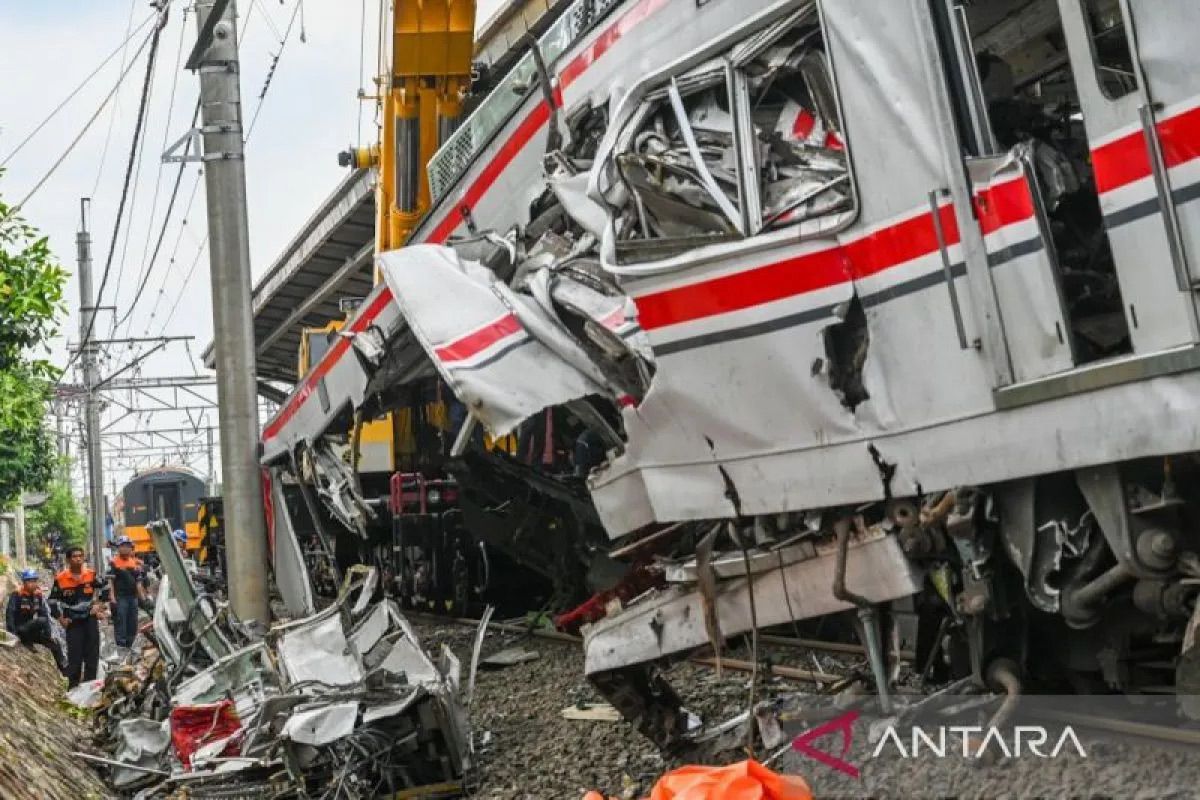
The National Transportation Safety Committee (KNKT) has revealed six factors that contributed to the collision between the Argo Bromo Anggrek and the Commuter Line in Bekasi Timur, Bekasi City, West Java, on 27 April, based on the results of an in-depth investigation.
“The contributing factors are actions, conditions, events, or a combination thereof which, if eliminated, avoided, or absent, would reduce the possibility of an accident or reduce the severity of the accident,” the KNKT report stated in Jakarta on Tuesday.
The KNKT concluded the first contributing factor was the failure to identify a hazardous signalling condition between Bekasi Station and Bekasi Timur Station. At the time of the accident, the 4B train was permitted to proceed directly from Track III of Bekasi Station through Exit Signal J12, which showed a green aspect, followed by Block Signal B104, which showed a red aspect because train 5568A was still present at Bekasi Timur Station (track 104BT).
Under these conditions, the driver of train 4B did not receive a signal showing a yellow aspect to provide information that the subsequent signal would show a red aspect. This condition was not identified during the design review and testing stages following the layout changes at Bekasi Station in 2021. In the 2022 design review documents, the signalling aspects were depicted in a signal-to-signal relationship without track occupancy status, meaning the differing behaviour of Exit Signal J12 relative to the occupancy status of tracks 104AT and/or 104BT was not illustrated. Because this was not documented, the condition went undetected from the design review and testing stages through to operations and the eventual accident.
Second, there were issues with communication during the emergency. The investigation found that when the driver of train 5181B contacted the South Train Movement Controller (PPKP Selatan) to report the collision at JPL 86, the call was made via an individual call using the PTT button on the microphone without pressing the emergency call button. Communication recordings showed that the clarification process regarding the condition of train 5181B and the affected tracks took 3 minutes and 20 seconds to be understood by the South Controller.
The investigation found audio output issues with train 5181B, including reverb, warbling, and relatively low volume because the distance between the sound source and the microphone exceeded the recommended distance in the Radio Tait TM9000 Operational Instructions. This reduced the audibility of the audio from train 5181B, affecting the South Controller’s ability to receive information. Furthermore, current procedures do not regulate standard terminology (phraseology) or the structure for delivering emergency information from drivers to controllers. The use of individual rather than emergency calls, combined with poor audibility and lack of standardised procedures, increased the duration of information delivery and affected the controller’s ability to assess the level of urgency, thereby impacting decisions regarding train control.
Third, there was a communication failure regarding train 5568A. Information that train 556larA was held at Bekasi Timur Station due to a crowd of people was not conveyed to the South Controller, as they were busy handling the incident at JPL 86. The driver of train 5568A contacted the South Controller via an individual call rather than an emergency call, meaning no emergency notification appeared on the radio console. Consequently, neither the South nor the East Controller received information regarding the disruption at Bekasi Timur, leaving them without adequate information to make appropriate control decisions.
Fourth, there was no mechanism for information sharing between the South and East Controllers. The investigation found no procedure regulating the exchange of information between these two controllers. In this incident, the East Controller only learned of the accident at JPL 86 by overhearing the communication between the South Controller and train 5181B, but did not receive full details regarding the surrounding situation. This led to inaccurate information and commands being issued by the East Controller to train 4B, leaving the driver without sufficient information to take appropriate action.
Fifth, there was a failure to identify the UB104 auxiliary signal aspect. The understanding held by the driver and assistant driver of train 4B, after passing the green aspect at Exit Signal J12 of Bekasi Station, influenced their attention allocation. Given the understanding that the next signal would still permit movement and the lack of a scheduled stop until Cirebon Station, the crew’s attention was primarily focused on information supporting that understanding. As a result, the aspect shown by the UB104 auxiliary signal potentially failed to capture the crew’s attention, meaning the signal aspect differing from their initial understanding went unanticipated.
Source: jawawa.id (https://jawawa.id/newsitem/knkt-reveals-six-contributing-factors-in-bekasi-timur-train-collision-1790654270)
Originally published by Antara (Indonesian) (https://www.antaranews.com/berita/5762587/knkt-ungkap-enam-faktor-pemicu-tabrakan-ka-di-bekasi-timur), translated from Indonesian