
KNKT Report Reveals Communication Chaos Before Fatal Train Collision
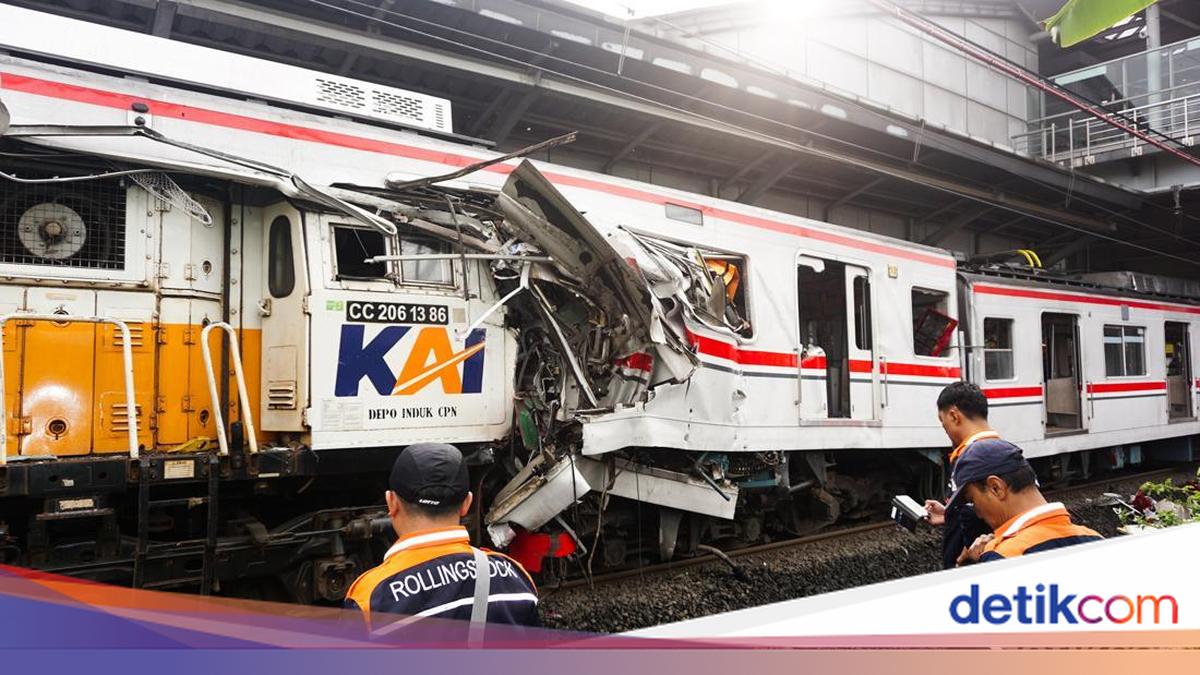
The National Transportation Safety Committee (KNKS) has revealed a breakdown in communication prior to the collision between the Anggrek train (formerly Argo Bromo Anggrek) and a Commuter Line service at Bekasi Timur Station, which resulted in 16 deaths. The KNKT identified various issues in communication leading up to the accident.
The report details the chronology of the accident between train 4B Argo Bromo Anggrek and Commuter Line 5568A on Track 1 at Bekasi Timur Station on 27 April 2026, at 20:52 WIB. The accident left 123 victims, including 107 injured and 16 fatalities.
The KNKT identified six contributing factors to the accident, noting that these findings are not intended to assign administrative, civil, or criminal liability. “The identification of contributing factors is not intended to establish fault or responsibility… The factors are arranged chronologically and do not indicate the level of contribution to the accident,” the KNKT stated.
One of the primary contributing factors was communication issues. The KNKT detailed the chaos that occurred moments before the crash, specifically regarding the driver of train 5181B, which had been involved in a collision with an electric taxi.
The driver contacted the Southern Train Dispatcher (PPKP Selatan) via an individual call rather than using the emergency button. According to the KNKT, the process of clarifying the condition of train 5181B and the affected tracks took 3 minutes and 20 seconds to be understood by the dispatcher.
Under the Standard Operating Procedures (SOP) for the Jabodetabek Commuter Line, a collision between a train and a motor vehicle is classified as an emergency. The KNKT also noted that a crowd gathering on Jalan Ampera constituted an emergency, which led the driver of train 5568A to decide not to continue the journey.
Technical issues were also found, specifically regarding the audio on train 5181B. The volume was relatively low because the sound source was too far from the microphone, reducing audibility and hindering the dispatcher’s ability to receive information. Furthermore, existing procedures did not regulate standardised terminology (phraseology) or the structure for delivering emergency information from drivers to dispatchers, which increased the duration of information delivery.
These communication failures impacted the Southern Dispatcher’s ability to assess the level of urgency, affecting decisions regarding train control during the incident.
There was also a failure to communicate that train 5568A was held at Bekasi Timur Station due to the crowd. This information did not reach the dispatchers because the Southern Dispatcher was preoccupied with the accident involving the electric taxi. Because the driver used an individual call instead of the emergency button, no emergency notification appeared on the radio console.
As a result, neither the Southern nor the Eastern Dispatcher received information regarding the service disruption at Bekasi Timur Station, leaving them without adequate information to make appropriate control decisions.
Additionally, the KNKT noted a lack of a mechanism for information sharing between the Southern and Eastern Dispatchers. While the Eastern Dispatcher controls the eastern region, they cannot communicate directly with Commuter Line trains, necessitating the use of the Southern Dispatcher as an intermediary. The investigation found no established procedure for the mechanism of information transfer between these two dispatch units.