
KNKT Releases Final Investigation Report on Bekasi Timur Train Collision
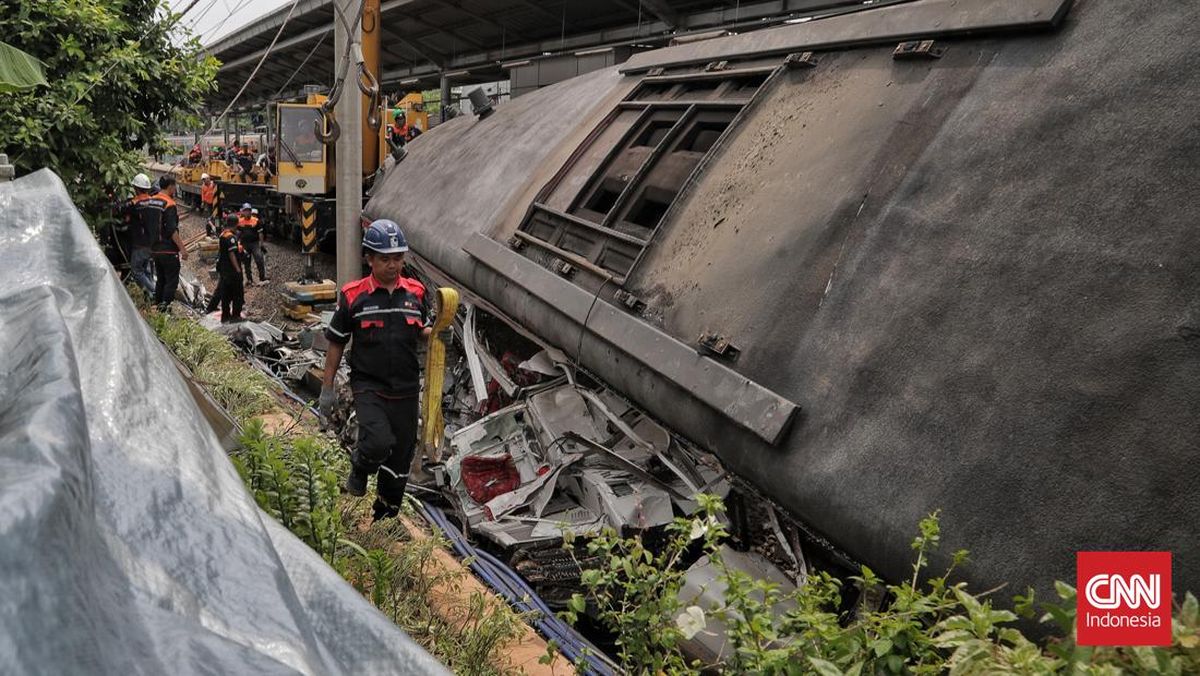
The National Transportation Safety Committee (KNKT) has revealed the results of its final investigation into the collision between the KA 4B Argo Bromo Anggrek and the KA 5568A Commuter Line in Bekasi Timur, which occurred on Monday, 27 April 2026.
The KNKT released several findings and the final investigation results on Monday (28/9).
Chronology of the Incident
“On 2lag 27 April 2026, at 20:52:12 WIB, a collision occurred between KA 4B Argo Bromo Anggrek (hereinafter referred to as KA 4B) and KA 5568A Commuter Line (hereinafter referred to as KA 5568A) on Track I, Bekasi Timur Station, Daop 1 Jakarta,” the KNKT stated at the beginning of its report.
According to the KNKT, prior to the collision between KA 4B and KA 5568A, there had been an accident involving the KA 5181B Commuter Line (Cikarang - Angke route) travelling from Tambun Station towards Bekasi Timur Station, involving an electric taxi at Level Crossing (JPL) 86, Jl. Ampera, at 20:48:24 WIB.
Subsequently, at 20:49:19 WIB, KA 5568A resumed movement approximately 1.69 metres from Track I, Bekasi Timur Station, towards Tambun Station. However, the train stopped again at 20:49:24 WIB because the driver observed a crowd of people on the upstream track.
“At 20:50:43 WIB, KA 4B proceeded directly on Track III, Bekasi Station, and at 20:52:12 WIB, a collision occurred between KA 4B and KA 5568A on Track I (upstream) of Bekasi Timur Station,” the KNKT explained.
Trigger Factors for the Collision
The KNKT detailed six factors that contributed to this train collision.
The first factor related to the failure to identify hazardous signalling conditions between Bekasi Station and Bekasi Timur Station. This occurred because, during the accident, KA 4B passed through an exit signal showing a green aspect, which was immediately followed by a red aspect.
“The driver of KA 4B did not receive a signal indicating a yellow aspect to provide information that the subsequent signal would show a red aspect,” the KNKT stated.
Secondly, a contributing factor was the presence of communication issues during the emergency. This occurred when KA 5181B failed to make an emergency call, and there was a lack of specific terminology and structured information delivery regarding the emergency situation to the South PPKP (Train Controller).
Thirdly, the KNKT noted a communication failure regarding KA 5568A. The fact that KA 5568A was held back due to the crowd was not communicated to the South PPKP, as the South PPKP was busy handling the accident at JPL 86 and calls were being made via individual lines.
The fourth factor was the lack of an information transfer mechanism between the South PPKP and East PPKP. The East PPKP reportedly did not receive complete information regarding the surrounding situation, which resulted in a lack of information being provided to the driver of KA 4B.
Fifth, there was a failure to identify the UB 104 Auxiliary Signal aspect.
“A combination of the understanding of signalling behaviour, reduced visibility of the UB104 Auxiliary Signal at night, and light scattering on the locomotive windshield reduced the effectiveness of the UB104 Auxiliary Signal in extending the visibility of the B104 Block Signal,” the KNKT explained.
Finally, the KNKT reported the absence of emergency braking procedures for high speeds on curved tracks. The lack of tactical guidelines for emergency braking when a train is at high speed on a curve ultimately left the tactics dependent on the driver’s subjective judgement.
Impact of the Accident
The collision directly impacted 123 people, with 16 fatalities and 107 injuries. The accident also affected railway rolling stock and infrastructure. Other train operations were also impacted by cancellations, shortened routes, and delays.
Recommendations
The KNKT formulated several recommendations for various parties, namely the Directorate General of Railways, PT Kereta Api Indonesia (Persero), and PT Kereta Commuter Indonesia.
There are eight points of recommendation provided to the Director General of Railways, which include re-evaluating the railway signalling system and ensuring standardised phraseology and communication structures during emergencies.
Meanwhile, six points of recommendation were given to PT KAI. These include evaluating the procedures for using communication equipment in the driver’s cabin, improving emergency communication training, and developing emergency braking procedures.
Additionally, three points of recommendation were provided to PT KCI, consisting of standardising time references, developing standardised phraseology and communication structures—particularly during emergencies—and evaluating and improving communication training.
Source: jawawa.id (https://jawawa.id/newsitem/knkt-releases-final-investigation-report-on-bekasi-timur-train-collision-1790607364)
Originally published by CNN Indonesia (https://www.cnnindonesia.com/nasional/20260928203701-20-1409221/knkt-rilis-investigasi-akhir-penyebab-tabrakan-kereta-di-bekasi-timur), translated from Indonesian