
KNKT Findings Ahead of Fatal Collision: Complex KA and KRL Communication Channels
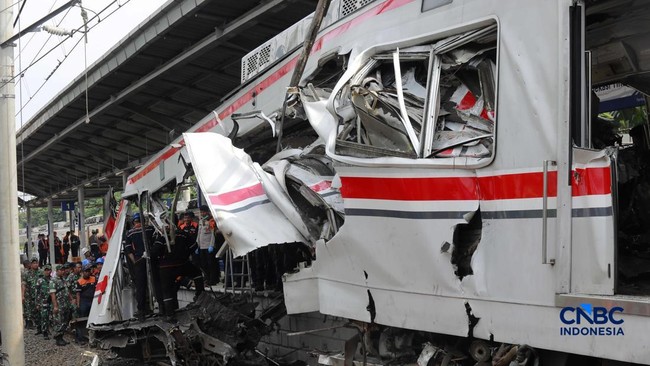
Jakarta, CNBC Indonesia – The National Transportation Safety Committee (KNKT) has begun to uncover the causes of the collision between the Argo Bromo Anggrek train and the Commuter Line at Bekasi Timur Station on 27 April 2026, which left 16 people dead. One focus of KNKT is the complexity of communications between Control Centres (PK).
This is the initial investigation result announced by KNKT before the DPR’s Commission V. The full investigation results into the collision between Argo Bromo Anggrek and the KRL will be announced in three months’ time.
KNKT Chairman Soerjanto Tjahjono revealed there was a miscommunication between the train operation controllers/Control Centre (PK). In addition, the communications system was considered overly convoluted.
‘The communications system of the Railway Operational Control Centre (PK) is too convoluted. Train KA 5568A uses a Sepura radio and is in the S.27 (South PK) communications area. Meanwhile, KA 4B Argo Bromo Anggrek uses locomotive radio and is in the S.1 (East PK) communications area. This creates too long a delay because the South PK must inform the Chief, who then forwards the information to the East PK. This needs to be improved,’ he said during a briefing at a hearing with DPR Commission V, Thursday (21/5/2026).
He said PK did not know the actual conditions at Bekasi Station, noting that the communication was via voice radio.
‘We received a report from the engineer of Argo Bromo Anggrek that he had to brake from a distance of 1.3 km after receiving information that there was an obstruction ahead from the KRL. The engineer attempted to brake. But PK did not know the actual conditions around Bekasi Timur Station, because communication is only conveyed by voice, via the cabin radio. So PK did not know the actual conditions, but they only reported that there was an obstruction, and the engineer had tried to brake,’ he explained.
Next, there were further reasons for miscommunication between Bekasi Station PK and the engineer of Argo Bromo Anggrek, where the engineer was told by PK to brake gradually rather than fully braking, which made a collision unavoidable.
‘Information from PK Timur indicates that KA 4B Argo Bromo Anggrek was only instructed to brake gradually and to sound horn 35 more times, and the status of the upstream and downstream track was not yet obtained from the line authorities regarding the clearance space (prepal),’ he said.
Soerjanto explained that KA 4B Argo Bromo Anggrek had actually performed emergency braking when passing the block signal before Bekasi Timur Station. But because PK only instructed the driver of KA 4B to brake gradually, the collision could not be avoided.
‘Data from the data logger shows that KA 4B Argo Bromo Anggrek performed emergency brake and independent brake 300 metres from the block signal before Bekasi Timur Station. The collision occurred at a speed of 40-60 km/h,’ he concluded.
(wur/wur) Add as a preferred source on Google [Gambas:Video CNBC]