
KNEKS Urges Integration of the Sharia Economy into Regional Development by Strengthening KDEKS Banten
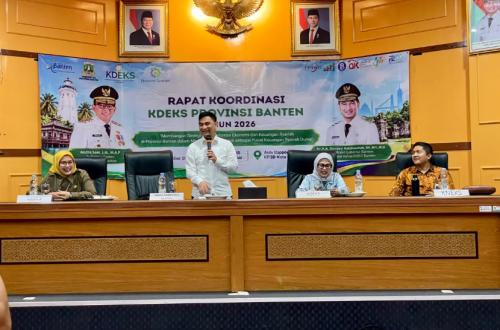
SERANG – The National Committee for Sharia Economy and Finance (KNEKS) is urging the Banten Provincial Government and the Regional Committee for Sharia Economy and Finance (KDEKS) to integrate sharia economy and finance development programmes into regional development planning. The move is considered important to strengthen the sharia economy’s contribution to the regional economy and support Indonesia’s ambition to become a global sharia economy and finance centre.
The recommendation was delivered by Sutan Emir Hidayat, Director of Sharia Ecosystem Infrastructure at the KNEKS Executive Management, while speaking at the 2026 Banten Province KDEKS Coordination Meeting at the Banten Provincial Development Planning Agency (Bappeda) Hall on Tuesday (3 November). The meeting, themed “Building Synergy and Collaboration in the Sharia Economy and Finance in Banten Province to Support Indonesia as a Global Sharia Finance Centre”, was held to align programmes and strengthen collaboration among stakeholders.
In a presentation entitled “Developing the Sharia Economy and Finance in the Regions”, Sutan Emir said the sharia economy had become part of the global economic mainstream and was no longer confined to a niche market. Given Indonesia’s potential, he said, the country needed to strengthen its sharia economy and finance ecosystem in an integrated way, from the national to the regional level.
“Sharia economy development has become part of the national development agenda, as set out in the 2025–2045 National Long-Term Development Plan (RPJPN), the 2025–2029 National Medium-Term Development Plan (RPJMN), and Asta Cita. This policy alignment provides a basis for central and regional governments to make the sharia economy one of the sources of national economic growth,” Sutan Emir said.
He outlined five policy priorities for developing the sharia economy under the 2025–2029 RPJMN: strengthening the halal industry and halal micro, small and medium-sized enterprises (MSMEs); boosting halal exports and international sharia economy cooperation; strengthening the halal ecosystem; strengthening Islamic finance; and strengthening sharia social funds. Implementing these priorities requires the support and involvement of various stakeholders, including regional governments.
In this context, Sutan Emir stressed KDEKS’s role as a navigator and catalyst for sharia economy and finance development in the regions. KDEKS is expected not only to serve as a coordination forum, but also to identify regional potential, set programme priorities, bring stakeholders together and promote measurable implementation.
One instrument KNEKS is promoting to strengthen implementation is the preparation of a Regional Action Plan (RAD) for Sharia Economy Development. Through the RAD, regional governments and stakeholders can set programme priorities, allocate responsibilities and establish performance indicators aligned with regional development planning documents.
These efforts are also supported by the Guide to Cross-Sector Collaboration among Regional Government Functions for Sharia Economy Development in the Regions, prepared by the Ministry of Home Affairs, KNEKS, the Ministry of National Development Planning (Bappenas) and Bank Indonesia. The guide provides a reference for regional governments to incorporate sharia economy programmes into planning and budgeting documents, including the Regional Medium-Term Development Plan (RPJMD), regional agency strategic plans, the Regional Government Work Plan (RKPD), agency work plans and regional budgets (APBD).
KNEKS is also encouraging the use of updated thematic sharia economy tags in the Regional Government Information System (SIPD). A total of 123 sub-activities have been identified across 12 government functions and the Regional Secretariat. This mapping can serve as a reference for regional governments seeking to integrate sharia economy development programmes into their development planning.
Sutan Emir set out four follow-up steps for KDEKS Banten. First, it should establish sharia economy outcome indicator targets in coordination with the regional government. Second, it should align sharia economy activities and sub-activities with those targets. Third, it should incorporate programmes run by regional agencies and non-government stakeholders into the RAD. Fourth, it should ensure that commitments to sharia economy development programmes are implemented through regular coordination among the Banten Provincial Government, KDEKS and KNEKS.
The regional sharia economy outcome indicators under consideration include the number of halal-certified products, Islamic banking assets as a share of gross regional domestic product (GRDP), and the National Zakat Index. These indicators are expected to help ensure that regional sharia economy programmes are well directed and deliver measurable results.
The coordination meeting was attended by KDEKS Banten Deputy Chair and Banten Deputy Governor Dr H Achmad Dimyati Natakusuma; Banten Provincial Assistant for General Administration Hj Rina Dewiyanti; KDEKS Banten Executive Chair Dr Hj Siti Ma’rifah; and KDEKS Banten elders and advisers Prof Dr Zakaria Syafei and K H Benyamin Hafidz.
Also present were Bank Indonesia’s Banten representative Sofwan Kurnia; acting head of the Banten Provincial Financial Services Authority (OJK) office Bondan Kusuma; head of the Banten Provincial Office of the Ministry of Religious Affairs Dr H Amrullah; head of Bappeda Banten H Babar Suharso; Banten Provincial BAZNAS chair Prof Wawan Wahyudin; and Banten Provincial Indonesian Ulema Council (MUI) chair Dr K H A Bazari Syam.
The meeting was also attended by KDEKS Banten Executive Director Prof Dr Euis Amalia, along with KDEKS officials and members, representatives of regencies and municipalities across Banten, leaders of Islamic financial institutions including BPJS Ketenagakerjaan, universities, business associations, Islamic community organisations, women’s organisations, religious scholars, Islamic boarding school leaders, and MSME and halal industry representatives.
Through the coordination meeting, KNEKS hopes to strengthen synergy among regional governments, KDEKS, regulators, financial institutions, academics and businesses. Integrating sharia economy programmes into regional development planning is expected to accelerate the development of the sharia economy and finance ecosystem, while increasing its contribution to economic growth and public welfare in Banten Province.
Source: jawawa.id (https://jawawa.id/newsitem/kneks-urges-integration-of-the-sharia-economy-into-regional-development-by-strengthening-kdeks-banten-1793706867)
Originally published by Republika (https://halalhub.republika.co.id/berita/tnx9a8490/kneks-dorong-integrasi-ekonomi-syariah-dalam-pembangunan-daerah-melalui-penguatan-peran-kdeks-banten), translated from Indonesian