
KLH to Mitigate Climate Change on Central Java's North Coast
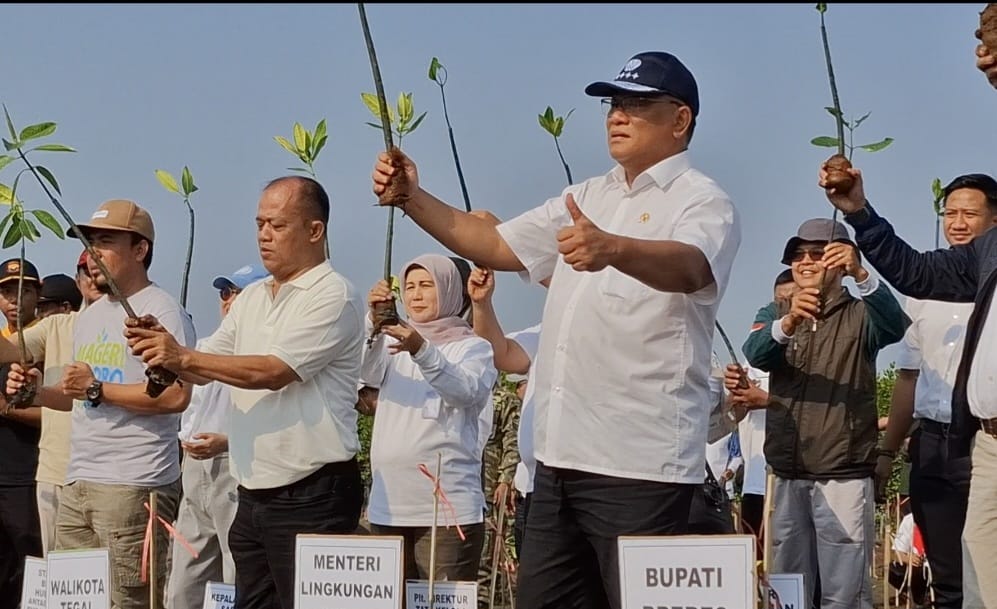
The Ministry of Environment (KLH) will take swift action to mitigate the impacts of climate change and the threat of abrasion in the North Coast (Pantura) region of Central Java. This commitment involves real action engaging all elements of society.
This was conveyed by Minister of Environment Muhammad Jumhur Hidayat after planting mangrove trees at Randusangan Indah (Parin) Beach, in Randusanga Kulon Village, Brebes District, Brebes Regency, Central Java, on Friday (3/7). The collaborative mangrove seedling planting between the Ministry of Environment, the Brebes Regency Government, and Harkat Nation University (UHN) Tegal also served as the launch of the Brebes ASRI Movement, symbolising coastal ecosystem restoration. “Coastal ecosystem preservation is one of the important pillars in the national environmental management strategy,” Jumhur stated.
Jumhur also highlighted the strategic role of mangrove forests. Besides functioning as a natural barrier against abrasion, these plants have an extraordinary ability to absorb carbon emissions. “Mangroves can also absorb carbon emissions, with a capacity four times greater than other types of forests,” Jumhur explained.
According to Jumhur, based on Ministry of Environment data, out of a total of 3.4 million hectares of mangrove forests in Indonesia, around 30 percent, or the equivalent of 770,000 hectares, are currently in a damaged condition. The government hopes this programme can be replicated massively to pursue global emission reduction targets. “Including to respond to the high vulnerability of the Central Java region, especially Semarang and other Pantura areas,” Jumhur added.
Jumhur added that although plans for the construction of a giant sea wall remain in place, the process is considered to take a long time. Therefore, mangrove planting is a priority solution that must be optimised immediately. “Apart from the abrasion problem, the government is also formulating a new regulation to address land subsidence due to massive groundwater exploitation. This regulation will mandate the implementation of the water farming concept,” Jumhur explained. He continued that this policy targets offices, hotels, and large-scale groundwater users in urban areas. “Implementation will be carried out through the creation of biopore infiltration holes and tree planting so that water can reabsorb into the ground,” he concluded.
Rector of Harkat Nation University (UHN) Tegal, Sudirman Said, expressed the university’s readiness to participate in national and regional programmes. “UHN is committed to supporting the Ministry of Environment’s programme to plant mangrove trees, as well as supporting the Central Java Governor’s work programme known as the ‘Magari Segoro’ (fencing the sea) movement through mangrove planting,” Sudirman Said explained.
Brebes Deputy Regent Wurja appreciated the Minister of Environment’s visit to the region. The presence of the ministry’s leadership brought a very positive psychological impact for the local government and all levels of society. “Thank you for his presence, Mr Minister. His presence will give encouragement to all of us, and all the community,” Wurja said.