
KLH/BPLH Invites Youth to Explore MRT as a Solution to Urban Ecological Crisis
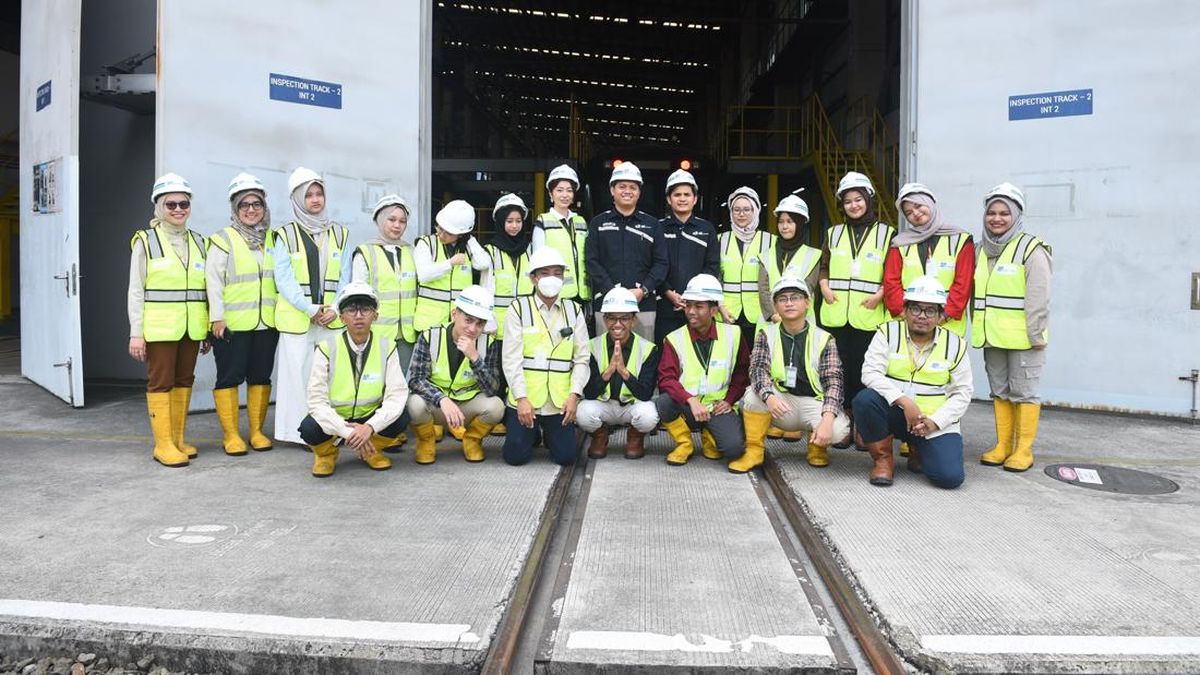
The Ministry of Environment/Environmental Control Agency (KLH/BPLH) held an experiential learning environmental education programme titled ‘Kenali Lingkungan Bareng Anak Muda’ (KELANA) Third Edition on Thursday (6/8). In this programme, 13 high school students from various schools in the Greater Jakarta area were invited to inspect the MRT Lebak Bulus Depot in South Jakarta and the underground construction area of the MRT Phase Two project at Silang Monas, Central Jakarta. The field visit aimed to deepen the younger generation’s understanding of the urgency of modern, low-emission, and sustainable transport as a tangible solution to overcoming the ecological crisis and urban congestion. This step reinforces the KLH/BPLH perspective that environmental control in urban areas requires the active involvement of young people who understand the link between modern transport infrastructure, carbon emission reduction, and environmentally sound spatial planning.
During the visit to the Lebak Bulus Depot, a facility for storing, maintaining, and operating the train sets, participants learned how MRT Jakarta operates as an environmentally friendly mass transport mode. The transport mode relies on overhead electric power supply and a modern Communication Based Train Control system, ensuring energy efficiency and producing no direct exhaust emissions in urban corridors. The presence of this high-performance public transport, with an on-time performance rate of over 99 percent, is a crucial representation of efforts to reduce private vehicle usage while making a real contribution to lowering greenhouse gas emissions in the capital. Head of Corporate Communication and Branding Department at PT MRT Jakarta (Perseroda), Angga Satria Perdana, explained that the MRT is a government-to-government cooperation between Japan and Indonesia, aiming to emulate Japan’s high standards and quality in railway transport management, including its discipline.
Head of the Communication, Information, and Education Working Group at the KLH/BPLH Public Relations Bureau, Romi Setiawan, explained that the visit to MRT Jakarta was designed so that young people could see firsthand the proof of sustainable development practices. Romi stated that KELANA aims to provide young people with direct experience of sustainable projects in Indonesia, with the MRT being one example. He noted that participants learn Jakarta has environmentally friendly and sustainable transport, which serves as a representation of public transport development in Indonesia.
Beyond electric technology and train operations, KLH/BPLH also introduced the concept of Transit-Oriented Development (TOD) applied by MRT Jakarta. The development of rail-based TOD areas acts as a catalyst for urban regeneration aligned with environmental sustainability principles, including reducing the urban carbon footprint by prioritising integration between mass public transport modes and pedestrian facilities, improving quality of life by providing public green open spaces and areas that are livable and lovable for the community, and building urban infrastructure that is resilient and responsive to disaster risks and the impacts of climate change. Through the visit to the MRT Phase Two construction area at Silang Monas, participants also saw firsthand how sustainable development principles are strictly applied in large-scale infrastructure projects.
Putri Indonesia Lingkungan 2026, Victoria Titisari Kosasieputri, who participated in the KELANA Third Edition programme, stressed the importance of real action by the younger generation in responding to the threat of global climate change. She said programmes like KELANA are very important because the young generation must be encouraged to care about the environment and sustainability, as the climate crisis and global warming require immediate action.
Through the special theme ‘KELANA Java Overtrip’, participants’ understanding of sustainable public transport was also linked to broader urban ecological challenges, including waste management issues that still require serious attention. Participants were equipped with communication skills to process their field experiences from MRT Jakarta managers and environmentalists into educational digital content. Sheikha Lana, a KELANA programme participant from SMA Negeri 1 Depok, shared that she could create content and share with friends how the younger generation can manage waste towards a cleaner Indonesia in the future. Through the KELANA programme, KLH/BPLH hopes the younger generation will not only understand the importance of switching to environmentally friendly public transport like the MRT but also become active agents of change who communicate a culture of sustainable living in society.