
KLH Addresses Air Quality and Forest Fire Threat During Dry Season
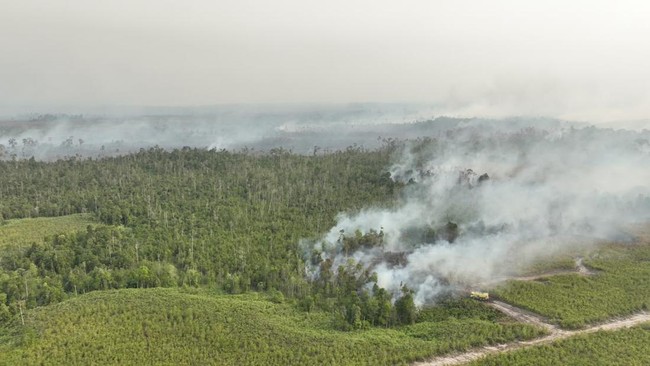
The Ministry of Environment/Environmental Control Agency (KLH/BPLH) has expressed deep concern to all levels of society currently affected by declining air quality due to the potential for land fires in this dry season.
“We fully understand that this haze condition is severely disrupting public health, hampering social activities, and negatively impacting the economy. Our main focus at present is protecting safety, particularly in affected areas such as Riau, South Sumatra, Central Kalimantan, West Kalimantan, Jambi, and South Kalimantan,” KLH/BPLH stated in an official release on Friday (21/8/2026).
KLH/BPLH explained that Indonesia is currently facing a strong El Niño phenomenon that has been present since July 2026. This phenomenon has triggered a high risk of forest and land fires. Based on KLH/BPLH monitoring, a significant decline in air quality has occurred in several provinces.
PM2.5 concentrations in Kampar (Riau) reached 48.84 µg/m³, Ogan Ilir (South Sumatra) 47.39 µg/m³, Katingan (Central Kalimantan) 30.16 µg/m³, Pontianak (West Kalimantan) 26.41 µg/m³, Jambi City 26.18 µg/m³, and Banjarmasin (South Kalimantan) 17.40 µg/m³.
Many of these areas have exceeded the ambient air quality standard or fallen into the unhealthy category. As a mitigation and anticipation measure against wider land fires, the Minister of Environment/Head of BPLH has issued guidelines through Circular Letter No. 16 of 2026 on the Prohibition of Land Clearing by Burning.
In line with the circular, the Minister of Environment/Head of BPLH has delivered an Urgent Instruction on Forest and Land Fires to the Governors of Jambi, West Kalimantan, South Kalimantan, Central Kalimantan, Riau, and South Sumatra.
KLH/BPLH has instructed immediate improvement and security measures through massive prevention actions at vulnerable points and increased intensity of routine integrated joint patrols before fires spread.
It also instructed strict monitoring of peatland groundwater levels and immediate wetting when levels reach vulnerable or highly vulnerable thresholds. Operational posts for land fire control in each region must be activated and maximised, with readiness of task force personnel and firefighting infrastructure ensured.
Furthermore, data from ambient air quality monitoring stations must be evaluated periodically as a basis for public health mitigation decisions, and canal blocking conditions in fire-prone areas must be monitored.
Finally, the public in affected areas is urged to protect themselves during this alert period. Outdoor activities should be reduced when air quality deteriorates, especially for children, the elderly, pregnant women, and those with respiratory disorders.
KLH urges the public to wear masks when outdoors, ensure air circulation inside homes is maintained, and seek immediate medical attention at the nearest health facility if experiencing respiratory complaints. The public should continue to monitor official information from BPLH or local environmental agencies for accurate updates. KLH/BPLH is committed to stopping the practice of land clearing by burning.
“We are instructing strict supervision and will not hesitate to impose firm legal sanctions—whether administrative sanctions, fines, or criminal penalties—on any party that violates the prohibition on burning land,” the ministry stated.
The government will also continue to coordinate cross-sector synergy between relevant agencies (environmental agencies, disaster management agencies, forestry services, TNI/Polri), regional governments, business permit holders, and community elements. The role of regional apparatus down to village/sub-district level and the empowerment of community forest fire task forces will continue to be optimised.
“We want to assure the entire public that this situation is being handled. KLH/BPLH will continue to monitor and convey information on air quality developments continuously and responsively in all vulnerable areas, and strengthen all control measures so that the impact does not spread and does not disrupt public health or livelihoods. We invite all parties to work together to maintain air quality for the sake of our collective health,” KLH/BPLH concluded.