
KKP Strengthens Maritime Heritage Preservation and the Blue Economy at APCONF6 in Bali
Jakarta, CNBC Indonesia — The Ministry of Marine Affairs and Fisheries is promoting stronger research and mapping, while placing coastal communities at the forefront of efforts to protect Indonesia’s underwater maritime sites. Protecting underwater heritage is considered important for ecosystem conservation, which can help reduce the effects of climate change and support the welfare of coastal communities.
“Our marine wealth is not limited to natural resources; it also includes maritime heritage, with the sea serving as a home to many kinds of organisms. In some areas, underwater heritage is also being well managed as a tourist destination,” Marine Affairs and Fisheries Minister Sakti Wahyu Trenggono said in an official statement in Jakarta on Saturday (31 October 2026).
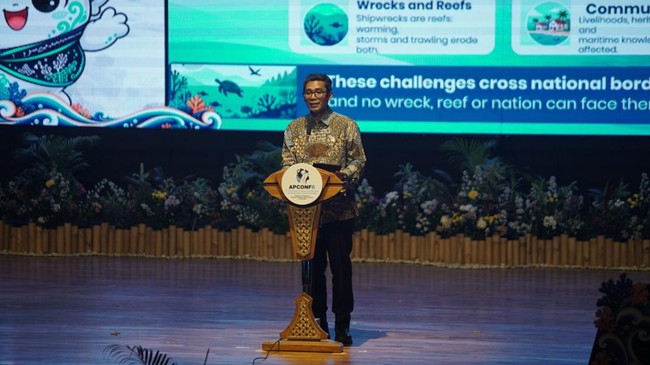
Trenggono expressed his full support for the 6th Asia-Pacific Conference on Maritime and Underwater Cultural Heritage (APCONF6), held in Denpasar, Bali, from 26 to 31 October 2026. The event, themed “Traditions and Trajectories: Maritime Heritage and Blue Economies in Asia-Pacific”, was organised by the ministry with support from domestic and international partners.
Participants included researchers, academics, government representatives, coastal communities, Indigenous peoples, international organisations, businesses and investors. “This forum must truly serve as a space for exchanging knowledge, strengthening collaboration and holding policy dialogue to connect maritime heritage preservation with blue economy development,” Trenggono said.
At the event, Deputy Minister of Marine Affairs and Fisheries Irwan Meilano said the USAT Liberty site — the wreck of a United States Army cargo ship on the seabed off Tulamben, Bali — showed how underwater heritage could support marine habitats as well as maritime tourism. The example demonstrates that shipwrecks are traces of civilisation linked to marine life and local livelihoods.
“Amid climate change, pollution and habitat destruction, stronger research, mapping and monitoring of sites, with coastal communities as the key actors in preservation, are crucial,” he said.
Local wisdom such as sasi, Panglima Laot and awig-awig, he said, provides a foundation for responsible marine management and must continue to be maintained. In protecting marine ecosystems, the ministry is pursuing blue economy policies that combine environmental and economic approaches.
Meanwhile, I Nyoman Radiarta, head of the ministry’s Agency for Marine and Fisheries Human Resources Development, said maritime heritage reflects knowledge, traditions, identity and the enduring relationship between people and the aquatic environment across generations. Through collaboration, he said, the agency hoped to protect this unique and finite heritage while supporting sustainable livelihoods and securing the future of the oceans.
The forum also marked a special milestone: APCONF’s 15th anniversary, known as its Crystal Anniversary. APCONF began in Manila, the Philippines, in 2011. For this edition, former chairs and founders from Manila, Hawaii, Hong Kong, Taiwan, Korea and Indonesia were also brought together.
Source: jawawa.id (https://jawawa.id/newsitem/kkp-strengthens-maritime-heritage-preservation-and-the-blue-economy-at-apconf6-in-bali-1793451050)
Originally published by CNBC Indonesia (https://www.cnbcindonesia.com/news/20261031191948-4-781185/kkp-perkuat-pelestarian-warisan-maritim-ekonomi-biru-di-apconf6-bali), translated from Indonesian