
KKP Quality Agency Ensures Fishery Products Meet Safety Standards
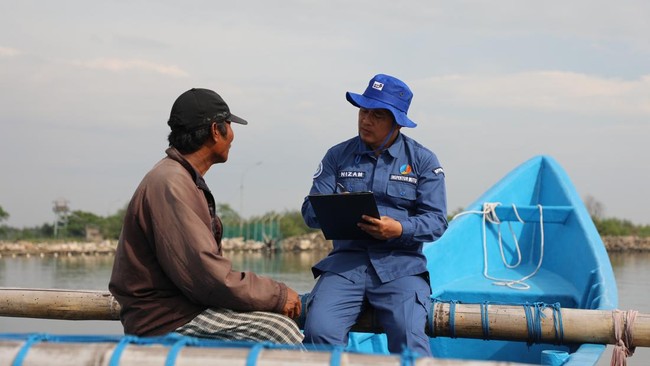
Jakarta, CNBC Indonesia - The Marine and Fisheries Quality Control and Supervision Agency (BPPMHKP), or KKP Quality Agency, reaffirms its commitment to ensuring that fishery products are safe for consumption and meet export standards. This is achieved through quality control and assurance of fishery products from upstream to downstream.
What is the food safety testing process at aquaculture sites, fish capture locations, and their distribution chains conducted by the KKP Quality Agency?
Catfish farmer Sujarwanto explains that the safety and quality of the cultured fish managed by the Merah Putih Village Cooperative (KDMP) in Karangrejek Ward are considered safe, having obtained Good Aquaculture Practices (CBIB) certification from the KKP Quality Agency. To meet this certification, cultivators must maintain water quality and its acidity level (pH).
“We use aerators to ensure sufficient oxygen for the catfish. (To maintain pH quality) from water acidity, if it’s not yet suitable, we add water,” he said during Squawk Box on CNBC Indonesia (Tuesday, 31/03/2026).
Sujarwanto continued that applying for CBIB certification from the KKP Quality Agency is relatively easy. The initial process involves submitting an application letter to the KKP Quality Agency, followed by a response, and once scheduled, it is directly processed by the relevant stakeholders.
“After that, the KKP Quality Agency team visits the site to check the production management conditions. Once it meets the quality standards set by the KKP, we receive the certificate for free and easily. It can be issued in as little as one week,” he explained.
He stated that they have experienced many benefits from the KKP Quality Agency certification, one of which is easier marketing of fish. Thus, CBIB certification not only guarantees food quality and safety for the public but can also serve as an export requirement.
Meanwhile, KKP Quality Inspector Maria Tresia Sundah said that they have a team to conduct inspections, checking production facilities related to safety aspects. The KKP Quality Inspector team also tests water and environmental quality parameters.
Maria added that the CBIB certificate for cultivators is valid for 4 years, during which there will be surveillance activities or periodic monitoring. In this regard, the KKP Quality Inspector team will recheck whether the cultivator is fulfilling their commitments in aquaculture practices or not.
“Surveillance is almost the same as inspection. But in surveillance, we take samples; we collect water and fish samples. After that, we test them in our laboratory,” she clarified.
KKP Quality Inspector Meitri Putri Damayanti added that the quality checks for fish at aquaculture sites and capture sites are essentially the same. At aquaculture sites, the KKP Quality Inspector team checks the practices carried out by the business operators. For capture fisheries, the checks are done after the fish are caught, specifically at the dock.
For example, the KKP Quality Inspector team usually checks the condition of the cool boxes used to store fish. They also verify the completeness of personal protective equipment (PPE) for fishermen related to safety and cleanliness at the production site.
“But it’s not just that; we also check how fishermen unload fish at the dock. Therefore, the dock conditions must be ensured to be clean. Because if the dock is dirty, it will affect the fish quality,” she explained as an example.
She also stated that on average, fishermen have implemented Standard Operating Procedures (SOP) well, in line with the CBIB certification they have obtained. One piece of evidence is their ability to manage cool boxes, which impacts the maintenance of stored fish quality.
Furthermore, to ensure fish freshness, fisherman Sarpan says he brings ice from home. Fishermen also rely on the cold chain in the fish capture process.
“So from capture to handling on the boat and storage in cool boxes, then landing at the auction site, it must be connected to the cold chain, ice. The service as well, the boat must be clean, fishermen must wear clean clothes, hygiene is always maintained for the freshness or safety of the fish,” he explained.
The use of cool boxes has proven effective in maintaining the quality of caught fish. Characteristics of fresh fish stored in cool boxes include firm flesh, shiny skin, and clear eyes. Conversely, fish stored without ice tend to have non-elastic flesh. Their eyes also appear cloudy and unclear.