
KKP Builds National Collaboration to Accelerate Priority Programmes for Food Security
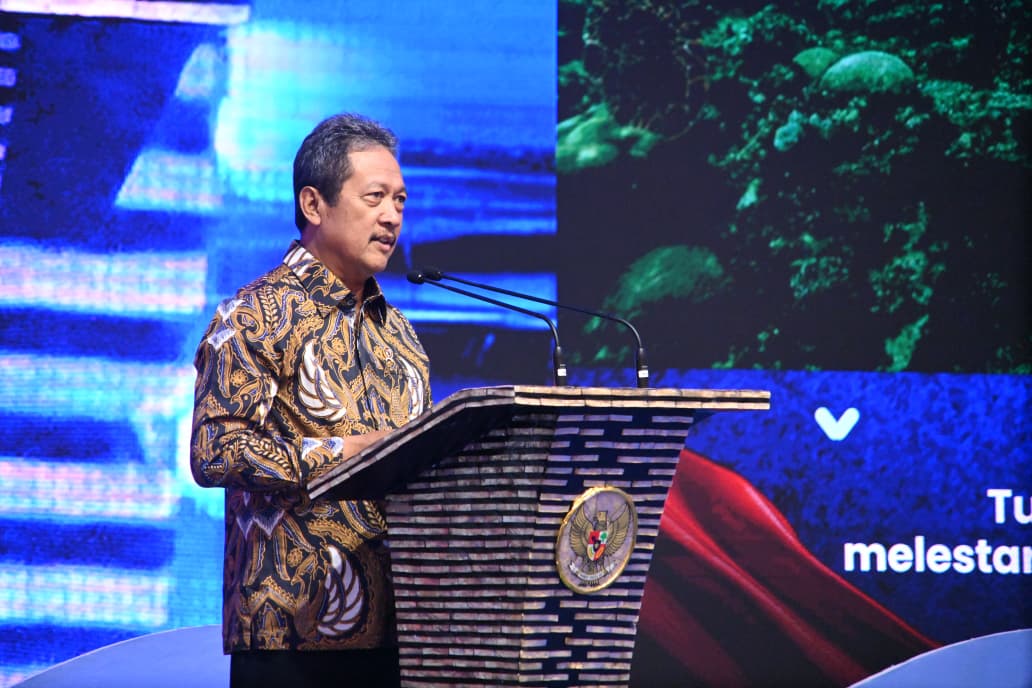
The Ministry of Marine Affairs and Fisheries (KKP) is inviting all ministries, agencies, regional governments, businesses, academics, and the public to strengthen collaboration in accelerating the implementation of the National Priority Work Programme (PKPN) for the marine and fisheries sector. Minister Sakti Wahyu Trenggono made this call during a National Coordination Meeting themed ‘Accelerating the Marine and Fisheries Sector PKPN to Support Food Self-Sufficiency’ in Jakarta on Thursday (2/7/2026).
‘This forum holds significant and strategic importance as a space for national consolidation to unify direction, strengthen coordination, and ensure the implementation of KKP’s 2026 priority activities runs faster, is well-targeted, and provides tangible benefits to the community,’ said Minister Trenggono. He explained that the development of the marine and fisheries sector plays a strategic role in supporting the national development agenda and the President’s Asta Cita mission, particularly in strengthening food sovereignty through the provision of fish protein and salt, encouraging sustainable economic growth, reducing poverty, and improving human resource quality.
To support the national food self-sufficiency target, KKP is consolidating six priority programmes. These include the Kampung Nelayan Merah Putih (KNMP) programme, which aims to build 5,000 locations by 2029 as economic growth centres for coastal communities, and the Thematic Inland Fish Farming programme, which targets the development of 40,000 farming points across 500 districts and cities to support national protein supply. Other programmes include the National Salt Self-Sufficiency programme through the construction of up to 2,000 hectares of salt ponds to reduce import dependency, the revitalisation of approximately 14,000 hectares of fish farms along the northern coast of Java to support protein self-sufficiency and coastal rehabilitation, the development of a 2,000-hectare Integrated Shrimp Farming Zone in Waingapu as a modern and environmentally friendly cultivation area, and a Fishing Vessel Modernisation programme to increase the productivity and competitiveness of fishers while supporting measured fishing policies.
Minister Trenggono stated that the implementation of these programmes adopts a bottom-up approach, involving active participation from the community, regional governments, and stakeholders from the planning stage through to evaluation. This approach ensures the programmes address local needs and potential, fosters a sense of community ownership, and enhances the effectiveness and sustainability of development in coastal areas. ‘All planned programmes must be jointly overseen until the implementation stage to ensure they provide real benefits to the community through increased regional economic growth, strengthened food security, job creation, and improved public welfare,’ he concluded.
To reinforce synergy between ministries and regional governments, the coordination meeting was attended by Coordinating Minister for Food Zulkifli Hasan, Chair of Commission IV of the House of Representatives Siti Hediati Soeharto, Deputy Minister of Home Affairs Akhmad Wiyagus, and Minister of Villages and Development of Disadvantaged Regions Yandri Susanto. During the event, a Memorandum of Understanding was signed between KKP and the state electricity company PLN, the Governor of West Nusa Tenggara, and the Indonesian Salt Industry Association (Aspeksindo), along with cooperation agreements between KKP and the Police Security Maintenance Agency (Baharkam Polri), PT Garam, and Pertamina Patra Niaga. This collaboration serves as a foundation for strengthening coordination in the implementation of the marine and fisheries priority programmes.
Coordinating Minister for Food Zulkifli Hasan stated, ‘Self-sufficiency is sovereignty, and sovereignty is the honour of the nation. Therefore, the government must side with farmers, fishers, and livestock breeders. We have been too dependent on imports of various food commodities. Going forward, we want to change this paradigm by empowering the main food producers so they become more productive, prosperous, and competitive.’ He assessed that the implementation of the six priority programmes would enhance the bargaining position of fishers and strengthen the national food supply chain. ‘If these programmes are implemented consistently and supported by regional governments and stakeholders, I am optimistic that Indonesia will not only be able to meet its domestic protein needs but also become a new force as a world fishery product exporter,’ he added.
Meanwhile, Chair of Commission IV of the House of Representatives, Siti Hediati Soeharto, affirmed the parliament’s commitment to continuously support KKP’s priority programmes, especially those that directly impact the welfare of fishers and coastal communities. She stated that Commission IV would ensure support through its budgeting, legislative, and oversight functions so that all of KKP’s strategic programmes can run optimally. ‘The development of Kampung Nelayan Merah Putih is one of the programmes we fully support because we have seen firsthand its benefits in driving the economy in several regions,’ she said.