
KKP builds collaboration to accelerate priority programmes for food self-sufficiency
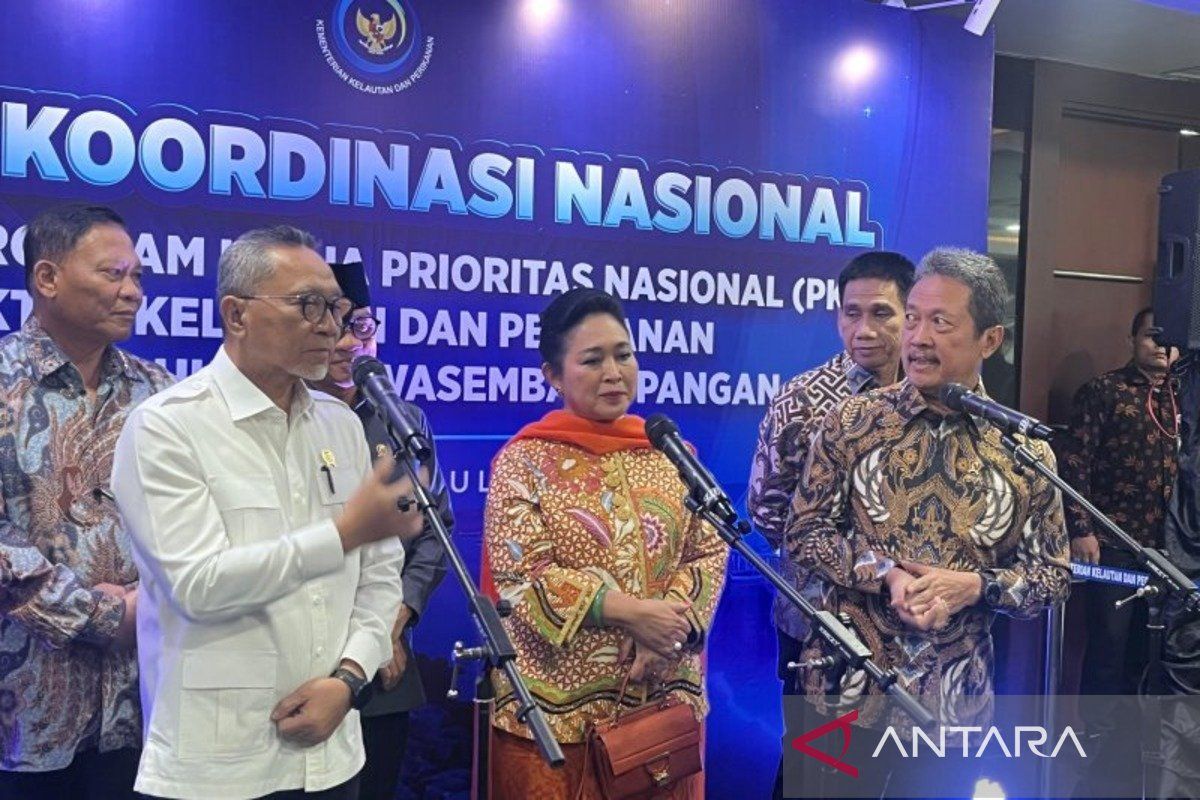
Jakarta (ANTARA) - The Ministry of Marine Affairs and Fisheries (KKP) is building collaborations with all ministries, agencies, local governments, the business sector, academics, and the community to accelerate priority marine and fisheries programmes to support food self-sufficiency.
“This forum holds significant and strategic importance as a space for national consolidation to unify direction, strengthen coordination, and ensure that the implementation of KKP’s priority activities for 2026 proceeds more rapidly, accurately, and provides real benefits to the community,” said Trenggono during the National Coordination Meeting (Rakornas) themed “Accelerating PKPN in the Fisheries Sector to Support Food Self-Sufficiency” in Jakarta on Thursday.
Trenggono stated that the development of the marine and fisheries sector plays a strategic role in strengthening food sovereignty through the provision of fish protein and salt, driving sustainable economic growth, reducing poverty, and improving the quality of human resources.
To support food self-sufficiency targets, the KKP is consolidating six National Priority Work Programmes under the ministry’s responsibility. These include the ‘Kampung Nelayan Merah Putih’ (Red and White Fishing Village) through the development of 5,000 locations by 2029 to serve as economic growth centres for coastal communities.
Furthermore, the programme includes thematic inland fish farming through the development of 40,000 farming sites across 500 regencies/cities to support national protein provision. There is also a national salt self-sufficiency programme involving the development of up to 2,000 hectares of salt ponds to reduce import dependency.
Additionally, Trenggono noted the revitalisation programme for the North Coast of Java (Pantura) fish ponds, covering 14,000 hectares, to support protein self-sufficiency and coastal area rehabilitation. He also highlighted the development of an integrated shrimp pond area in Waingapu spanning 2,000 hectares as a modern, environmentally friendly shrimp farming zone, alongside a fishery vessel modernisation programme to increase productivity, enhance fisherman competitiveness, and support measured fishing policies.
According to Trenggono, all these programmes are expected to strengthen food security, create jobs, increase regional economic growth, and improve the welfare of fishermen and coastal communities.
On the same occasion, the Coordinating Minister for Food, Zulkifli Hasan, stated that the implementation of these six programmes could strengthen the national food supply chain while increasing the bargaining power of fishermen. “If these programmes are implemented consistently, I am optimistic that Indonesia will not only be able to meet domestic protein needs but also emerge as a new global force in fishery product exports,” he said.
Meanwhile, the Chairperson of Commission IV of the Indonesian House of Representatives (DPR RI), Siti Hediati Soeharto, reaffirmed the Parliament’s commitment to supporting the Ministry of Marine Affairs and Fisheries’ priority programmes, particularly those with a direct impact on the welfare of fishermen and coastal communities. She noted that Commission IV would ensure support through budgeting, legislation, and oversight functions to ensure all KKP strategic programmes run optimally. “The development of the Kampung Nelayan Merah Putih is one of the programmes we fully support because we have seen firsthand its benefits in driving the economy of communities in several regions,” she said.