
Kitchen Waste Turns to Profit: UNM Students Create Business Opportunities from Organic Waste
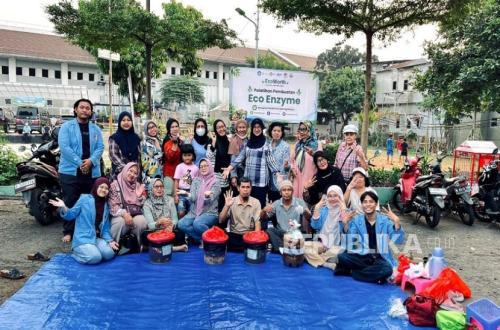
Household organic waste, which often ends up in the bin, can be transformed into environmentally friendly products with practical use and even economic value. This is the focus of a community service activity carried out by the Student Creativity Programme for Community Service (PKM-PM) EcoWorth team from Universitas Nusa Mandiri (UNM), a Digital Business Campus. The PKM-PM EcoWorth team held a training session on the utilisation of eco enzyme for 17 members of the PKK from RW 012, Cipinang Melayu Village, Makasar District, East Jakarta, on Wednesday (17/6/2026). The activity ran from 16.00 to 18.00 WIB and aimed to increase the community’s knowledge and skills in processing organic waste into products that are beneficial for the environment and have economic potential. The programme was initiated by the PKM-PM EcoWorth team, chaired by Nazwa Syifa Fitriani, with members Raka Muhammad Setia, Shahnaz Hafiza Bilqis, and Nasywan Abhinaya, under the guidance of supervising lecturer Johan Hendri Prasetyo. During the training, participants received education on the concept of eco enzyme, its environmental benefits, the production process from household organic waste, and various opportunities for its use in daily life. Participants were also invited to understand sustainable organic waste processing practices that can be directly applied in the household environment. Nazwa Syifa Fitriani explained that the training was designed to raise public awareness about the importance of responsible organic waste management. “Through this training, we want to invite the community to see organic waste as a resource that can still be utilised,” Nazwa said. Eco enzyme is a simple solution that can be applied in the household environment to reduce organic waste and has economic potential if developed into products that can be used or marketed by the community. “Our hope is that the PKK members can become agents of change in more productive and sustainable waste management,” Nazwa stated. According to her, eco enzyme can be used as a natural cleaning fluid, liquid organic fertiliser, and a supporting ingredient for various more environmentally friendly household needs. Supervising lecturer Johan Hendri Prasetyo emphasised that this activity is a tangible form of student contribution in applying knowledge to meet community needs. “Through an educational and empowerment approach, this activity not only fosters environmental awareness but also encourages the creation of sustainability-based economic opportunities. We hope the positive impact of this programme can continue to grow within the community,” he explained. Appreciation was also conveyed by the Head of the Digital Business Study Programme at UNM, Lia Mazia, who assessed that the programme reflects students’ ability to deliver innovative solutions that have a direct impact on society. She said PKM-PM EcoWorth shows that Digital Business students not only have competence in technology and business but are also capable of producing innovations that provide real benefits to the community. “We hope this experience strengthens students’ ability to create creative, adaptive, and sustainable solutions according to community needs in the digital era,” she stated. The enthusiasm of the participants was evident throughout the training. PKK members actively discussed and asked questions regarding the eco enzyme production process and its development opportunities as a product with economic value. The Chairperson of PKK RW 012 Cipinang Melayu, Ive Sulistiah, expressed appreciation for the programme. The activity provided new insights for PKK members on how to utilise organic waste that has often been discarded. “We greatly welcome this programme because it not only impacts environmental cleanliness but also has the potential to improve skills and family economic value. We hope the knowledge gained can be applied sustainably by residents,” she said. Through the EcoWorth programme, UNM has again demonstrated its commitment to encouraging students to deliver innovations that are not only science-based but also capable of providing real solutions for the community. This activity is expected to be a first step in building a more sustainable waste management culture, creating a healthier environment, while opening up community economic empowerment opportunities through the utilisation of organic waste that has been underutilised.