
King Charles Takes a Subtle Jab at the Trump Administration in US Congress
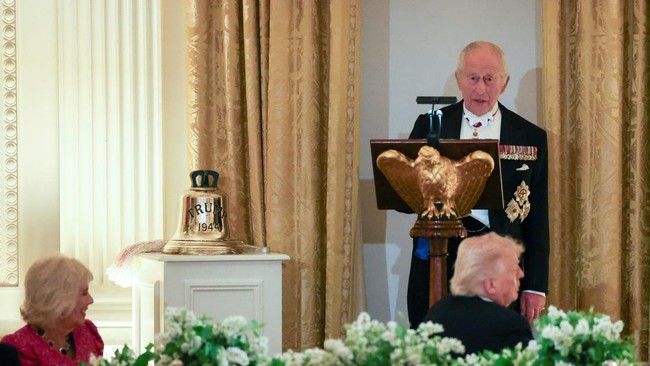
King Charles III of the United Kingdom delivered a diplomatically subtle yet sharp message in his address to the United States Congress. Without directly naming President Donald Trump, he alluded to the importance of the rule of law, democracy, and the United States’ global role as a world exemplar.
In the speech, Charles emphasised that “American words carry weight and meaning,” while reminding that the actions of a superpower are far more decisive.
However, implicitly, the king signalled his disagreement with the current direction of American politics, while affirming the importance of upholding the main pillars of Western democracy, such as domestic checks and balances mechanisms, the strength of international alliances, and interfaith tolerance.
Quoting analysis from CNN International, the speech was viewed as a form of “gentle warning” against the current direction of US politics, particularly under Trump’s leadership. Though wrapped in diplomatic language, Charles’s message was considered to target sensitive issues such as climate change, wars, and international relations.
Charles also implicitly defended Ukraine and called for environmental protection, issues that have often been debated in the US. He even alluded to the fact that differences between friendly nations should not damage long-term relations, referring to recent tensions between the UK and the US regarding the Iran conflict.
“We do not always agree, at least not at first,” Charles stated, emphasising that differences can actually strengthen relationships.
While delivering a critical message, Charles still showed respect for his hosts. He praised the “special” UK-US relationship and quoted Trump’s statement on the bond between the two nations as “invaluable and eternal.”
Observer of transatlantic relations, Garret Martin, assessed the speech as laden with political meaning. “You could interpret it as a subtle dig at the Trump administration’s policies. It sounds like a king reminding a president not to act too much like a king,” he said.
The speech was also rich in historical irony. Charles, a descendant of King George III, the figure opposed in the American Revolution, spoke about democratic values in the institution born from the struggle against monarchy. He quoted principles such as the Magna Carta to judicial independence as the foundation of the modern rule of law state.
On the other hand, the White House appeared relaxed in responding to the message. Trump even boasted of his closeness to the royal family and described the relationship between the two countries as a continuation of the “Anglo-American freedom revolution.”
However, behind the grand state ceremony, this visit also carried an important diplomatic mission. Tensions regarding the UK’s refusal to become involved in the Iran conflict formed a sensitive backdrop that Charles sought to ease.
The king’s role as an apolitical figure actually gives him great symbolic power. With measured language, Charles was able to convey criticism without direct confrontation. This is a form of subtle yet effective diplomacy.
At the end of his speech, Charles quoted the spirit of Abraham Lincoln’s address as a strong closing: the world may not always heed what is said, but it will never forget what is done.