
Kimia Farma expands stem cell education, pushes for multicentre studies
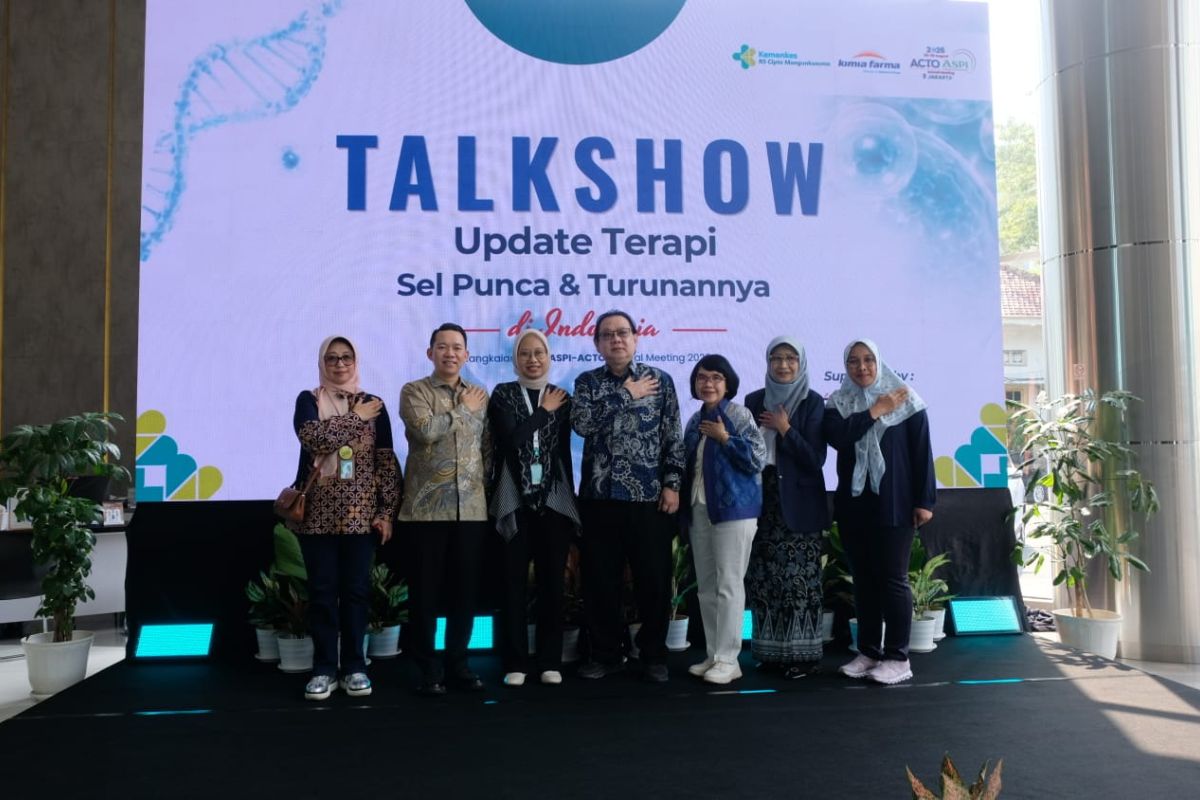
State-owned pharmaceutical company PT Kimia Farma (Persero) Tbk is expanding public education on the safety and use of stem cell therapy and pushing for multicentre studies to strengthen medical evidence in the clinical application of regenerative therapy.
Kimia Farma Commercial Director Hanadi Setiarto said advances in science and technology in regenerative medicine are opening new opportunities in healthcare, but these need to be balanced with adequate public education.
“Our short-term focus is not limited to introducing StemXera to the public, but rather expanding the network of healthcare facilities capable of providing this therapy with high safety standards,” Hanadi said in an official statement received in Jakarta on Saturday.
The statement was made during a talk show titled “Update on Stem Cell Therapy and Its Derivatives in Indonesia” at RSCM Kencana in Jakarta on Saturday, as part of the ACTO-ASPI 2026 series of events.
The 17th Annual Meeting of the Asian Cellular Therapy Organization (ACTO) 2026 is being held in collaboration with the Indonesian Stem Cell Association (ASPI) and brings together academics, researchers, clinicians, industry players, and regulators from various countries to discuss developments in cell-based therapy.
ACTO’s main annual meeting is taking place from 26 to 28 August 2026 and is being attended by participants and delegates from 15 countries across Asia. The forum is discussing, among other things, research developments, clinical applications, and the regulatory direction of cell-based therapy.
As part of the series of events, Kimia Farma presented developments on StemXera, a stem cell and secretome product brand developed together with Cipto Mangunkusumo National Central General Hospital (RSCM).
Kimia Farma noted that development of the product has been ongoing since 2013, while StemXera was officially launched in April 2026.
StemXera is developed at RSCM’s stem cell laboratory facility, which has obtained a Good Manufacturing Practice (CPOB) certificate from the Food and Drug Supervisory Agency (BPOM).
BPOM handed over the CPOB certificate to RSCM’s Stem Cell Medical Technology Installation facility in July 2024.
To expand its use, Hanadi said the development of the therapy also needs to be supported by strong clinical evidence.
“For the medium and long term, we are encouraging multicentre studies so that the clinical use of StemXera going forward becomes broader, more proportionate, and supported by solid clinical evidence,” Hanadi said.
Regenerative medicine is a medical approach that utilises the ability of cells and biological components of the body to repair, regenerate, or restore damaged tissue.
One of the technologies developing in this field is the use of stem cells and their derivatives, including secretomes.
Kimia Farma said stem cell-based therapy is used, among other things, in orthopaedics to treat degenerative joint conditions such as osteoarthritis.
In neurology, the technology is also part of research and development of regenerative therapy for certain conditions, including stroke.
Meanwhile, in dermatology and aesthetics, Kimia Farma said its use is directed, among other things, at treating hair loss, skin rejuvenation, and hyperpigmentation conditions such as melasma.
A number of areas of use for stem cells and their derivatives include osteoarthritis, stroke, baldness, skin rejuvenation, and melasma.
From a regulatory perspective, BPOM classifies cell-based therapy as advanced therapy medicinal products (ATMP). Its development is supervised using a science- and risk-based approach and must meet safety, efficacy, and quality standards.
BPOM has issued five CPOB certificates for cell processing facilities that meet safety and quality standards. Meanwhile, clinical application to patients is carried out through synergy between BPOM and the Ministry of Health.
Hanadi said the challenge of developing biotechnology products such as StemXera is not only about presenting innovation, but also building public understanding and trust in the technology.
“Advances in regenerative therapy cannot be driven by technological development alone. The public also needs to receive accurate information about potential benefits, scientific evidence, safety, and its use,” Hanadi said.
For this reason, the company views collaboration between healthcare institutions, academics, researchers, regulators, medical personnel, and industry as necessary to ensure that scientific innovation can be translated into appropriate clinical benefits.
Through collaboration with RSCM and various other health institutions, the company wants to contribute to building a regenerative medicine ecosystem in Indonesia that connects research, technology, production capacity, medical personnel, and patient services.
“We believe collaboration is the key so that health innovation can develop sustainably while providing broader benefits to society,” Hanadi said.