
Kiai Said Aqil Sirodj Launches 11-Volume History of Islam in the Indonesian Archipelago
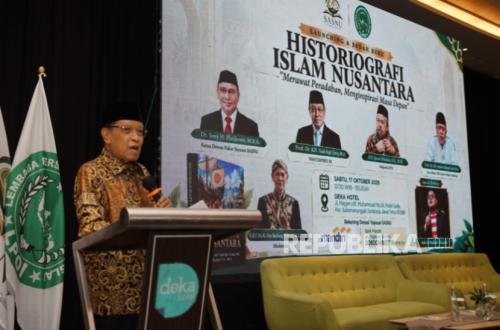
SURABAYA — The Islamic Organisations Friendship Institute (LPOI) has launched Historiography of Islam in the Indonesian Archipelago, written by Professor KH Said Aqil Siroj and Imam Pituduh. The book examines the long history of Islam in the archipelago and its contribution to shaping Indonesian civilisation.
LPOI chairman and Presidential Advisory Council member KH Said Aqil Siroj said that understanding Islam in the Indonesian archipelago requires more than tracing its arrival and the figures who spread it. It also requires understanding how Islam interacted with local cultures, shaped social institutions and developed networks of knowledge.
“Understanding Islam in the Indonesian archipelago is not simply a matter of tracing when Islam arrived, who spread it, or how Islamic teachings developed in different regions,” Kiai Said said in a press release on Saturday (17 October 2026).
At the launch and discussion of Historiography of Islam in the Indonesian Archipelago in Surabaya, Kiai Said emphasised Islam’s important role in the formation of Indonesian civilisation. Its contribution can be traced through the development of education, trade, law, diplomacy, language, literature and culture, as well as various social and political institutions.
He said the book was intended to encourage the public to understand Islamic history as a dynamic field of academic study, open to a range of perspectives. Historical writing, he said, must continue to develop as new sources are discovered and different research approaches are applied.
In his view, differing interpretations of Islam’s history in the archipelago are part of the dynamics of academic research. They can arise from differences in sources, methods, perspectives and analytical frameworks.
In historical writing, Islamic organisations should also be treated as active subjects that produce knowledge and preserve collective memory. Their historical experience can be traced through documents, archives, manuscripts, organisational records and oral testimony.
“Developing the historiography of Islam in the Indonesian archipelago is an effort to broaden the sources, perspectives and actors represented in the writing of Indonesian history,” said the PBNU senior adviser.
The head of Al-Tsaqafah Islamic boarding school in Jakarta stressed that writing the history of Islam in the archipelago was not intended to create an apologetic narrative or elevate any particular group. Instead, the research is expected to present Muslim communities in the archipelago as active, creative historical agents who have made a tangible contribution to the development of civilisation.
Source: jawawa.id (https://jawawa.id/newsitem/kiai-said-aqil-sirodj-launches-11-volume-history-of-islam-in-the-indonesian-archipelago-1792281028)
Originally published by Republika (https://khazanah.republika.co.id/berita/tn2461483/kiai-said-aqil-sirodj-luncurkan-buku-historiografi-islam-nusantara-11-jilid), translated from Indonesian