
Khofifah Urges Schools to Become Hubs for Food Security Innovation
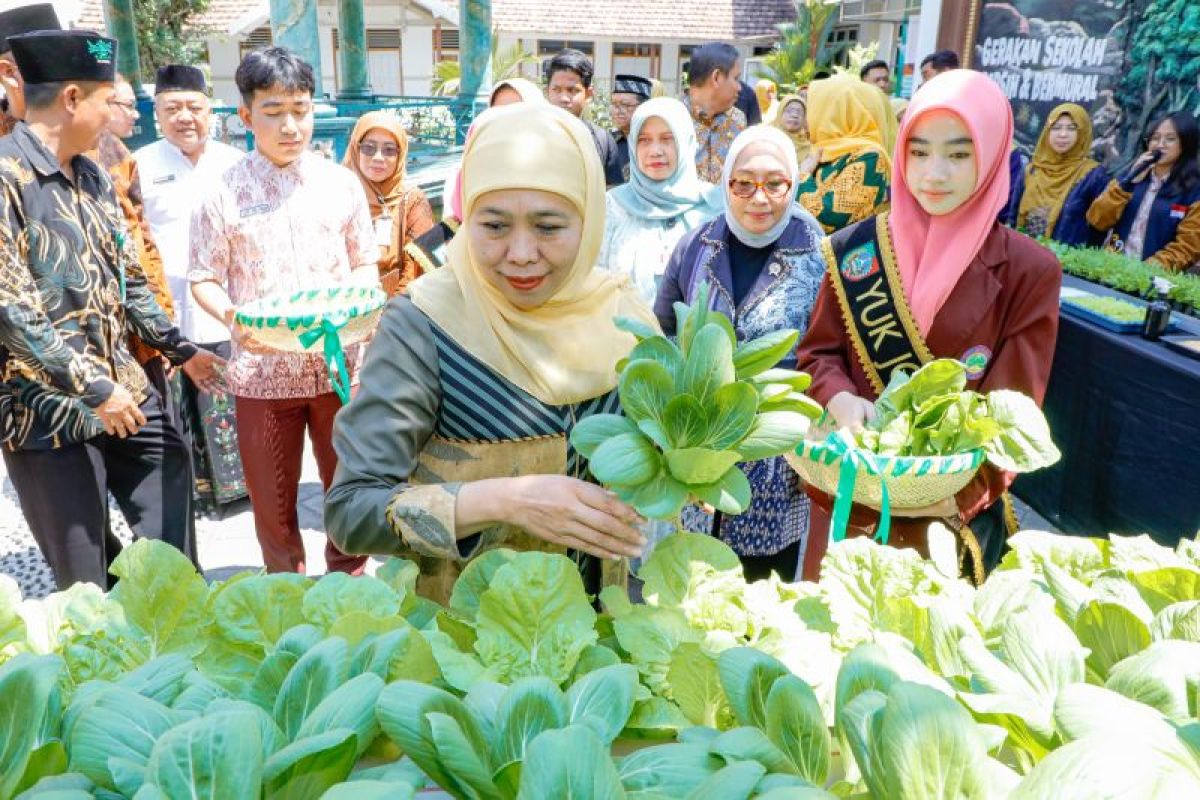
Surabaya (ANTARA) - East Java Governor Khofifah Indar Parawansa has urged schools to become centres for learning and food security innovation through the School Food Security Innovation Programme (SIKAP), which has been implemented in 1,548 schools across East Java.
“SIKAP shows that strengthening national food security can begin in schools and directly involve the entire school community,” Khofifah said in a statement received in Surabaya on Wednesday.
The programme earned the East Java Provincial Government the 2026 Innovation for Nation-Building Award in the Innovation for Public Service category, organised by TV One.
The award was presented by Deputy Minister for Administrative and Bureaucratic Reform Purwadi Arianto to East Java Education Department head Aries Agung Paewai in Jakarta on Monday (26 October).
Khofifah said SIKAP supports national food security and the achievement of food self-sufficiency through the education sector.
School grounds have the potential to become productive spaces for cultivating food crops and raising livestock, while also serving as learning facilities for pupils.
“President Prabowo Subianto’s food security programme focuses on achieving national food self-sufficiency and strengthening the people’s economic sovereignty through various strategic policies and cross-institutional cooperation. East Java has begun this work through the education sector,” Khofifah said.
In 2026, SIKAP was operating in 1,548 schools across 38 regencies and cities in East Java. These comprised 596 senior high schools, 759 vocational high schools and 193 special schools.
Khofifah stressed that strengthening food security does not always require extensive farmland. Schools can use the land available for cultivation, according to their circumstances and capacity.
“Food security does not have to start with hectares and hectares of land. It can begin with whatever space we have, by making the land available at school more productive,” she said.
In addition to supporting food security, the programme gives pupils hands-on learning experience through planting, tending and harvesting. These activities also foster independence, discipline, creativity, responsibility, cooperation and care for the environment.
“SIKAP teaches not only educators and education staff, but also children how to cultivate food crops and raise livestock, starting in the school environment,” she said.
Khofifah said the cultivation activities are also consistent with the deep-learning approach. Through practical work, pupils can understand food production and relate their knowledge to everyday life.
“They learn how to plant or cultivate crops and raise animals, how to make them more productive, and what values can be learnt from gardening and farming activities,” she said.
She added that sustaining SIKAP requires the involvement of the entire school community, stronger teacher capacity, partnerships and continued innovation.
Schools are expected to make the best use of their land and growing media so that cultivation can produce food on a sustainable basis.
“Children must be enthusiastic about looking after and caring for everything so it can continue to grow well and yield produce, including for supply within the school,” she said.
Meanwhile, East Java Education Department head Aries Agung Paewai said SIKAP reflected the provincial government’s commitment to aligning regional innovation with national development priorities, particularly food security.
Source: jawawa.id (https://jawawa.id/newsitem/khofifah-urges-schools-to-become-hubs-for-food-security-innovation-1793166890)
Originally published by Antara (Indonesian) (https://www.antaranews.com/berita/5816435/khofifah-dorong-sekolah-jadi-ruang-inovasi-ketahanan-pangan), translated from Indonesian