
Khofifah urges community elements to strengthen preparedness against drought
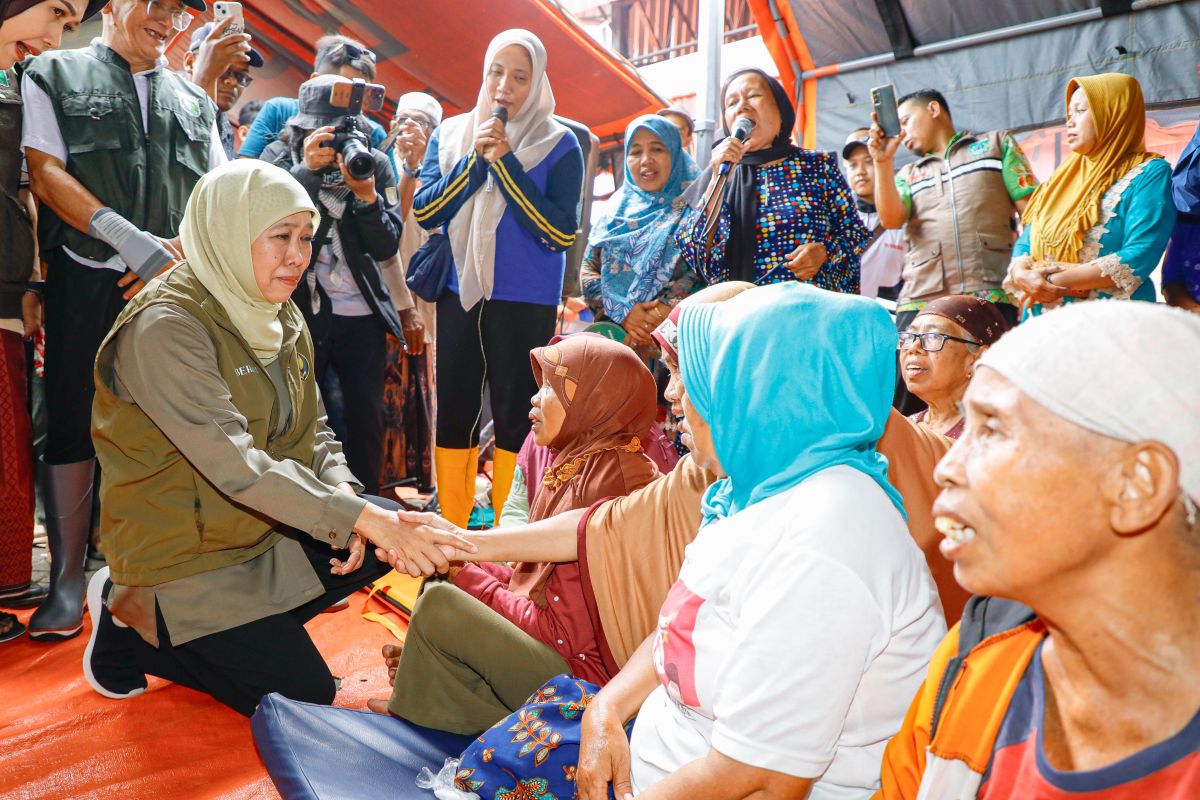
Surabaya (ANTARA) - East Java Governor Khofifah Indar Parawansa has urged all elements of government and society to strengthen preparedness in facing the potential for extreme drought due to the El Niño phenomenon during the 2026 Disaster Preparedness Day commemoration.
“At this year’s Disaster Preparedness Day commemoration, let us together ensure preparedness, mitigation, and concrete steps in protecting the people of East Java. Therefore, all regional heads are asked to act proactively before the peak of the dry season occurs,” Khofifah said at the 2026 Disaster Preparedness Day Commemoration in Surabaya on Sunday.
She emphasised that preparedness is the main key in suppressing disaster risks and impacts, so anticipatory steps must be carried out in a planned, measured, and data-based manner.
Not only local governments, but society is also urged to play an active role in disaster prevention.
Residents are asked not to carry out land and waste burning without supervision, to use water wisely, and to immediately report potential disasters to local authorities.
“I urge the public not to do things that could trigger forest and land fires (karhutla),” she said.
The synergy between government and society is considered effective in preventing and handling disasters, as reflected in the downward trend of East Java’s Disaster Risk Index (IRB).
East Java’s IRB was recorded at 117.26 in 2021, dropping to 108.69 in 2022, 101.65 in 2023, and 95.75 in 2024, rising to 108.36 in 2025.
“For 2025, why did it rise again? Because there was a change in the Hazard (H) and Vulnerability (V) variables in BNPB Letter Number B-44/BNPB/D-I/SS.01.03/1/2026 dated 30 January 2026 regarding the Submission of IKD 2025 and IRB 2025 in East Java Province. However, in essence, every year we continue to lower the disaster risk index in East Java,” she said.
East Java has diverse disaster potentials, such as floods, landslides, earthquakes, droughts, and karhutla.
Handling is carried out in an integrated manner through hazard, vulnerability, and capacity analysis as regulated in Governor Regulation Number 53 of 2023.
Data shows that 92 to 97 percent of disaster events in East Java from 2022 to 2025 are hydrometeorological disasters, namely disasters influenced by weather and climate factors.
“Our response must not be ordinary. Not only reactive, but must be measured, quick, and data-based,” she stated.
In the first quarter of 2026, 121 disaster events were recorded in East Java, dominated by strong winds with 82 events and floods with 27 events, which impacted infrastructure damage and tens of thousands of families.
“This must be a serious concern for all of us and together we carry out anticipation,” she said.
The Meteorology, Climatology, and Geophysics Agency (BMKG) predicts that the 2026 dry season in East Java will start in May in around 56.9 percent of the region, peaking in August covering 70.9 percent of the region, and a critical period up to 72.5 percent of the region. The dry season duration is estimated to reach 220 to 240 days.
Khofifah urged all elements to strengthen synergy and preparedness in facing potential disasters.